A moment in history: Oct. 10, 1985
By Scott Lilwall
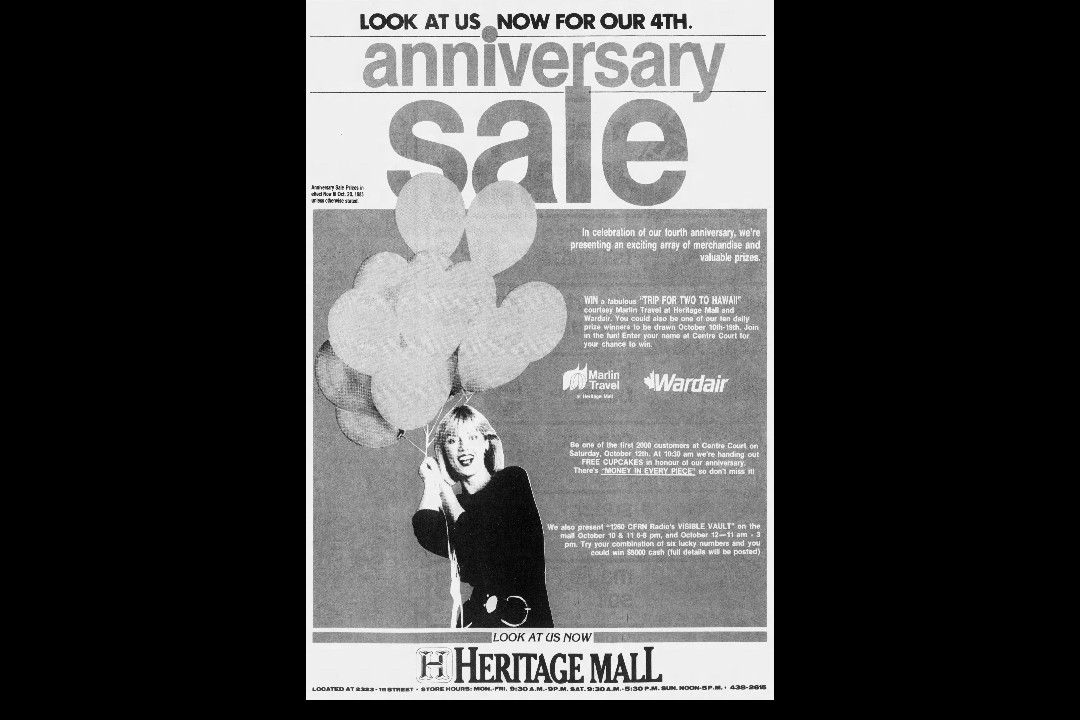
On this day in 1985, Edmonton's Heritage Mall was celebrating its fourth anniversary.
Edmonton is a mall city. West Edmonton Mall gets most of the attention, though there are shopping centres throughout the city. Despite its relatively short existence, few of Edmonton's malls inspire the same wistful nostalgia as Heritage does.
It certainly wasn't because of the convenient location. When construction of the mall on 23rd Avenue started in 1980, it was on the very southern edge of the city, surrounded mostly by farmland. The mall was initially planned to be the Kaskitayo Centre, but another company purchased it mid-construction and renamed it Heritage Mall. When it opened in August 1981, it was Edmonton's largest mall — for a split second. The next month, WEM opened its doors.
The building's aesthetics probably played a significant role in its lasting legacy. The aim was to evoke both a feeling of luxury and warmth. The mall featured massive skylights set in a ceiling of hemlock wood, with brown-brick walls. Dotted around the mall's interior were 30-foot palm trees imported from Florida. The result was an indoor tropical feel that, as captured in old photos, oozes about as many '80s vibes as a synth-pop album, or neon green lycra.
Topping it all off was a waterfall. The four-storey water feature apparently started as a joke before becoming a reality. When it was first turned on for testing the day before the mall's grand opening, the water reportedly blew horizontally due to the building's airflow, which required an urgent fix. The water did eventually fall as expected, allowing the mall to boast Edmonton's second-tallest waterfall, behind the (now defunct) one off the side of the High Level Bridge.
The mall proved to be very popular. Traffic jams surrounded the shopping centre on opening day, and crowds kept coming in the years to follow. Part of the appeal was Heritage Mall's frequent events and special celebrations. Malls have always held special events to get shoppers through the doors, but Heritage was well-known for hosting all kinds of different days, contests, and parties. In addition to the usual staples, Heritage would host Halloween events, baby races, and shopping sprees. Events like that, as well as later opening hours that would see the mall open until 9pm most nights, helped make the mall a popular place even for those not looking to shop.
Despite its initial popularity, the mall's fortunes declined in the late '90s. It was a difficult time for all malls, as shopping habits began to change. But Heritage faced some unique challenges. Two of its anchor stores, Eatons and Woolco, folded. But more importantly, the mall was purchased by a company called Ivanhoe Cambridge. A few years later, the same company became a partial owner of Southgate Centre.
It didn't make sense for Ivanhoe Cambridge to have two competing malls so close to each other, so the company started slowly siphoning stores to Southgate, considering it the better bet of the two properties. Heritage struggled through years of closures, layoffs, and empty corridors, until it was finally closed in 2001.
The building remained for years, boarded up and partially demolished. Eventually, it was razed to make way for a parking lot, condo towers, and an LRT station, now known as Century Park. Although Heritage Mall has been gone for more than 20 years — longer than it was open — it still has a loyal fanbase. Even now, a 700-person Facebook group memorializing the mall remains active.
The farmland that surrounded Heritage Mall when it first opened has changed as the city has grown and expanded southward at an incredible rate. Century Park is the last stop on the Capital LRT line for now, but construction is underway on the site to expand the system farther south, with five more stops planned.
This clipping was found on Vintage Edmonton, a daily look at Edmonton's history from armchair archivist Rev Recluse of Vintage Edmonton.
Share