
A moment in history: Oct. 17, 1929
By Scott Lilwall
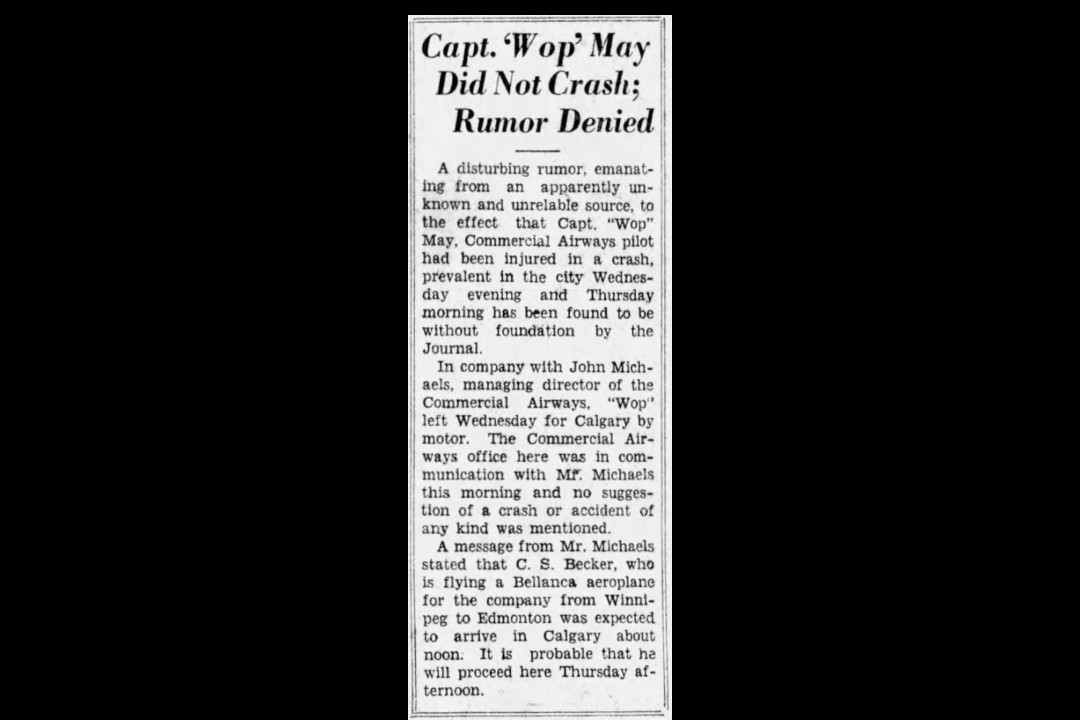
On this day in 1929, there were false rumours of a plane crash involving Edmonton's famed aviation ace, Wilfred 'Wop' May.
May was born in Manitoba in 1896. He was a youth when his family moved to Edmonton. It was around this time that May got the nickname he would carry for the rest of his life, courtesy of a two-year-old cousin who couldn't pronounce "Wilfred" and instead called him 'Woppie'.
In 1916, May enlisted in the military after the outbreak of World War I. He spent a year as an instructor in Canada before being shipped out to England. When there, he volunteered to join Britain's Royal Flying Corps, the predecessor to the Royal Air Force. The use of airplanes in war was still a new idea, and even the training was risky. But May was excited by the idea of flying, and signed up.
After his training, he was assigned to an air squadron in France. It was only on his second day as a full fighter pilot that May took part in a historic battle. While trying to escape enemy aircraft after his plane's gun jammed, May found himself with a German aircraft on his tail. The chase lasted for miles, with May flying dangerously close to the ground and dodging around obstacles to keep from being shot down. Some of May's allies were eventually able to German pilot, ending the chase.
May later discovered that the plane chasing him was flown by the famed German ace, Manfred von Richthofen, better known as The Red Baron (who died due to injuries from the battle). May later said he was lucky he didn't know it was Manfred von Richthofen, or else he would have passed out from fright.
It was an auspicious start to what would be a distinguished flying career. By the end of the war, May was credited with 15 air victories and was awarded the Distinguished Flying Cross, becoming an ace in his own right.
When he returned to Edmonton, May partnered with his brother to open the country's first registered airline out of a rented field near the city (which is where the neighbourhood name of Mayfield comes from). The May's business venture was a vital step in building Edmonton's long history of aviation. And May's dramatic air adventures would continue: In addition to passenger flights, air mail and cargo, May's company would be one of the first barnstorming outfits in the country, performing aerial stunts to entertain crowds. The airline was also hired by Edmonton police to assist in hunting down fugitives. May would also play a crucial role in what has become known as the Race against Death, when the ace braved freezing temperatures on a dangerous flight to deliver diphtheria inoculations to northern Alberta to prevent a deadly outbreak.
Wop continued to fly for decades, until a medical exam in 1936 revealed that he was blind in one eye (something he had kept secret for years). While that ended his flying career, May made good use of his expertise during the Second World War, where he led training programs for Allied aviators in Western Canada. May died in 1952 from a stroke while on a hiking trip in the United States.
May's legendary career had a huge impact on Edmonton's aviation history. His achievements have achieved interplanetary fame — in 2014, NASA named a lumpy rock on the surface of Mars 'wopmay' in his honour. Much of May's legacy remains preserved at the Alberta Aviation Museum, which recently hosted its annual Open Cockpit Day to highlight its extensive collection of historic aircraft.
This clipping was found on Vintage Edmonton, a daily look at Edmonton's history from armchair archivist Rev Recluse of Vintage Edmonton.
Share