
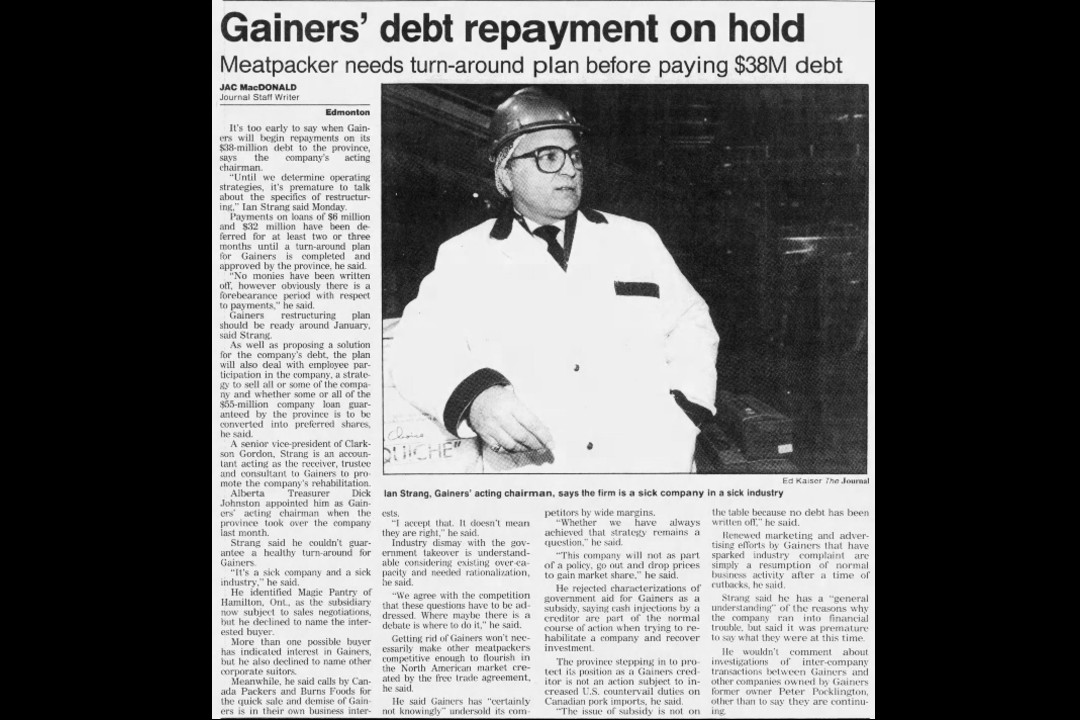
A moment in history: Nov. 7, 1989
By Scott Lilwall
On this day in 1989, the Gainers meatpacking plant was restructuring — just years after it played host to one of the longest and most heated strikes in Alberta's history.
The meatpacking plant's financial and labour battles were big news in the 1980s, but the meatpacking industry has been a central part of Edmonton's development since its early days.
In the late 1880s and early 1900s, two areas just beyond Edmonton's borders became major hubs for the meat industry: One north of the river, and one south of it. To the north was an area that became known as Packingtown. In 1908, the Swift plant opened in the village of North Edmonton on the outskirts of the city along Fort Road. A few years later, the Burns company opened another plant. The tiny village grew rapidly as workers settled near the plants, leading to retail shops, cafés, and other businesses setting up along Fort Road. When the railway was extended to North Edmonton, cattle could be brought to the plants faster and more efficiently, leading to the stockyard there becoming the second-largest in North America. In 1912, the city absorbed North Edmonton, and the meatpacking industry in Packingtown and other parts of Edmonton continued to grow. In 1936, Canada Packers built another massive facility in the area, employing 1,000 workers at its peak.
While Packingtown is best known, there was also a substantial meat industry to the south in Strathcona. In 1891, John and Amy Gainer arrived in Alberta and opened a small dairy at their home near present-day Whyte Avenue. Seeing the growing demand for meat in the expanding city, the pair soon added a slaughterhouse to their operations.
The small abattoir grew into a successful business, and Gainer replaced his modest wooden shop with the two-storey brick Gainer Block in 1902. The building not only had more space, but also held the offices needed to manage his growing meatpacking business, which by then had expanded along the Mill Creek ravine. Soon, other slaughterhouses opened in the area, taking advantage of the ravine to move and store hundreds of pigs, sheep, and other livestock. The sounds and smells of the meatpacking operations became part of life in neighbourhoods like Ritchie.
Meatpacking remained a significant industry in Edmonton into the latter half of the 1900s, especially after the Second World War, when rising wages led to more demand for meat. The Gainer company grew into a massive operation, but as other plants opened in other parts of the province, it began to decline.
In 1972, the Gainer family sold the Gainers plant, which was resold a few years later to Peter Pocklington, then the owner of the Edmonton Oilers. Pocklington made sweeping changes. He moved the plant north and bought out Swift, a competitor, merging the two companies. This made the Gainers plant one of the largest meatpacking operations in Canada, with annual sales reported at around $800 million. But it also led to discontent among workers, who complained of mistreatment and low pay. This ultimately led to the strike.
In June 1986, more than 1,000 Gainers workers went on strike, following Pocklington's plans to cut wages and eliminate pensions. The strike lasted nearly seven months and gained national attention. Pocklington took an aggressive stance, hiring replacement workers, and expressed his desire to break up the union. Clashes between protestors and police turned violent, and more than 400 union members were arrested. Protestors criticized the provincial government, particularly for its restrictions on picketing and weak response to what they said was Pocklington's bad-faith approach to negotiations. The strike also led to a nationwide boycott of Gainers products.
Eventually, due to government pressure, Pocklington and the union reached a deal that saw workers rehired and some demands met, though many workers were unhappy with the deal. Two years later, the provincial government provided a $65-million loan to the company, in part to fund the construction of a new plant. Some have described the loan as a bribe for returning to the negotiating table. The company later defaulted on the loan, and the promised new plant never materialized.
Edmonton's meatpacking industry, once a significant part of the city's economy, has largely disappeared. Gainers was sold off and permanently closed in 1997, one of a wave of closures that hit the big plants in the 1990s and 2000s. The Gainers strike remains one of the most important and memorable events in the history of labour activism in Alberta. Almost 40 years later, the province finds itself in another era of labour action, following the United Conservative Party government's use of the notwithstanding clause to force striking teachers back to work in October, and the growing signs of a looming strike by some provincial nursing staff.
This clipping was found on Vintage Edmonton, a daily look at Edmonton's history from armchair archivist Rev Recluse of Vintage Edmonton.
Share