
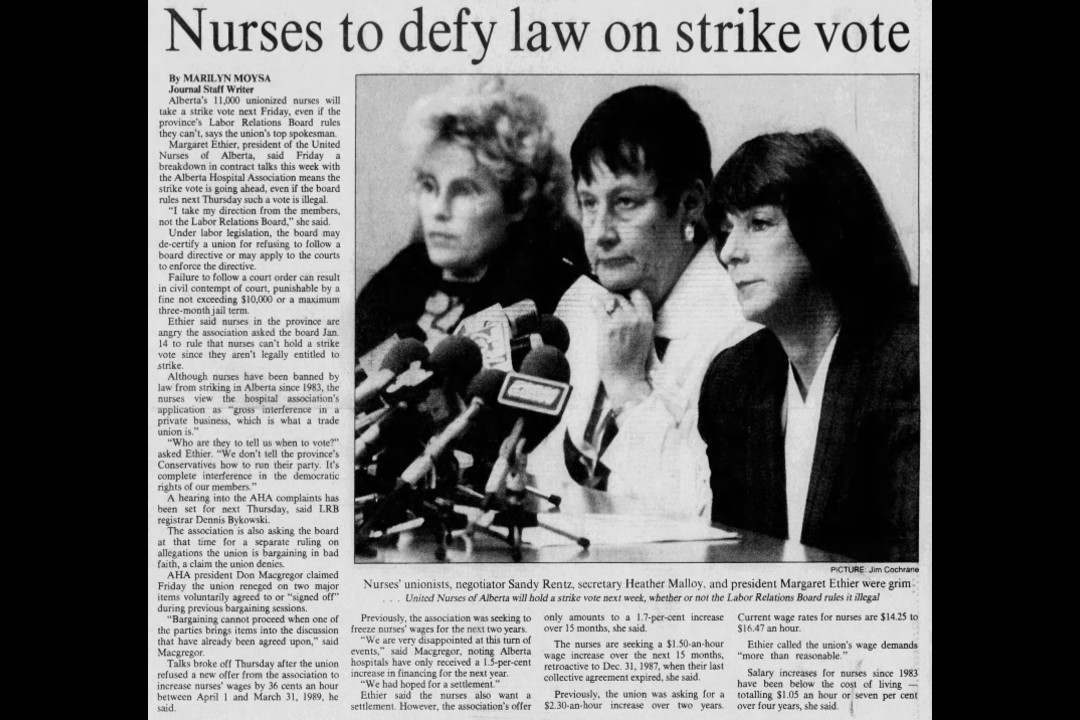
A moment in history: Jan. 16, 1988
By Scott Lilwall
On this day in 1988, Alberta's nursing union was preparing to hold an illegal strike vote.
The threat of a strike vote wasn't uncommon in the 1980s. Hospital nurses went on strike for the first time in the province's history in 1977, with subsequent strikes in 1980 and 1982, all of which saw the nurses win some concessions for improved working conditions. But the 1988 strike was much different, leading to criminal charges, attempts to bankrupt the union, and overwrought comparisons to terrorism.
Stung from the previous labour actions, Alberta's government passed a law in 1984 restricting hospital staff from going on strike. When Premier Don Getty's government started negotiating with nurses for a new contract in 1987, it pushed hard for rollbacks on wages and benefits, which would have erased much of what the union had won in the previous strikes.
After months of messy negotiation, the United Nurses of Alberta announced a vote to ask if members would be willing to go on strike. The province's Labour Relations Board responded swiftly, declaring that not only would a strike be against the law, but holding the vote to strike itself was illegal.
.jpg)
If the hope was to stop a strike vote from happening, it failed spectacularly. The union held the vote anyway. Nurses, angry with being denied even the chance to vote on a strike, voted overwhelmingly on Jan. 22 to stop working. That was the start of a heated 19-day strike.
Nurses from almost every hospital in Edmonton took to the picket line, braving -30C degree temperatures. Elective surgeries were cancelled, patients were sent home, and other hospital staff had to take over the essential duties of the nurses. The University of Alberta Hospital was the only fully functioning hospital in the city, since its nursing staff belonged to a different union. That led to a massive spike in transfers to the U of A, which saw a 350% increase in maternity patients alone during the strike.
The Alberta government responded with heavy fines, terminations, and 75 criminal charges in an attempt to break the strike. Some medical authorities compared the striking nurses to armed criminals and claimed the strike "was no different than terrorism." Public opinion was also divided. Many supported the law preventing hospital staff from striking. On the other hand, the UNA was flooded with small individual donations (as well as support from other unions across Canada) to keep it afloat in the face of massive fines.
Eventually, both sides returned to the negotiating table. On Feb. 13, a new deal was ratified and accepted by the union. The strike wasn't a complete victory for the nurses — the union ended up paying $425,000 in fines. But it prevented wage rollbacks, and the nurses' willingness to defy Alberta's no-strike law would help in later negotiations.
The 1988 nurses' strike is remembered as one of the biggest moments in Alberta's labour history. Hospital strikes remained illegal in Alberta until 2015, when the Supreme Court ruled such blanket bans unconstitutional. Earlier last year, the UNA agreed to a new four-year contract with the province. And in November, a strike by nurses and healthcare aides represented by the Alberta Union of Provincial Employees was averted at the last minute by a new four-year agreement.
This clipping was found on Vintage Edmonton, a daily look at Edmonton's history from armchair archivist Rev Recluse of Vintage Edmonton.
Share