
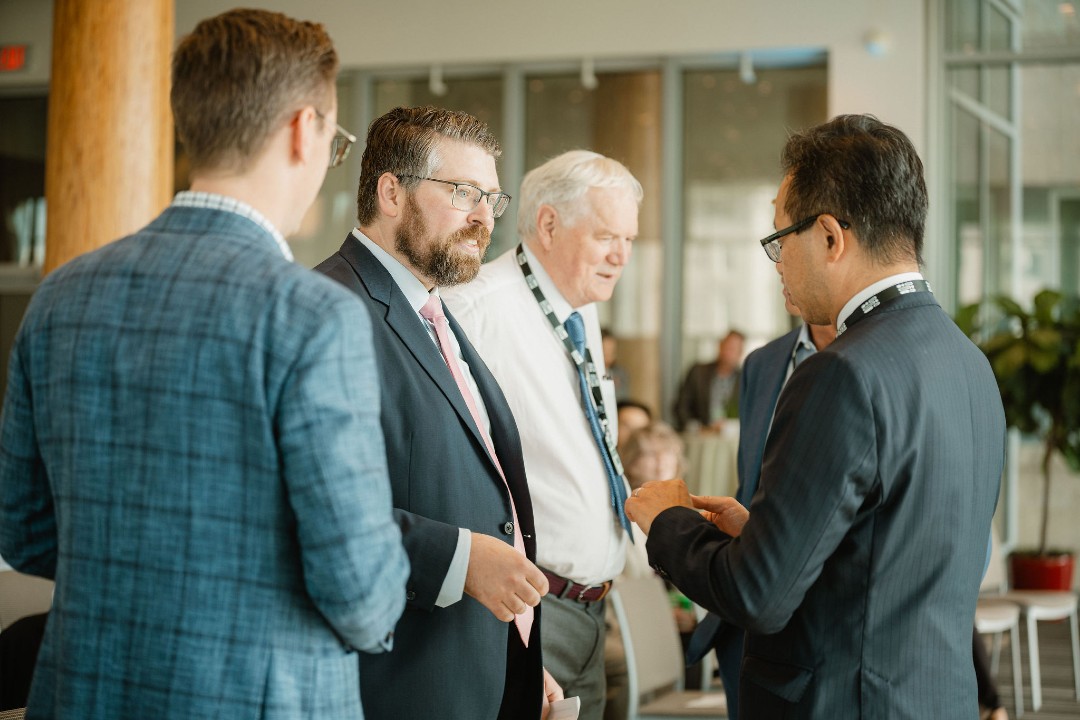
Andrew MacIsaac (second from left), the CEO of Applied Pharmaceutical Innovation, said Edmonton is at a tipping point for its growing life sciences industry. The sector will be in focus from Sept. 22 to 26 during Life Sciences Week.
Alberta's life sciences sector is surging as industry event nears
By Colin Gallant
As the Sept. 22 kick-off to Life Sciences Week approaches, sources from the event's presenter said Alberta is charging ahead in the sector faster than other parts of the world.
"We have a sector that suddenly started rapidly growing," Andrew MacIsaac, the CEO of Applied Pharmaceutical Innovation, told Taproot. "It's also bucking a trend here, too, because globally, there's a downturn in the life sciences that began in late 2021."
MacIsaac said the life sciences sector contributed around $750 million to Alberta's GDP in 2018, the year API was founded. He also cited a report from BioAlberta that showed the contribution increased to $4.7 billion in 2024. The same report also showed that the total economic output of life sciences in Alberta for 2024 is $9.2 billion, the sector has 34,415 full-time equivalent employees, and research and development spending reached $327.3 million in 2022, which is a 32.2% increase compared to 2020.
MacIsaac said Edmonton's portion of the sector has further developed since the last Life Sciences Week, in September of last year. Those developments include API opening the Life Sciences Campus in collaboration with the Edmonton Research Park, where renovations to API's Biotechnology Business Development Centre are now complete; Entos Pharmaceuticals announcing it will spend nearly $200 million to build a facility; Future Fields securing US$8 million in Series A funding and opening its biomanufacturing facility; and Nanostics receiving an undisclosed amount of investment from Genome Canada (via Genome Alberta).
"Even if you look at the tech updates for the city, so many of them are life science related," MacIsaac said. "The global sector is stagnant, and we're growing, because there's a huge amount of potential here that hasn't really been tapped before. Now, it's coming to the surface."
MacIsaac said the reasons for this success include leading researchers, like those at the University of Alberta, lessons about Canada's lacking production capacity for medical supplies that emerged during the COVID-19 pandemic, and a growing, non-partisan desire from policymakers to diversify the province's economy. Two of those factors converged in a $100 million provincial investment to overhaul the biological sciences building at the U of A into the Life Sciences Innovation and Future Technologies Centre. API, meanwhile, runs the nearly $200 million Canadian Critical Drug Initiative in partnership with the university.
As for API's own momentum, Launa Aspeslet became its first chief translational officer this year. Her role is to help life science companies take products "from bench to bedside," or from prototype to profit. The organization is also nearing the completion of its Critical Medicines Production Centre, in 2026. Taproot has reported that the facility could rapidly produce vaccines or other medications in an emergency.
"The CMPC is the equivalent of an oil refinery," MacIsaac said. "Its main task is to provide the very expensive final step of production, which is the aseptic filling of vials and bottles with product, as well as packaging and all those other components. You could have a company like Future Fields that makes the active ingredient that then gets shipped to the CMPC (for the final steps in production)."
Life Sciences Week offers the chance for a glimpse of the CMPC, the Life Sciences Campus, and the Biotechnology Business Development Centre during a tour and reception that features food trucks, drinks, and music.
Another Life Sciences Week event of note is the Health Tech Showcase. Co-hosted by the Glenrose Hospital Foundation and the Edmonton Regional Innovation Network at Edmonton Unlimited, the showcase will feature regional health innovators and spotlight the Glenrose's clinical validation efforts. The week wraps up on Sept. 26 with a party at the Art Gallery of Alberta where participants will experience a hybrid game show-pitchathon created in collaboration with Rapid Fire Theatre.
Share