
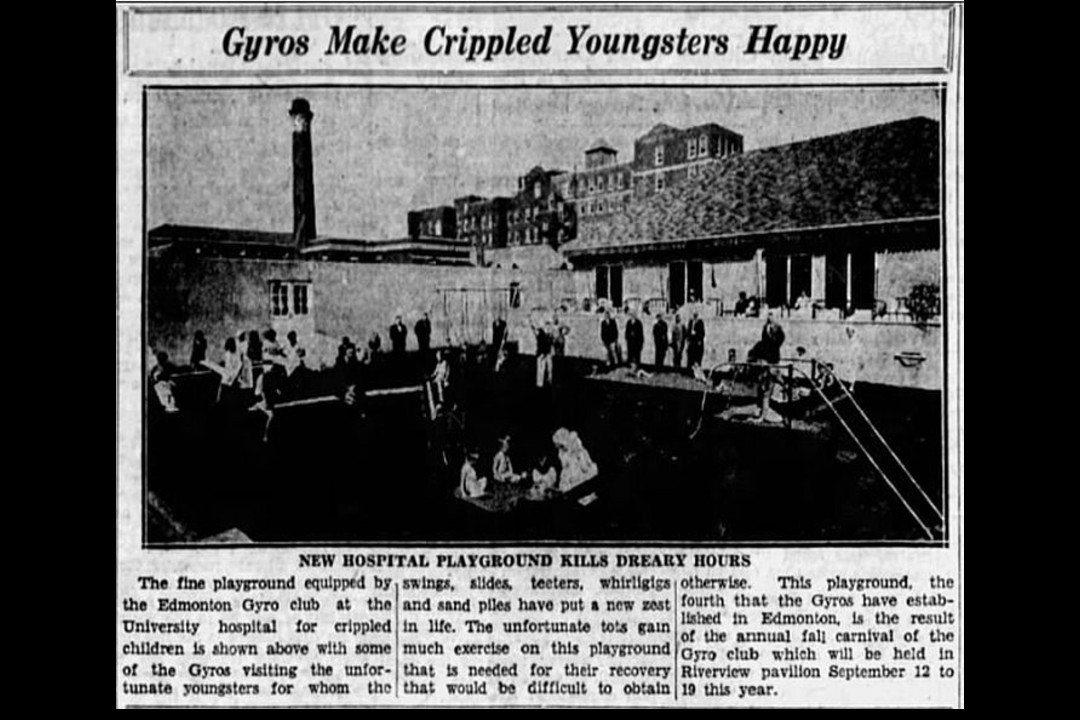
A moment in history: Sept. 5, 1931
By Scott Lilwall
On this day in 1931, the Gyro Club of Edmonton was opening a new playground at the University of Alberta Hospital, their fourth such facility in the city.
At the turn of the century, Edmonton didn't have a lot of good places for kids to play. The city's population was rapidly growing, and empty spaces were giving way to new buildings. The city's park infrastructure wasn't enough to serve its numbers, so many kids ended up in more dangerous places — spending their days playing on busy city streets or swimming in the North Saskatchewan River.
That led to concerns about both the children's physical and moral safety. Many social reformers thought that the rapid urbanization Edmonton was experiencing would lead to overcrowding, disease, and poverty. Playgrounds and supervised play were seen as an inoculation against such ills, and more people began calling for more public spaces for kids.
Those concerns inspired the formation of a local chapter of the Gyro Club. The organization (named after the gyroscope, not the food) had started in Cleveland in 1912 as a fraternal social club, before spreading to other cities, including a Toronto chapter that began in 1919. Canadian chapters of the club quickly became known for their philanthropic work around establishing playgrounds and other infrastructure for children.
Edmonton's Gyro Club was established in 1921 with a membership of 32, most of them local businessmen. Originally, membership was limited to men under 35, and no two members were allowed to be from the same business sector.
They quickly began work on the playgrounds. By this time, Edmonton's booming expansion had cooled following the First World War, leading to foreclosed land that the city could donate to the cause, while the club raised money for construction and operation. By 1922, the Gyro Club opened the creatively titled Playground No. 1 in Patricia Park (now Giovanni Caboto Park).
That would be the first of nine playgrounds the club would build in the city, with an additional one in Fort Saskatchewan. And while children's play spaces were a common cause for other such Gyro clubs in Canada, Edmonton's system was unique. Instead of building the playgrounds and handing them over to the municipality, the local club continued to operate and maintain the playgrounds. They also funded play programs and wading pools at the locations.
While some of the money came from the group's membership fees, most of it came from fundraising. In the 1930s, the club began hosting an annual children's carnival downtown, which soon became a primary source of funds.
In 1946, the club ended its stewardship over the playgrounds it had helped construct, handing over operations to the city. The Gyro Club continues as both a social club and a service organization, and has recently established an endowment fund with the Edmonton Community Foundation for the renovation of older playgrounds, as well as the construction of new facilities.
This clipping was found on Vintage Edmonton, a daily look at Edmonton's history from armchair archivist Rev Recluse of Vintage Edmonton.
Share