
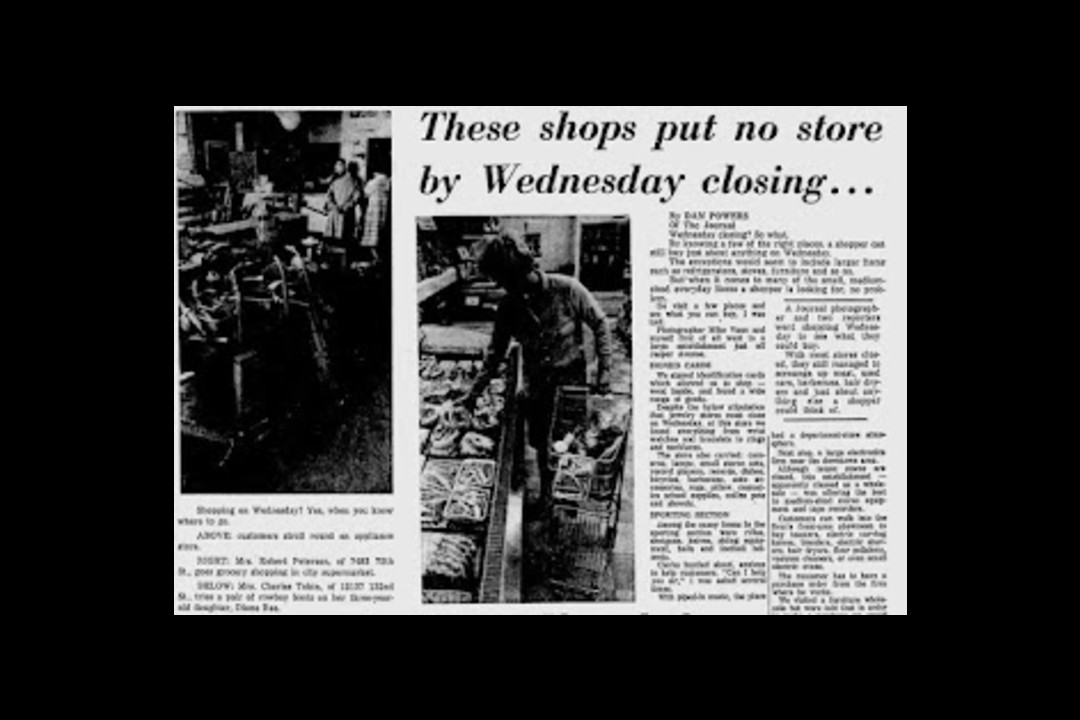
A moment in history: Oct. 3, 1968
By Scott Lilwall
On this day in 1968, some Edmonton reporters were testing the limits of the city's Wednesday shopping ban.
Most people are familiar with Sunday shopping bans. Canada had a federal law for nearly 80 years restricting shopping on Sundays, until it was struck down by the Supreme Court of Canada in 1985, the same year Wednesday shopping bans were outlawed.
But why Wednesdays? At first, it seems arbitrary. One of the earliest references to the ban in Edmonton comes from a 1929 plebiscite. It asked voters if they would like to see the Wednesday "half-holiday" retail ban extended to the whole year, save for December. But there's no context as to what purpose it served, or why the idea was popular (most people voted yes, but not enough to reach the two-thirds majority needed). The city did eventually institute a bylaw extending the ban to every Wednesday outside of December.
In 1962, another vote was held to exempt all food stores from the Wednesday ban, regardless of size. Edmontonians rejected the idea soundly, showing that the ban was still largely popular.
Digging a little deeper reveals that the idea of a Wednesday half-holiday wasn't just an Edmonton thing. Similar shopping bans appeared in other towns and cities across the country. Looking at examples from Saskatchewan and Ontario, it seems like it was mostly to give retail workers a break in the middle of the week. In some towns in the United States, Wednesday half-holidays also freed people up for livestock auctions that were usually held on that day.
With Edmonton's ban, there were several exceptions and loopholes that allowed some shops to stay open. As the Journal reported in its 1968 story, businesses like florists and pharmacies could remain open, since they were stores that provided services "for the ill or the dead." Shops under a certain size could stay open. In 1962, another vote was held to exempt all food stores from the Wednesday ban, regardless of size. Edmontonians rejected the idea soundly, showing that the ban was still largely popular. The Journal writers also reported that stores were straight-up ignoring the ban, allowing them to get by nearly anything they were looking for, with a bit of digging.


The journalists who wrote that 1968 story on the shopping ban might have been inspired by an incident that happened a few months earlier. In March, Liberace — the famed and flamboyant pianist — was in Edmonton to play a couple of shows. Liberace was an avid shopper and had spent at least $15,000 on a previous trip to Alberta. But, since his only free day was on a Wednesday afternoon, his shopping plans were cut short.
Support for the shopping ban began to wane in the 1970s, partially due to pressure from larger grocery stores and retail chains, and stores could once again open on Wednesday afternoons.
Opening hours are no longer the concerns they used to be. But cities still have some power over what retail stores sell. Edmonton has not been shy about using it. The city enacted rules to reduce single-use plastics in 2023, which still might be an issue of contention in the municipal election this month. And earlier this year, council passed restrictions banning the sale of knives at convenience stores in an effort to curb violent crime.
This clipping was found on Vintage Edmonton, a daily look at Edmonton's history from armchair archivist Rev Recluse of Vintage Edmonton.
Share