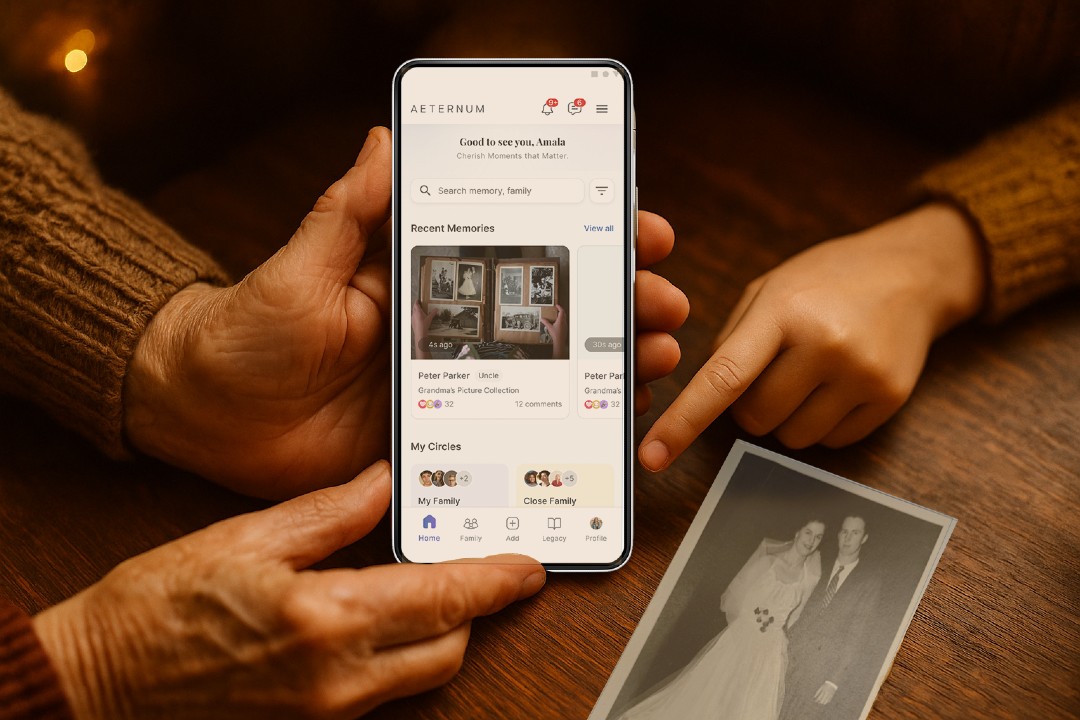
A preview of the Aeternum digital platform, a private, ad-free alternative to social media for family stories, photos, and files. (Supplied)
Startup offers families more control over memories as privacy deteriorates
By Colin Gallant
Aeternum, a startup that's hoping to keep family photographs and other memories safer in the social-media age and into the future, is now accepting test users for its private digital platform.
"I decided to take the risk (to found Aeternum) because I think my family needed it, I needed it, and the world possibly needed it," founder Aaron Tong, who's also a father, told Taproot. He added that private, secure, paid alternatives to social media are growing in popularity because people see they are losing control of what happens to files and personal information with free, less secure options.
"Everything that we've been using for the last couple of decades, primarily social media for content dissemination purposes, (no longer has) a very good reputation in terms of privacy protection and data ownership," Tong said. "I know many people that don't use traditional social media for sharing family-related — especially children-related — content. A lot of them don't even find it safe for their family, especially their younger children, to be engaged in social media. We don't want them to carry on the burden that we as parents had growing up with such social media."
Aeternum is a platform that stores files and allows users to create and share posts it labels as "memories." Users can also lock digital content to specific people and times, partly to make sure kids only see what they should, and partly so content that forms a family's history is delivered to future generations in the preferred way.
"(We built a function) to condition and release this information to the right people, generations down the road. Not just today, not even just the people that we know how to name, but even our future grandkids and generations," Tong said.
What Aeternum does not do is monetize the data of its users with third parties for advertisements or algorithm-inserted content. "We look at data as an inheritable asset for families. It's not data to be utilized for the company's purpose, except for providing the services that the clients need," Tong said.
For now, Aeternum will store said data with a third-party cloud provider — potentially Amazon Web Services. But Tong said the company will assess its storage practices as it grows. The conversation about digital sovereignty is growing, in many ways, thanks to 2018 United States Clarifying Lawful Overseas Use of Data Act. The act, also known as the CLOUD Act, established a standardized process to compel American tech companies to surrender user data to law enforcement agencies, even if that data is stored outside the U.S.
"To be honest, there is no foolproof way of managing (the CLOUD Act)," Tong said. "It's like saying, 'How are we going to influence the outcome of a war between countries?' We can't, not unless we ourselves are powerful enough to have that influence."
Alpha testing for Aeternum begins on Nov. 28, and the company is seeking out people to test for them. Looking ahead, Tong said he wants to add more features to Aeternum as it progresses through a five-part development plan (for which Aeternum received a $50,000 grant from Alberta Innovates in October). One planned feature is called Aela, and it's an artificial intelligence tool aimed at accessibility.
"Not everybody can sit down and write something on a particular memory," Tong said. "Aela will be catered to helping, say, seniors that are maybe less tech-enabled, and those with disabilities who are not able to access typing and things like that. (The goal is) to help them craft meaningful memories, so that their next generations will be able to see who they are in the way that they want themselves to be displayed."
Share