
A moment in history: Dec. 5, 1967
By Scott Lilwall
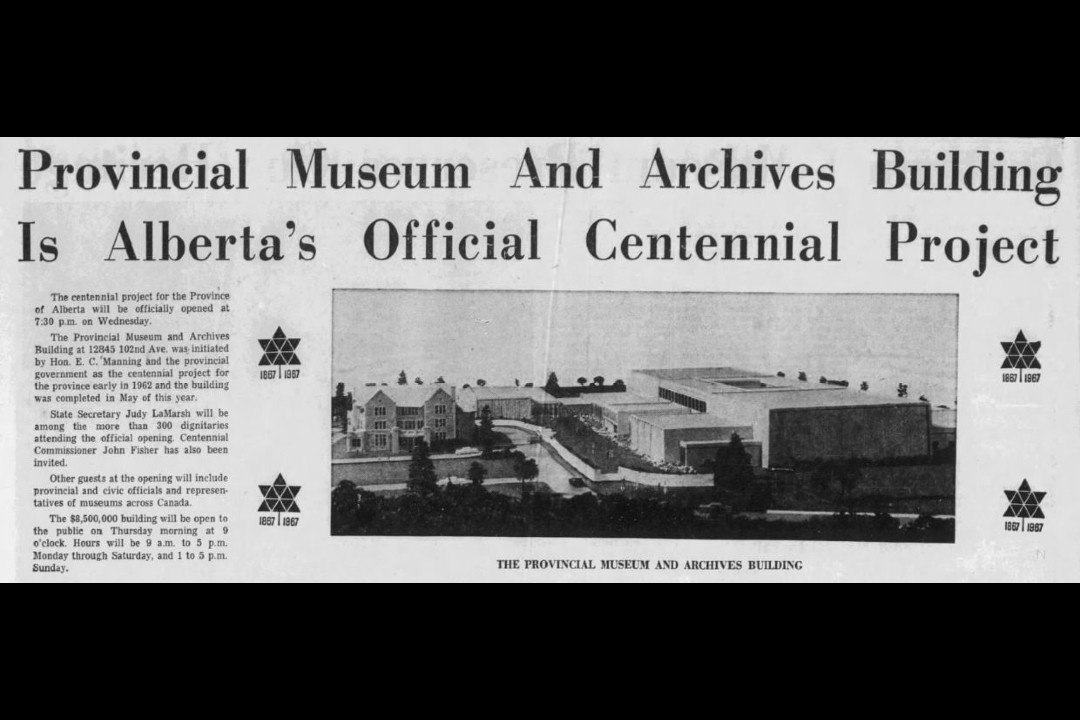
On this day in 1967, Alberta's new provincial museum was set to open its doors.
The year was Canada's centennial, which led to lots of investment from Ottawa and hundreds of community projects across the province. The biggest of which was a provincial museum, meant to preserve and promote Alberta's natural and cultural history. With $2.5 million in funding from both the provincial and federal governments, construction began in 1962.
Both the location and the design of the new museum were carefully chosen. The site in Glenora, overlooking the river valley, was right beside Government House. The materials used to build the museum were purposefully sourced from across the country as a symbol of national unity — black granite from Quebec, marble from Ontario, slate stone from British Columbia and Alberta. The most memorable, though, was the Tyndall stone from Manitoba, containing visible fossils, which was used on the exterior. Recreations of the ancient Petroglyphs found at Alberta's Writing-on-Stone Provincial Park were also carved into the exterior.
When the Provincial Museum and Archives opened its doors to the public, it featured exhibits on Canada's fur trade, Indigenous history, and the history of farming and industry in Alberta. It was instantly popular: More than 310,000 people visited in its first year of operation, helped, no doubt, by the fact that admission was free.
Soon, the museum expanded, both publicly and behind the scenes. The well-known dioramas of Alberta wildlife were added in 1969, with permanent displays on geology and Indigenous history added soon after. But, as with many museums, exhibits are only part of the story. The institution also expanded its research programs to include things like botany, military history, and ethnology.
In 1982, much of the museum's fossil collection, as well as the scientists working in its paleontology program (including famed Alberta paleontologist Phil Currie), were transferred to southern Alberta to create the Tyrell Museum in Drumheller.
In the late 1980s and into the '90s, attendance declined. This led to a shift to revitalize the museum's public programming. Some of the older displays were reworked, and renovations included a large new feature space for special exhibitions.
Just as Canada's centennial led to its creation, the province's own 100th anniversary was a big moment for the Provincial Museum. In 2005, as part of the Alberta Centennial, Queen Elizabeth II visited the site and granted it royal patronage, which led to a new name: The Royal Alberta Museum.
In 2011, the province announced a new plan for the RAM. The original building, now showing its age, would be closed down, and a new facility would be built downtown. The original museum closed its doors on Dec. 6, 2016, exactly 48 years from when it opened. Over the next two years, museum staff embarked on a massive undertaking, transferring the extensive collection and equipment over to the new museum.
When the new RAM opened in 2018, it was the largest museum in Western Canada, with more than 7,600 square metres of exhibit space. For the first week, as a nod to the original 1967 opening, admission to the museum was free. During that time, 41,000 people visited.
With the new building now established, there has been a debate for nearly a decade about what should happen to the original building. Last year, the provincial government reversed its unpopular plans to demolish the structure. And just this week, it announced that it was currently in negotiations with an unidentified third party to redevelop the site.
This clipping was found on Vintage Edmonton, a daily look at Edmonton's history from armchair archivist Rev Recluse of Vintage Edmonton.
Share