
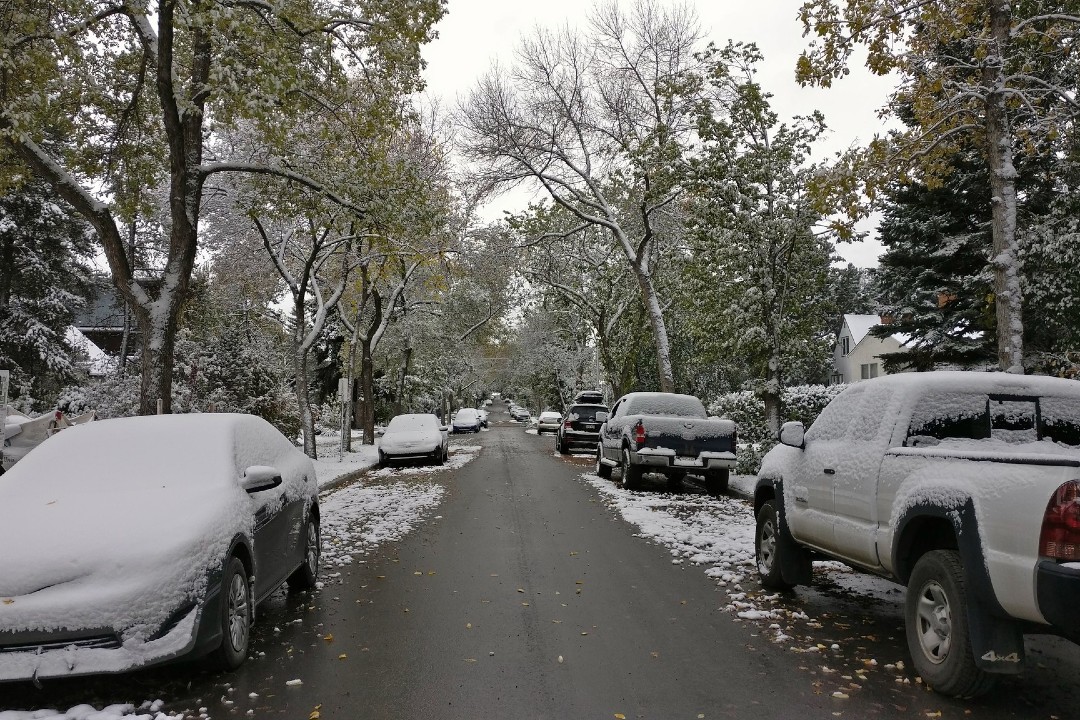
Boulevard trees like these are part of Edmonton's plans for two million more trees by 2030. (Mack Male/Flickr)
Edmonton nearly halfway to tree goal, with slight extension
By Colin Gallant
The City of Edmonton says it is on track to add two million trees by 2031, lengthening its deadline by one year after condensing a 30-year plan to a decade-long one.
The city has planted 810,546 net new trees and shrubs since 2021, including 484,091 of them in 2025 alone. Net means the number of trees planted minus those removed for reasons such as age and disease, which amounts to 3,000 to 4,000 per year, said Mark Beare, the director of parks and urban forestry.
City council first called for two million net new trees by 2050 when it approved the City Plan in 2020. It later moved that deadline to 2030 to help meet a goal for 20% canopy coverage by 2071 as set out in the Urban Forest Asset Management Plan. Now, halfway between the passage of the City Plan and the revised deadline, the city should hit the two million mark by 2031, Beare told Taproot in a statement.
The most accurate estimate for total trees in Edmonton is still the 12.8 million the city calculated in the City Plan, Beare said. Of those, the city maintains an inventory of around 400,000 on boulevards, streets, and parks. The numbers get fuzzier when it comes to the 3,000 hectares of natural areas (dominated by native vegetation in naturally occurring patterns) and more than 1,000 hectares of naturalized areas (which the city has intervened to return to a natural state), as the city doesn't count individual trees in such spaces.
The city has estimated the new trees will cost about $114 million, $48 million of which will come from the 2 Billion Trees program as the city achieves certain benchmarks, Beare confirmed. The federal government is expected to honour existing agreements, but 2 Billion Trees is winding down early and shy of its goal.
The remaining $66 million comes from the municipal budget and supports a healthier city, Beare said. "Having a healthy urban forest improves our city's air quality, reduces energy consumption, preserves soils, maintains ecological connectivity, promotes biodiversity, keeps the streetscape cool, and conserves water resources," he said.
The city calculates a monetary value for its trees to quantify public benefit and fees or penalties for tree removal. Open space and boulevard trees alone are worth just shy of $2 billion, a spokesperson said. The city also encourages volunteer planting through Root for Trees, which planted more than 45,000 trees and shrubs this year.
On a longer time scale, The Secret Longtree Society has planted a few hundred trees in its quest to plant 1,000 that each live for 1,000 years. The Art Gallery of Alberta is exhibiting a mural inspired by the effort, exploring why trees are an avenue for city-building and storytelling. It's on display until March 15.
Update: This file has been updated to include newer figures for trees and shrubs planted by the City of Edmonton.
Share