
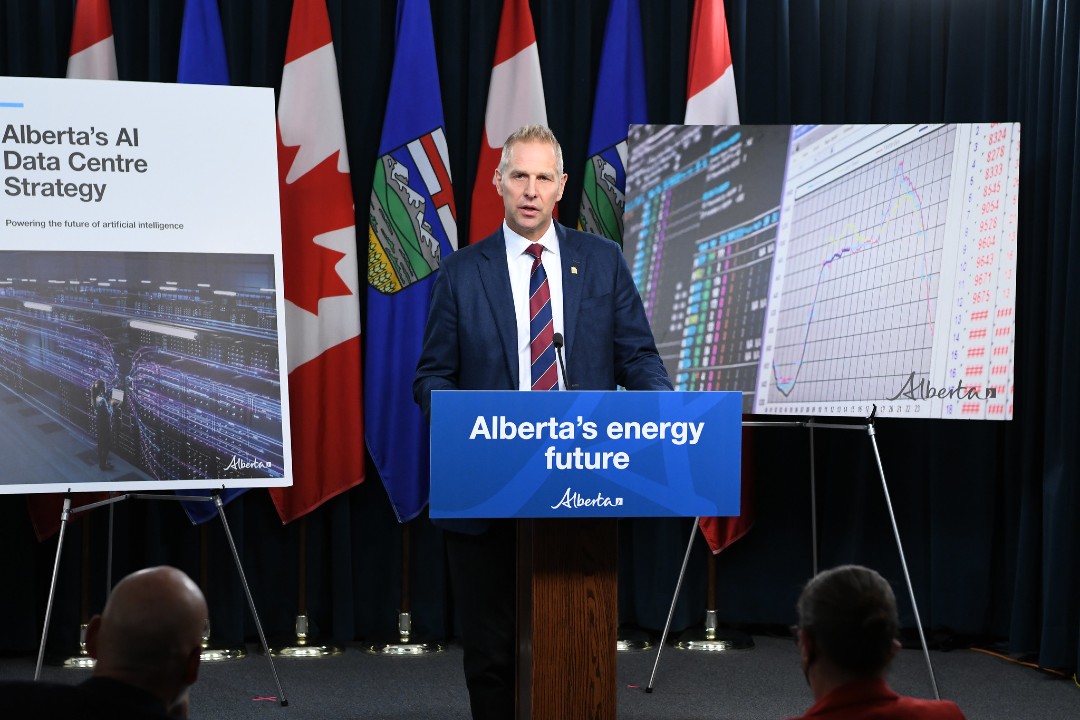
Affordability and Utilities Minister Nathan Neudorf announced Bill 8, the Utilities Statutes Amendment Act, on Nov. 25. (Chris Schwarz/Government of Alberta)
Sturgeon County leverages industrial zone for data centres
By Colin Gallant
Sturgeon County is betting on Alberta's only designated industrial zone and a $16.6-million industrial water facility for data centres as Beacon AI Centers gains momentum on an application in the county.
"I think (the new water intake) does give us a bit of an advantage," Mark Morrissey, the director of economic growth and innovation for Sturgeon County, told Taproot. "But in our conversations with data centres, most of them are now looking at closed-loop systems and new technology to reduce their water draw. They're recognizing that, from a social licence perspective, consuming huge amounts of water is really one of the reasons they're getting pushed out of their traditional markets."
Even so, Sturgeon County's approach to data centre development lets potential applicants know that the dedicated industrial water system is funded and on its way, noting that industrial users will be directed to use this processed water system rather than the potable water that households need. Morrissey said the Sturgeon intake could be constructed within two years, and Sturgeon County council would have to approve any additional cost beyond the $16.6 million.
The province announced in May 2024 that it would spend $50.5 million on this water-intake facility and two others in Strathcona County and Lamont County. All three will be within the province's only designated industrial zone, which the provincial government made official in October 2022. The zone encompasses parts of Sturgeon County, Strathcona County, Lamont County, Fort Saskatchewan, and Edmonton. Part of its purpose is to streamline regulatory approval for industrial development.
Alberta's government is working to attract $100 billion in data centre investment over five years, Technology and Innovation Minister Nate Glubish said in December 2024. Part of the pitch is that Alberta has the only deregulated energy market in Canada, so data centre operators can generate the power the grid lacks. Bill 8, the Utilities Statutes Amendment Act, passed third reading on Dec. 4. The act is intended to make it easier for data centres to generate power and require operators who connect to the grid to pay for any needed upgrades.
Morrissey said the designated industrial zone is an ideal place for data centres to generate their own power. "You can build large-scale (electricity) generation capacity in the designated industrial zone," Morrissey said. "Not only from a permitting and a regulatory perspective does it support that, but the infrastructure is there. So when you look at the major (petrochemical) industry that calls the Heartland home, the supporting infrastructure — whether it's gas supplies, whether it's the labour force ... used to building these types of development — that's all present in the designated industrial zone."
Plus, he said, "The prize is the power plant itself," when making a data centre deal. "It's not that traditional oil and gas development, which we still fully support and we're still very much aligned with, but at the same time, you're broadening out your industry into the technology space."
Sturgeon County staff have granted Beacon a master site development permit for land in the county, Morrissey said, but several municipal and provincial approvals remain for both a data centre and a co-located power plant. "I would ballpark it at 2027 or 2028 at the earliest," he said.
Meanwhile, The Logic has reported that Beacon is a partner in a data centre project for Meta at the Greenlight Electricity Centre in Sturgeon. Neither of those companies, nor Greenlight owners Pembina Pipeline Corporation and Kineticor, have confirmed this. On Dec. 10, Edmonton's Capital Power announced it had entered into a binding memorandum of understanding to supply a data centre in Alberta with 250 megawatts of electricity. The Globe and Mail reached out to Meta to ask if the company is Capital Power's unnamed client, to which the tech giant did not respond.
Share