
A moment in history: Dec. 19, 1986
By Scott Lilwall
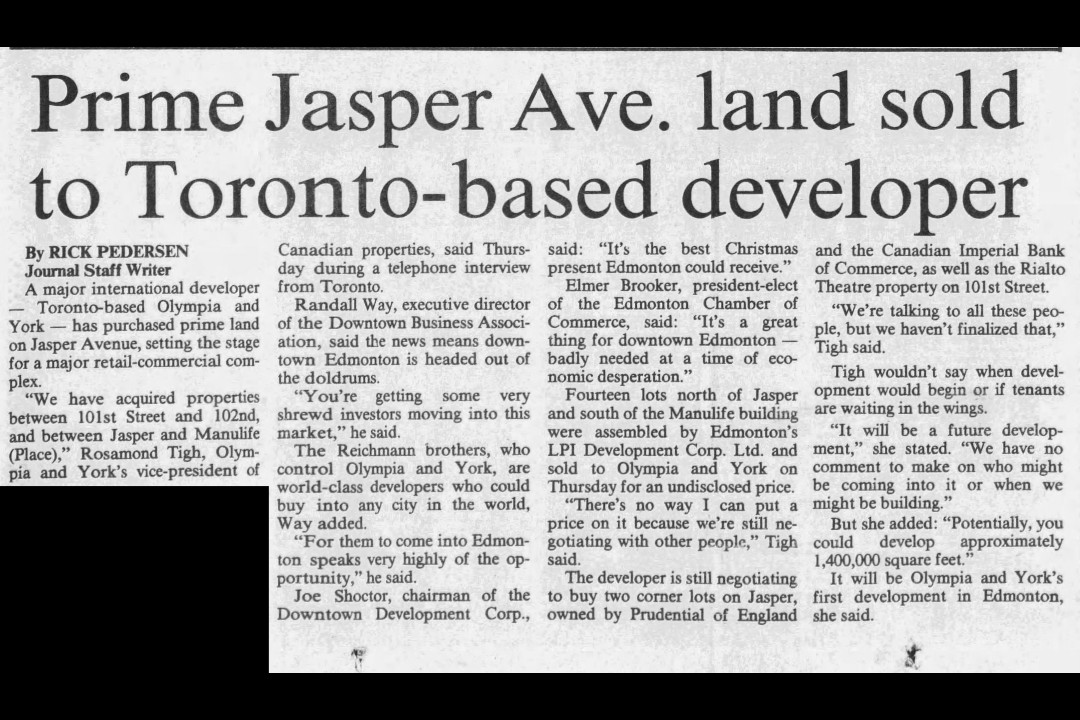
On this day in 1986, a land sale was the first step to building one of Edmonton's tallest downtown towers.
For most of the 20th century, 10120 Jasper Avenue NW was home to the Commercial Chamber Building (also known simply as "the Commercial Building"). A two-storey structure built in 1930 was designed by Herbert Magoon and George MacDonald, a prolific pair of architects responsible for many of Edmonton's early commercial and institutional buildings, including the Edmonton General Hospital and the H.V. Shaw Building.
Built during the city's slow recovery from the economic crash that followed the First World War, the Commercial Building housed retail stores on the first floor and offices on the second. One of its most memorable features was a sundial set above one of the entrances, inscribed with the initials "M&S" after the builders, McDougall & Secord Limited.
The Commercial Building would remain a quiet part of Edmonton's growing downtown core for the next half-century. In 1986, Toronto's Olympia and York bought it as part of an ambitious plan to demolish both the Commercial Building and the neighbouring Canadian Imperial Bank of Commerce Building, and turn them into a commercial centre stretching along Jasper Avenue between 101 and 102 Streets, bookended by two large office towers.
That plan ended up half-finished. The Commercial Building was demolished in 1989, and construction started on the mall and the first tower. The second tower was never completed: the idea of razing the ornate stone CIBC building received much more public push-back than the demolition of the Commercial Building. On top of that, Edmonton's city council sparred with Olympia and York over the company's ever-shifting promises to preserve the CIBC facade in the new building. The plans for a second tower were soon abandoned.
The 27-storey CityCentre tower opened in 1990. The old M&S sundial was installed on the tower's podium, the last surviving piece of the old Commercial Building. The mall was supposed to open around the same time, but that was delayed by a year due to trouble finding tenants. That might have been a sign of the hardships ahead. Demand for office space downtown remained low, putting a strain on the project's finances. In 1992, Olympia and York would go into bankruptcy, and the project would be sold off to, ironically, CIBC. A couple of years later, the complex was renamed Commerce Place.
Commerce Place did survive the 1990s, and remains both an established part of the city's core and an anchor for Edmonton's extensive pedway system. However, it and other downtown towers are contending with another period of low demand for office space. This summer, Edmonton's downtown office vacancy rate dipped below 20% for the first time in years. And like many downtown retail buildings, the Commerce Place mall has long struggled to find and keep tenants.
This clipping was found on Vintage Edmonton, a daily look at Edmonton's history from armchair archivist Rev Recluse of Vintage Edmonton.
Share