
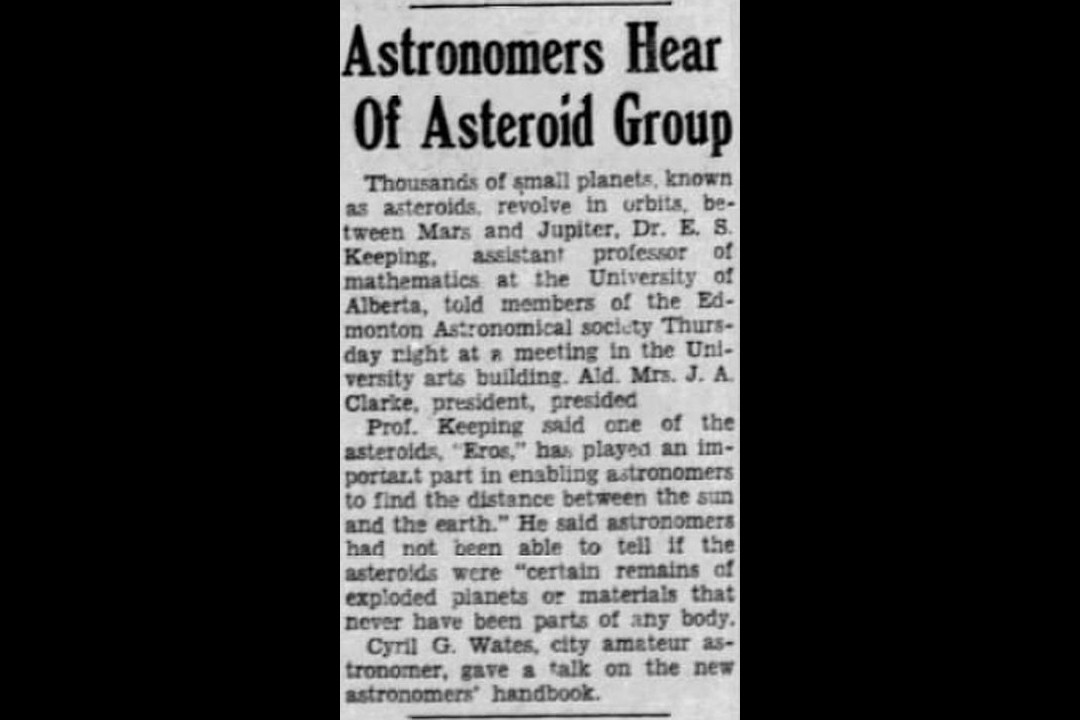
A moment in history: April 10, 1942
By Scott Lilwall
On this day in 1942, Edmonton's amateur astronomers were getting a lesson in asteroids.
The skies above Edmonton have been captivating people for thousands of years. It's far enough north to be treated to spectacular aurora displays, and the cold, long winter nights make for clear skies perfect for stargazing. This nêhiyaw tale shared by Jacquelyn Cardinal shows how long the stars above have been inspiring stories.
In 1932, a group of amateur astronomers, led by University of Alberta math professor J.W. Campbell, petitioned the Royal Astronomical Society of Canada to create an Edmonton chapter. Campbell would serve as the organization's first president, and the group grew quickly under his leadership. In addition to stargazing, the RASC Edmonton Centre would host monthly lectures on astronomy, hold public events, and create a "provincial fireball reporting program" for anyone witnessing one of Alberta's surprisingly frequent meteors.
One of the group's early members was Cyril Wates, an engineer for Edmonton's telephone company who had a knack for building telescopes. During the 1930s and early 1940s, he would build half a dozen of them and write articles for Scientific American and the RASC's journal. His most ambitious creation, which took him five years to craft, was a 32-centimetre telescope cobbled together out of dental equipment, washing machine parts, and other objects. Wates donated the telescope to the University of Alberta, where it became the foundation of the institution's first observatory, which opened in 1943.
In 1958, Edmonton's city council put out the call for civic projects to honour the upcoming visit of Queen Elizabeth II. Members of RASC Edmonton Centre pushed for a municipal planetarium, the first of its kind in Canada. Through an "inventive" campaign, the astronomers gathered strong public support for the idea. In 1959, the Queen Elizabeth II Planetarium was built.
The astronomical society continues to encourage stargazers in the city. The group manages the observatory at the TELUS World of Science Edmonton, one of the city's two observatories open to the public (the other is at the U of A). In 2023, the society opened a second observatory at Black Nugget Lake, 70 kilometres outside of the city, and thus far enough away to take advantage of the darker skies. That new observatory houses the largest publicly accessible telescope in Western Canada.
Many of us have been keeping a closer eye on the skies these days due to the historic Artemis II lunar mission, which is currently in flight. Among the crew is Canadian astronaut Jeremy Hansen, who at an earlier stage in his career served as a fighter pilot at CFB Cold Lake.
This clipping was found on Vintage Edmonton, a daily look at Edmonton's history from armchair archivist Rev Recluse of Vintage Edmonton.
Share