
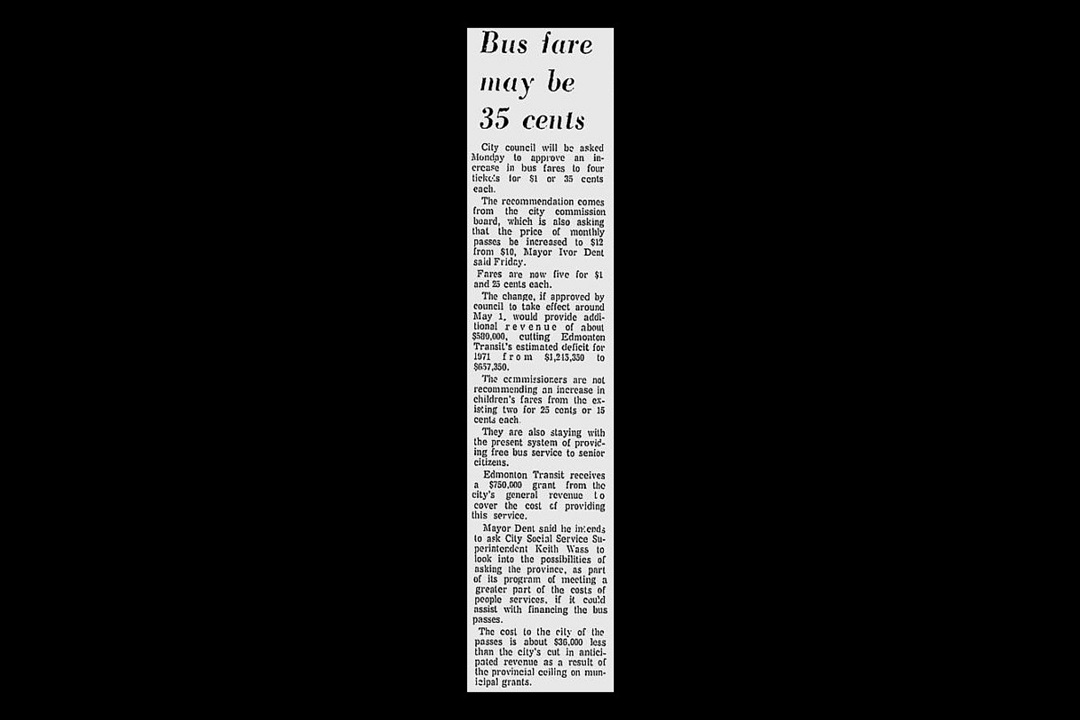
A moment in history: April 24, 1971
By Scott Lilwall
On this day in 1971, Edmonton city council was contemplating raising bus fare to 35 cents. Monthly bus passes were to rise to $12, though seniors' passes remained free, a subsidy that Mayor Ivor Dent hoped to get the province to chip in on.
There has been some form of bus service in Edmonton for at least 130 years. Privately owned horse-drawn omnibuses (a Latin word meaning "for everyone") would ferry riders between Edmonton and the railway station in Strathcona for 25 cents.
For the first 30 years of public transit in the city, the streetcars of the Edmonton Radial Railway were the main way of getting around. By the late 1930s, the streetcar system was struggling. The rail lines and other equipment were in poor condition due to a lack of funding after the Great Depression. Starting in 1938, the city began phasing out the streetcar system in favour of electric trolley buses. It spent over $250,000 on vehicles, paving and installing the electrical lines along the routes that would power the buses. In 1939, the service opened to the public, charging a 10-cent cash fare. Diesel buses were also added to the fleet to service areas where the trolleys weren't practical.
The transition away from the streetcars didn't go smoothly. While the public strongly supported the trolley, expanding the fleet proved to be difficult. Edmonton was ordering most of the buses from England at the time, but the outbreak of the Second World War slowed that process. Despite the plan to phase out the streetcars, the rails were expanded to address increased demand until the trolley system could grow.
In 1946, the Edmonton Radial Railway changed its name to the Edmonton Transportation System (and, a year later, to the Edmonton Transit System). Five years later, the streetcar system was fully retired, making buses the backbone of the system. The system continued to grow, both in vehicles and in ridership. In 1962, changes were made to the bus system to make commutes faster and easier. This was when the first dedicated bus lanes and express routes were added. It also saw the arrival of the monthly bus pass for regular riders.
The trolleys remained part of ETS for decades, even as the LRT system reintroduced rail to the public transit system in the 1970s. Eventually, though, they fell out of favour. The trolley buses were quiet and clean, but didn't have the flexibility of those with diesel engines. Trolley bus lines began to disappear, and in 2008, the city council voted to scrap the system entirely to save on costs. The next year, the last trolley bus route ran for the final time.
These days, ETS's fleet of buses numbers around 1,000, most of them being conventional engines, with 60 all-electric vehicles. The city is currently debating further changes to Edmonton's bus system, including the introduction of new rapid bus routes.
This clipping was found on Vintage Edmonton, a daily look at Edmonton's history from armchair archivist Rev Recluse of Vintage Edmonton.
Share