
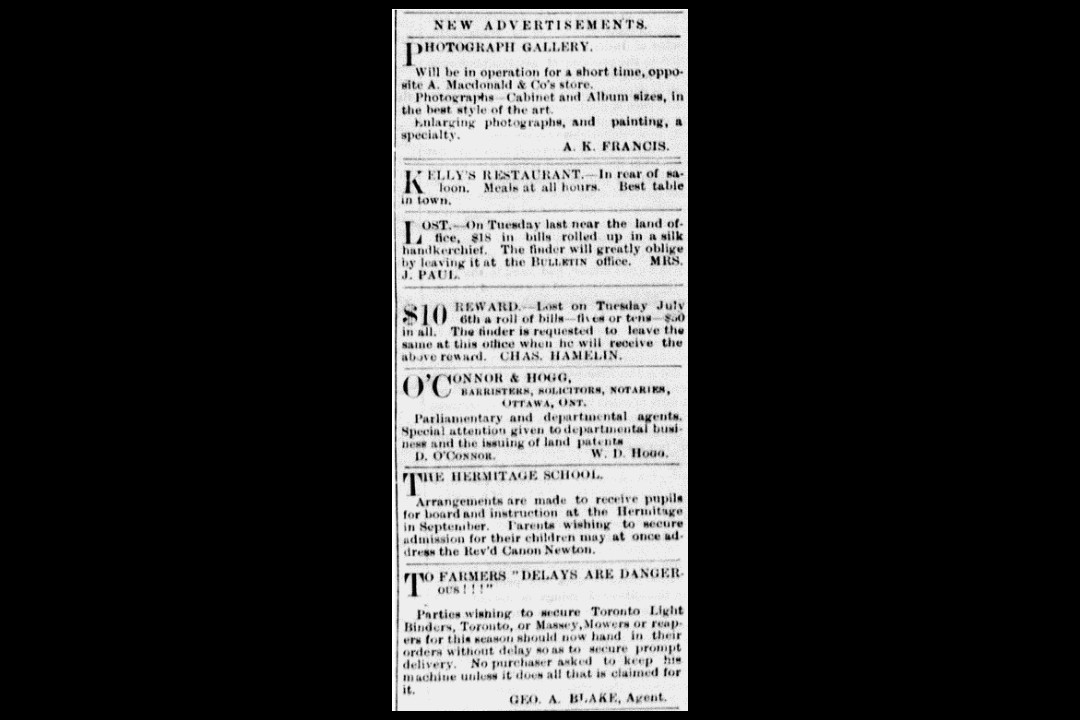
A moment in history: July 17, 1886
By Scott Lilwall
On this day in 1886, the Hermitage homestead was accepting students into one of Edmonton's earliest schools.
The 66 acres of Hermitage Park hug the curve of the North Saskatchewan River in northeast Edmonton, drawing people to enjoy its nature trails, picnic areas, and a pond stocked with trout. But long before the park existed, people were drawn to the area after Canon William Newton established Hermitage in the late 1800s; it would become an important site for both the spiritual and physical health of people in early Edmonton.
William Newton was born in 1828 in England. After immigrating to Canada, he was ordained as an Anglican minister in Ontario. In 1875, Newton left behind his wife and nine children to become the first Anglican missionary in Edmonton. When he arrived, he found his housing options to be extremely limited: there was Fort Edmonton, and most of the land around the fort had been claimed by farms. Newton ended up renting a space from the Fort's head trader. That arrangement was short-lived, however. Newton and his landlord had a falling out, and the missionary was kicked out with a day's notice.
With the land surrounding the Fort already claimed, Newton travelled 10 kilometres before he found a spot alongside the river. In that isolated patch of land, he built a log cabin he called Hermitage, the first foothold for the Anglican Church in the province. Newton used it as a home base for his missionary work throughout the province.
Over the years, Newton's single log cabin expanded to a modest cluster of buildings. A guesthouse was built to house visiting missionaries and other travellers. A small chapel went up. The largest building was reserved for a library, holding Newton's impressive collection of books. There, he established Edmonton's first Anglican parish, All Saints. In addition to his missionary work, Newton was an avid gardener, and Hermitage became well-known for its beautiful gardens, particularly the lilacs he carefully planted around the buildings.
In 1886, Hermitage added a small school for children in the area, advertising in the classifieds that parents could apply to Newton to admit their children "for board and instruction" in September. That same year, the homestead gained another Newton: William's sister Eliza. She was a nurse who had worked in several London hospitals. She set up the area's first medical facility at Hermitage, increasing the number of people visiting the growing homestead.
In 1900, Newton retired from his position and sold Hermitage. A year later, he would move to Victoria, where he would remain until his death in 1910. The land itself would later be used for agriculture.
In 1951, the City of Edmonton erected a historic cairn and plaque on the Hermitage site, a relatively new practice at the time. While the monument is gone, there is still a historic marker on the original site of Hermitage, adjacent to the park that shares its name.
In fact, the legacy of Hermitage can still be seen on signs and maps all over northeast Edmonton. In addition to Hermitage (the park, the road, and the residential area), there is a Newton Park at 121 Avenue and 54 Street. And the neighbourhoods of Newton, Canon Ridge, Homesteader, and Overlanders all trace their names back to Newton's original homestead. Some of those neighbourhoods are currently under neighbourhood renewal, with construction in Overlanders and Homesteader expected to continue into 2027.
This clipping was found on Vintage Edmonton, a daily look at Edmonton's history from armchair archivist Rev Recluse of Vintage Edmonton.
Share