
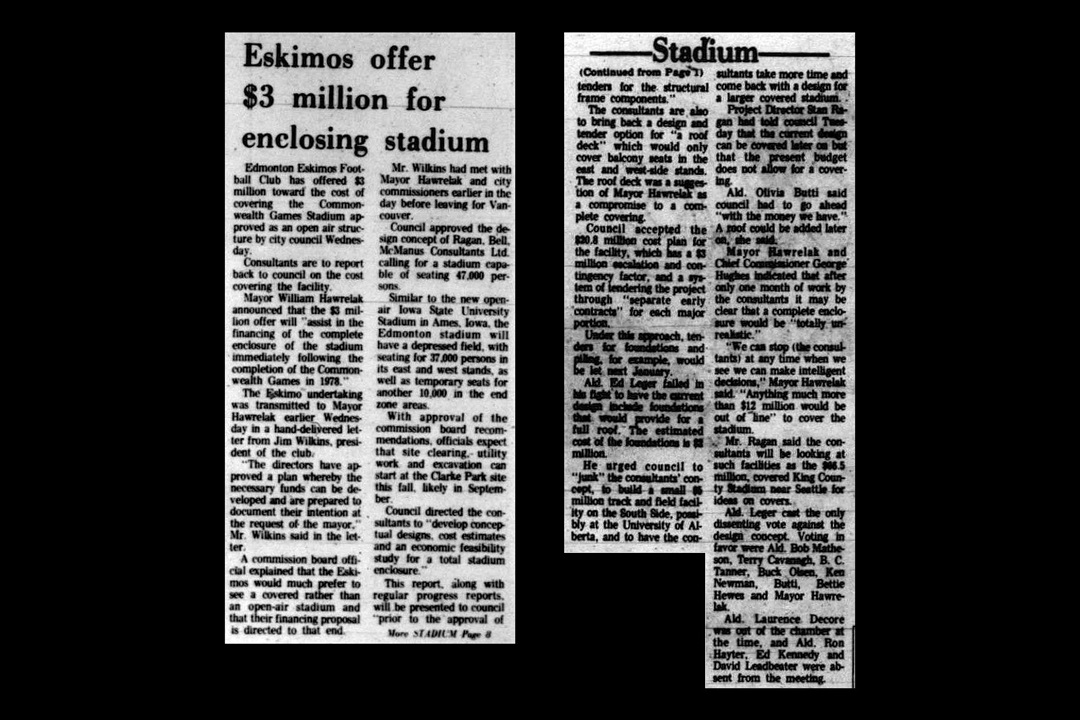
A moment in history: Aug. 14, 1975
By Scott Lilwall
On this day in 1975, Edmonton's football team was pledging $3 million towards a brand new stadium.
For the first three decades of the team's existence, Clarke Stadium served as its home field. But when Edmonton was announced as the host city for the 1978 Commonwealth Games, it became apparent that Clarke would not be large enough to accommodate the expected crowds. The original plan was to expand the building, but that was quickly axed in favour of a new, much larger sports complex to be built beside Clarke.
While the idea of a new stadium received support from city council and much of the public, there was a lot of controversy over what would go on top of the new facility. Some wanted a domed roof, which would have cost around $18.5 million — a significant price tag, considering the rest of the stadium would cost about $21 million. City council never really felt comfortable with the roof plan, partially because of the cost overruns that Montreal was dealing with building Olympic Stadium around the same time. The plan eventually landed on an open-air stadium, with a future proposal for a much cheaper roof (that would never happen).
Construction began in the winter of 1974, one of several major projects planned for the 1978 games that would have a lasting impact on the city. The work was briefly delayed when crews found objects from the Rat Creek Dump and an old incinerator that had occupied the land in the early 20th century. Archaeologists were called in to examine the site before construction resumed.
The stadium opened on July 15, 1978, with a capacity of 42,500 seats. While it might not have a roof, Commonwealth Stadium did have something that no other stadium in Canada could boast: a $50,000 restroom. The fully furnished "royal retirement room" was built specifically for Queen Elizabeth II to use when opening the Commonwealth Games in August 1978. Although it was installed, she never did actually use it, and the restroom was dismantled and used as a storage area. But that $50,000 didn't go completely to waste, as the toilet was reportedly used once during the games, by a then-six-year-old Justin Trudeau.
Edmonton's football team, then known as the Eskimos, moved into Commonwealth that same year. The stadium was expanded to 60,000 seats for the 1983 Summer Universiade, making it the largest stadium in Canada. It still holds that title, despite being reduced to 56,302 in 2013 when the original seating was replaced with wider, more comfortable seats.
In addition to the Commonwealth Games and football (including five Grey Cup games), the stadium has hosted a wide variety of shows and other sporting events over its 48 years. It was the site of the first outdoor regular season NHL game in history at the 2003 Heritage Classic, which saw the Montreal Canadiens beat the Oilers 4-3 in -18C weather. It held the opening ceremonies and the initial matches for the FIFA Women's World Cup in 2015, as well as a men's World Cup warm-up game between Canada and Uzbekistan in June of this year.
The football team, which was renamed the Elks in 2021, decided to close Commonwealth's upper bowl in 2024, cutting its capacity down to around 31,000. The change was billed as "enhancing the game day atmosphere," but really, there were too few fans in too many seats due to a record losing streak. However, some of those upper seats were reopened on Aug. 1 due to increased ticket sales after Edmonton's drastic turnaround this season, aided by a bit of an influx of Saskatchewan Roughriders fans. And big concerts still fill it, sometimes disrupted by weather, as was the case for Post Malone, and sometimes not, as 50,000 AC/DC fans experienced. The Elks return on Aug. 15, and Guns N' Roses will play on Aug. 26.
This clipping was found on Vintage Edmonton, a daily look at Edmonton's history from armchair archivist Rev Recluse of Vintage Edmonton.
Share