
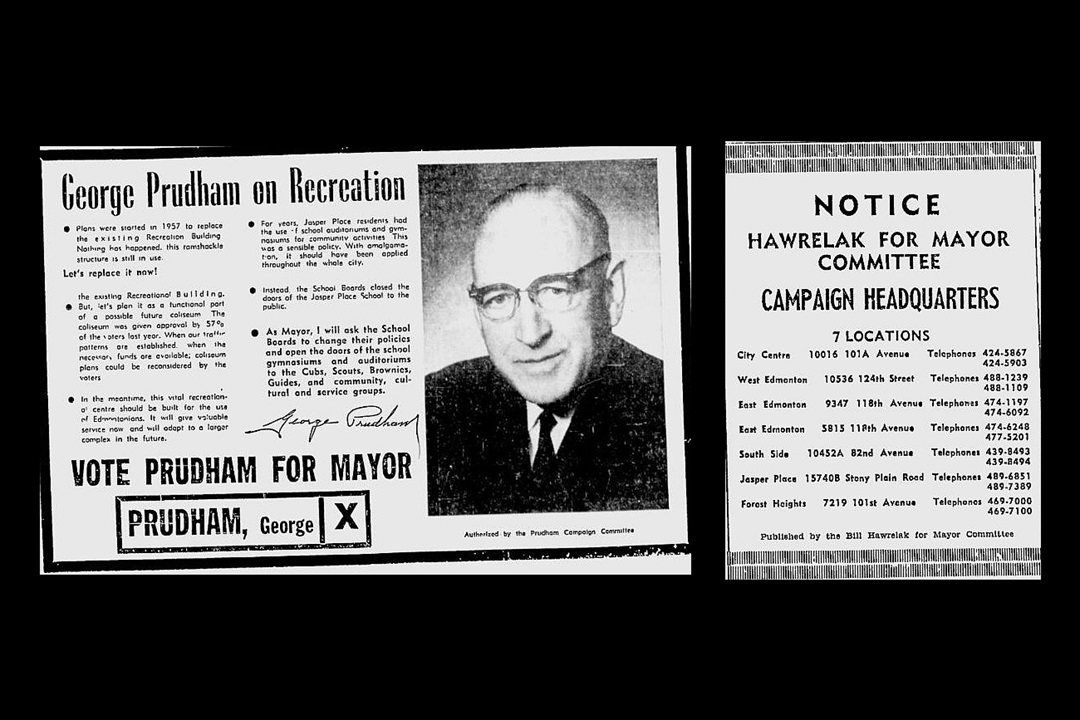
A moment in history: Oct. 2, 1964
By Scott Lilwall
On this day in 1964, the recent amalgamation of Jasper Place and Edmonton was playing a part in the mayoral election.
Starting in the early 1870s, Jasper Place was homesteaded, once the Dominion Land Survey started distributing land that Indigenous people had long lived on and travelled through. By the turn of the century, there were hundreds of small farms set up in the area, a short distance west of a growing Edmonton.
Within 10 years, that distance had largely disappeared, and Jasper Place and Edmonton were side by side, separated by a road where 149 Street now runs. The area was subdivided in 1912 in anticipation of more residential development. But those plans would stall due to economic depression and population declines just before the First World War, and the area stayed largely agricultural. Jasper Place did not have the same infrastructure as neighbouring Edmonton. Roads were largely unpaved, and the homesteads didn't have the same access to running water and electricity that city-dwellers enjoyed.
The 1930s saw the population of Jasper Place boom, mostly due to people moving west to escape the comparatively higher taxes in Edmonton. That population growth would become a surge in the late 1940s, after the discovery of oil at Leduc #1. By 1948, Jasper Place's population was 4,000 people, making it the largest hamlet in Alberta. Within the next two years, that population would more than double, and Jasper Place would become a village and then a town at a breathtaking pace.
That growth continued into the '50s and '60s. But it came with costs. A growing population demanded more services — infrastructure, recreation areas, and schools. But as a mostly residential development, Jasper Place lacked the diverse tax base needed to pay for such things. The Jasper Place council held a plebiscite on merging with Edmonton in 1962, which would take on the town's debt and the responsibility for municipal services. Two years later, the town officially amalgamated with Edmonton, adding 38,000 residents to the city's population.
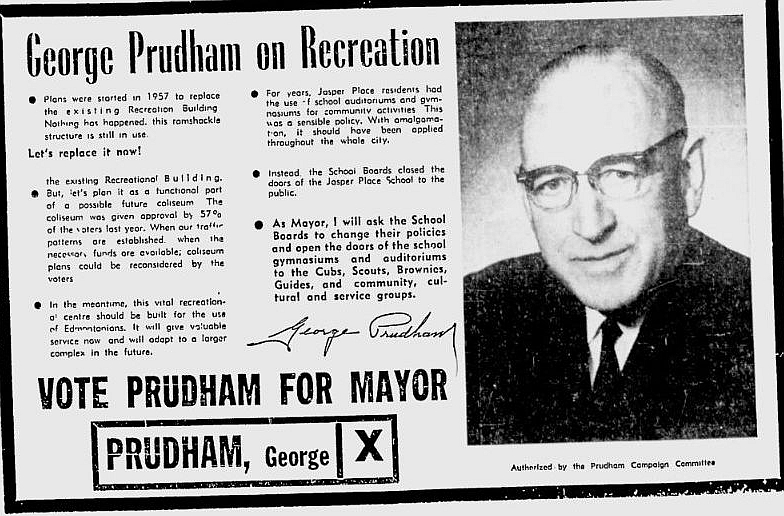
The new addition got some attention in the 1964 mayoral election, held a few months after the merger. Candidate George Prudham lamented the end of a policy to allow public use of Jasper Place school auditoriums and gymnasiums. Meanwhile, the ultimately successful candidate, William Hawrelak, made sure he had a campaign office in Jasper Place to try to woo new voters.

The site of the former town now spans nearly two dozen neighbourhoods, including West Jasper Place, Jasper Park, Britannia-Youngstown, and Glenwood. No longer on the western boundary of the city, these neighbourhoods are considered mature, with opportunities for infill development under the City Plan. Not everyone loves that. Jasper Park residents were among those who protested against infill and densification on Sept. 27.
This clipping was found on Vintage Edmonton, a daily look at Edmonton's history from armchair archivist Rev Recluse of Vintage Edmonton.
Share