
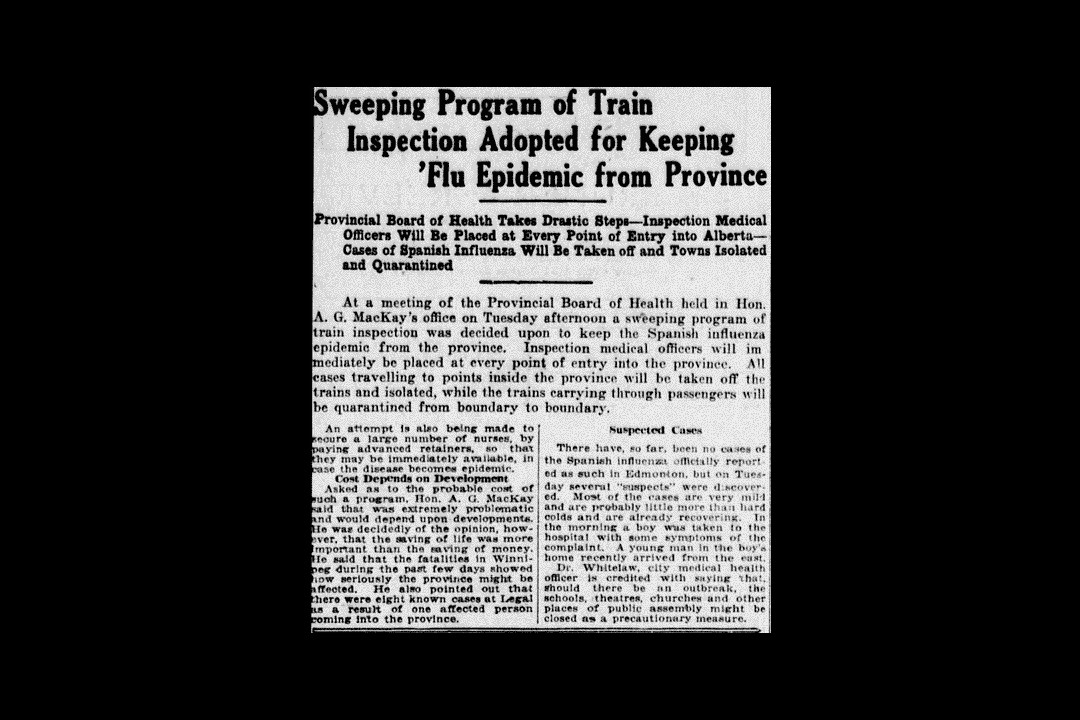
A moment in history: Oct. 16, 1918
By Scott Lilwall
On this day in 1918, the province was proposing a strict program of inspections to try to keep the Spanish flu away.
The influenza pandemic had started in the spring of 1918. Despite its name, it didn't originate in Spain; it may have begun in Kansas before spreading worldwide. At first, the disease was relatively mild, but by the fall of 1918, the world was facing a second, deadlier wave, and tensions ran high.
That prompted Alberta's health leaders to suggest plans such as train inspections, where medical professionals would cover every entry point in the province and quarantine potentially sick passengers. By early October, the flu was spreading through southern Alberta, but there were no confirmed Spanish flu cases in Edmonton at the time when the above-mentioned article was written.

That would change rapidly. By Oct. 19, there were 41 reported cases in the city, followed by many more. That fall saw soldiers returning from the battlefields of Europe, some bringing the disease with them. The First World War also meant the city was short on doctors, many of whom were still overseas. Students, both at schools and the University of Alberta, were also coming back to classrooms. This created ideal conditions for the virus to multiply and spread.
By late October, the city had closed down schools, churches, and theatres. The province mandated that masks be worn on public transit a few days later. By Oct. 26, masks were required for anyone going outside.
The University of Alberta cancelled classes, although research into the flu and potential treatments would continue. The University's Pembina Hall was turned into an emergency influenza hospital, housing sick students. Due to the shortage of doctors and nurses in the city, much of their care fell on university support staff and faculty. Among those working in Pembina Hall was William Muir Edwards, founder of the U of A's engineering faculty. While caring for students in Pembina Hall, Edwards contracted the flu himself, and would die on Nov. 14 — his 39th birthday. A century after his death, Edmonton declared Nov. 14 as William Muir Edwards Day in his honour.
Edwards was one of hundreds of Edmontonians to die of the Spanish flu. The fall of 1918 was the deadliest wave, with 445 in the city dying. While subsequent waves would be more forgiving, the death toll still rose to 614. Still others would die of complications, sometimes years later. This included Alexander G. MacKay, Alberta's first Minister of Health, who helped lead much of the provincial flu response. He succumbed in 1920. All told, the death toll in Alberta was more than 4,300 people.
Much of the response, and the fear, around the Spanish flu pandemic in Edmonton was echoed more than a century later during COVID-19, with school closures and mask mandates returning. One tool not available in 1918 was a flu vaccine, which wouldn't come until decades later. The province has opened bookings for flu and COVID vaccines, and has directed pharmacies to start administering flu shots earlier than originally scheduled, due to a flu season that is hitting earlier and harder than expected.
This clipping was found on Vintage Edmonton, a daily look at Edmonton's history from armchair archivist Rev Recluse of Vintage Edmonton.
Share