
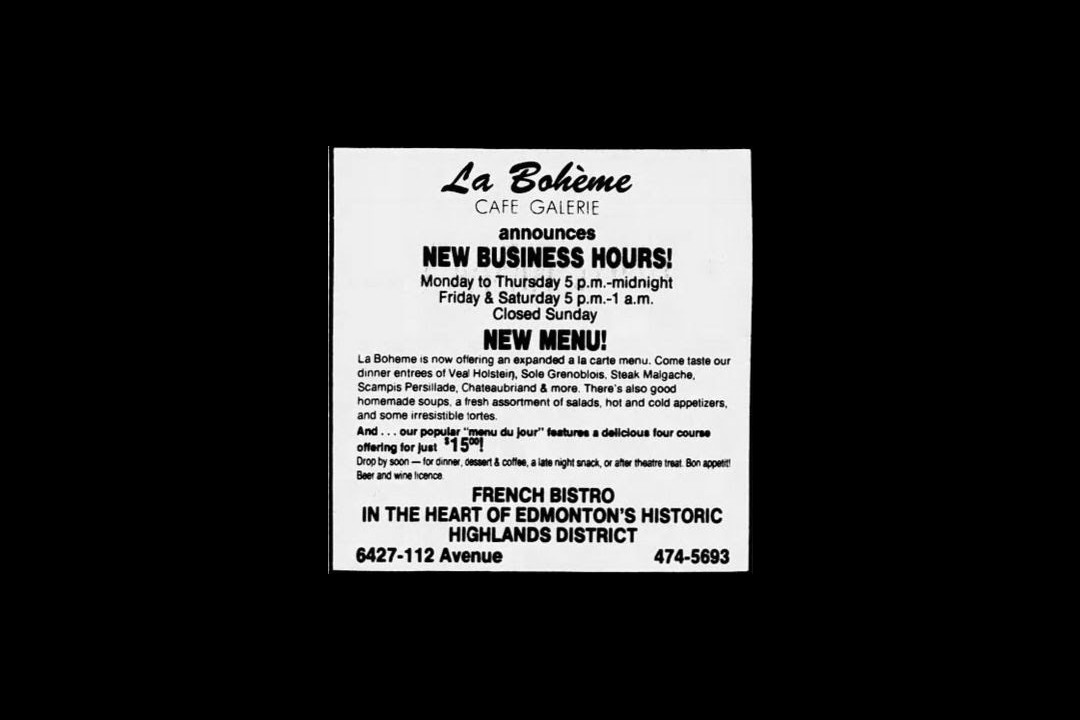
A moment in history: Nov. 27, 1982
By Scott Lilwall
On this day in 1982, La Bohème in the Gibbard Block was advertising its new menu.
Edmonton's population was booming right before the First World War. And all those new arrivals needed somewhere to live. A lot of development businesses sprang up around this time, looking to profit from the lucrative housing boom, including the Magrath-Holgate Company, started by William J. Magrath and Bidwell Holgate. While the company had an interest in a number of developments around Edmonton, much of their focus was on creating a premier riverside residential community east of Edmonton, called the Highlands.
One of the anchors of this plan was the Gibbard Block, which began construction in 1912 (the same year that Edmonton annexed Highlands). Originally, the plan was to design Highlands solely as a high-end residential area, although this plan was changed to include some ground-floor retail in the Gibbard to take advantage of the area's connection to the city streetcar system. Designed by architect Ernest W. Morehouse — who also designed mansions for both Holgate and Magrath around the same time — the three-storey brick building in the Edwardian style held about a dozen multi-room apartments. In keeping with the plan for a prestigious enclave on the edge of the city, the stores and apartments of the Gibbard featured the latest in luxuries: electricity, hot water, and telephones among them.
The building got its name from one of its investors, an Ontario businessman named William Gibbard. Despite having a building and nearby street named after him, it seems that Gibbard never actually lived in Edmonton, although he did visit family in the city.
The Gibbard Block was finished in 1913. But Magrath and Holgate's grand plans for the rest of the neighbourhood would start collapsing that year, as a global recession froze Edmonton's heated housing boom. Much of the construction planned for Highlands stalled and eventually disappeared, while current residents struggled financially. The ground floor of the Gibbard Block, which hosted several different groceries and other businesses over those years, served as an important economic centre for the neighbourhood. But the building was an expensive asset. It was foreclosed on in 1926 and ended up in the hands of Queen's University in Kingston, until it was sold in the 1940s.
By the 1970s, the building at 6427 112 Avenue NW had lost much of its lustre, having been turned into an inexpensive boarding house. So, it was a very odd choice for businessman Ernest Enders to pick as the home for a traditional French restaurant and B&B. But Ender had fallen in love with the rundown but still beautiful brick building. In 1979, he started La Bohème and sank around $800,000 into restoring the building.
La Bohème operated for almost 40 years under Enders and later owners, becoming a well-known Edmonton destination. The building was designated as a historical resource in 2017. The restaurant and B&B closed a year later. By this time, Highlands had grown, and the area's future was more secure. The building was sold to a development company, which partnered with the city on a $4-million project to restore and modernize the building.
The Gibbard Block is still one of the best-known landmarks in Highlands, housing a restaurant, retail, rental suites, and a coworking space. The building has helped contribute to the overall rhythm of the community, which Airbnb recently named as a trending neighbourhood in Canada.
This clipping was found on Vintage Edmonton, a daily look at Edmonton's history from armchair archivist Rev Recluse of Vintage Edmonton.
Share