As Edmonton hits its matcha moment, experts think the trend may cool
By Sharon Yeo
Matcha's popularity in Edmonton is growing, with at least four pop-ups devoted to the beverage over the summer, and significant social-media attention driving the buzz. But one local tea flavourist said the hype may not be sustainable.
"It looks very trendy online, and eventually everyone has to try it and decide whether it will continue to be a part of their day or not," Sarah Proudlock, owner of tea wholesaler The Tea Girl, said. "This is the top of the bubble, but it will level off."
Matcha is a finely-ground powder made from shade-grown green tea. It was introduced to Japan in the 12th century, and that country produces most of the matcha consumed worldwide today. Matcha is prepared by whisking the powder with water. The ubiquitous matcha latte is made by adding milk and optional flavouring or sweeteners.
This summer, Edmonton saw no less than four matcha-focused pop-ups, including Meet Your Matcha, The Girly Pop Café, Never the Same Company, and Whisked (which just transitioned from a pop-up to being available daily at Kommune Snack Bar). Many other local cafés have added matcha-based drinks to their menus, something Proudlock has found is tied to seasons.
"The whole trend is driven by the summer," Proudlock said. "If you had asked me 10 years ago, I would have thought matcha would be considered a winter drink. I would have never expected it to be driven by strawberry matchas. But it is very visual, bright green and red and white. One of my cafés said that some days, they sell more matcha than coffee."
Proudlock has seen the appetite for matcha grow exponentially over the last several years. "No one can ever predict booms," Proudlock said, noting that matcha was once a small part of her work but is now much larger. "Twenty-eight of the cafés I supply to now serve matcha, many of them in small town Alberta."
The Tea Girl supplies matcha to several Edmonton cafés, including Rogue Wave Coffee, Labo Coffee, and Felice Café, plus The Nest with locations in Lamont, St. Paul, and Vegreville, and CAFN8 in Bonnyville. Proudlock said her wholesale quantities have doubled every year since 2020, and that by August, she had already sold more matcha in 2025 than in all of 2024.
Proudlock said the eye-catching appeal of matcha helped it spread on social media, especially during the COVID-19 pandemic when people were glued to their screens. She credits Edmonton's strong café culture for matcha's propagation locally.
"Per capita, we have a lot of cafés for our population," Proudlock said, who ran her own café from 2010 to 2018. "Then people started to ask for matcha. Coffee shops used to have a chai latte, London fog, and now, it's a matcha latte."
At Boa and Hare in Chinatown, Kelly Yu has seen that demand firsthand. Matcha-based drinks (including the café's most popular, a strawberry matcha latte) make up almost two-thirds of its sales. Yu believes attention to process, water temperature, and recipes sets Boa and Hare apart from others.
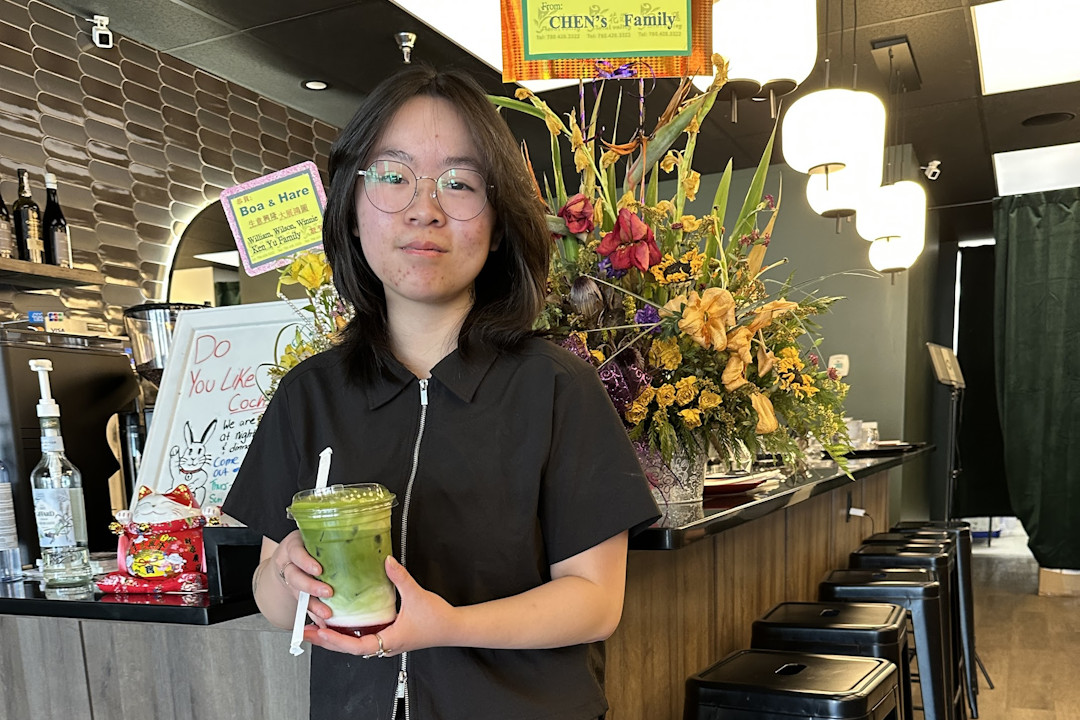
Kelly Yu is the resident matcha expert at Boa and Hare. (Sharon Yeo)
"A while back, our team went to different cafés to try different matchas," Yu said. "I was seeing places that were not whisking the matcha correctly, not using the correct equipment, not taking care of the equipment. Our matcha lattes are measured by grams. Other cafés made the drinks too sweet, which takes out the grassy earthiness. We are matcha-forward."
Yu said it is also important not to mislead customers about the type of matcha being used. Boa and Hare sources its matcha from Tea Monde, a Calgary-based supplier with close ties to farmers in Japan's Kagoshima region.
"I like to describe my matcha as second harvest matcha," Yu said. "First harvest is perfect, leaves with the best-looking outward appearance (before they are milled). Second harvest is taking more imperfections."
Yu said many cafés are trying to exploit the trend and the general public's lack of knowledge by misusing terms such as "ceremonial grade" in order to imply a level of quality that may not be accurate. "People will capitalize on it and people think that it will be better," Yu said. "It is good to try new things but not let yourself fall for marketing."
Proudlock echoes that sentiment, and acknowledges that while one of the two types of matcha she sells is labelled "ceremonial", it is used "tongue in cheek, with it being a way for Western North Americans to understand it."
For Proudlock, it is key that the matcha used is appropriate for the end product. "Get the right tea for the right application," she said. "For example, when you mix high-grade matcha with milk you lose the flavour. You want it to be bright and green and blended for that but you want it to be more bitter so it will cut through the flavour of milk."
At Boa and Hare, Yu's love of matcha is partly due to its role as a vehicle for creativity, as the café encourages her to experiment. To commemorate the Filipino Sari Sari Mercado that took place in Chinatown on Aug. 31, she created an ube sapin-sapin matcha with ube syrup and salted coconut foam. Boa and Hare offers a weekly matcha drink special to entice return visits.
Yu is considering ways to better share her knowledge of matcha. As a result, she will lead monthly matcha classes starting in September. The one-hour session will teach participants how to make matcha at home, including syrups, and all attendees will take home a matcha kit with powder and syrups. Dates and more information will be shared on Boa and Hare's Instagram page.
Yu believes customers will continue to patronize cafés like Boa and Hare because they specialize in matcha. "Edmonton is late to trends, and there are many business owners trying to capitalize on it right now," Yu said. "I think cafés that focus on matcha will last, but for those just adding it to the menu because it is trendy, no."
Proudlock, who has been enjoying matcha herself for more than 20 years, looks forward to the hunger for matcha stabilizing. "It's an amazing product, but it would be good for people to slow down a bit," Proudlock said. "Like everything, we need to stop overconsuming it."
Share