
Raymond Biesinger writes a book to help artists fight back against thieves
Edmonton-born illustrator Raymond Biesinger has captured the creative ways he fought back against intellectual property theft in his new book, 9 Times My Work Has Been Ripped Off.
"Part of why so many of these rip-offs are so emotional is because when someone tries to not pay me for something that I made, or to take an image that I made, there is a big chunk of me in that thing," Biesinger told Taproot from his home in Montreal.
Biesinger's book tells nine tales about people taking his work without permission, refusing to pay a commission, violating a usage rights agreement, or just plain copying it. (It's also "covertly a memoir," he wrote.) It also details how difficult and expensive it is to seek recourse as an artist living off work sold on commission. For example, going to small claims court is tricky and time-consuming, and hiring a collection agent often costs more than the commission fee. Plus, the system just doesn't care, Biesinger said.
"In writing this book, when I was really deep into it, I had such a crisis of faith — well, loss of faith — in the legal system," he said. "(If) someone comes up to me on the street and steals $50 out of my hand, that's illegal. The police will act on that if they're anywhere around. But if someone takes an image of mine that's worth $1,000 and gets that amount of usage (out) of it, there's no (realistic) mechanism for dealing with that kind of injustice."
Biesinger is an artist who has worked with international clients like The New Yorker and Toyota for commission work, but today mostly makes his living selling prints of self-driven work, like his popular Paper Cities series. Some Edmontonians may know him best as the founder of the Royal Bison Art and Craft Fair, which has now passed over to its spiritual successor in OddBird Art & Craft Fair. This book is his second, after a collaboration with The Globe and Mail's Alex Bozikovic on 305 Lost Buildings of Canada, but 9 Times is the first book he has made all on his own.
In the book, Biesinger writes about how he circumvented traditional ways to get paid. The first story is about when he was a University of Alberta student who was earning modest commission fees for work published in magazines, newspapers, and gig posters. In 2005, Biesinger illustrated a cover for the now-defunct Vue Weekly for an article about the metal band Megadeth's Edmonton show. An Ontario concert promoter saw this, asked for a similar version, and promised to pay Biesinger $50 for the work. The promoter then made excuses and tried to ghost Biesinger.
Biesinger threatened to hire a collection agent, with no intention of following through on the threat, and eventually got paid. "Today, that's not a lot of money to me, and probably not a significant amount to you," Biesinger wrote in the first chapter of the book. "But at the time $50 was the difference between me paying rent on time and not being able to. It was needed money — the most desirable kind."
The stakes get higher as Biesinger's career takes off, and he later goes to bat against a government agency and a well-funded non-profit. The interaction is when the seed for 9 Times was sown. Biesinger never names the non-profit, nor any other party he writes about a dispute with. That's not the point of the book, he said.
"It's been important to me to, instead of this book being a name-and-shame (effort), that there are educational lessons to be had," Biesinger said. "The book is more about human-to-business interaction and how to deal from a not-that-strong position and using unorthodox tactics to fix it."
Biesinger even examines his own role in image rights. For example, he used an original photo of a human skull in the aforementioned Vue Weekly cover. Legally, he has the rights to use the photo, but he wonders what the deceased might think about their internal likeness promoting a Megadeth concert.
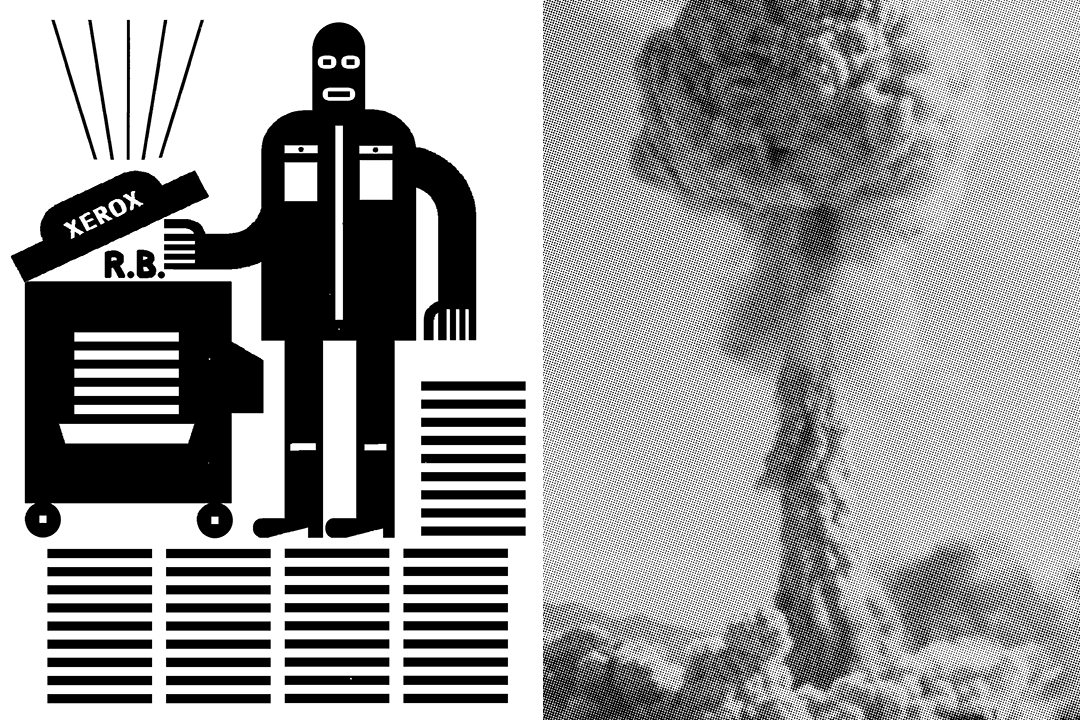
Raymond Biesinger's new book 9 Times My Work Has Been Ripped Off explores being ripped off. These two images are included in the book, and the one on the right is part of the public domain — a sometimes murky copyright status. (Raymond Biesinger/United States Library of Congress.)
How artists can fight back against AI thieving
The conversation about the spectre of artificial intelligence stealing jobs from artists and stealing their work regularly stirs up controversy, because generative AI models are trained on existing words and images generated by human beings. In the book, Biesinger briefly touches on AI's threat to artists, directing readers to critics like Moiya McTier of the Human Artistry Campaign and Cory Doctorow, the author of Enshittification.
In September, Biesinger taught a workshop in Toronto for artists on how to defend themselves against AI. In the lead up to the workshop, he told Taproot he is mulling the idea for a 9 Times sequel focused on AI.
One piece of advice he has for artists is to find a way to make something that's never been made before. For example, Biesinger is working on a project that uses photographs of pennies he's collected using his metal detector. Pennies buried underground are unique in appearance to the visual source material AI has become good at copying, he said.
"The subject matter (AI) is fluent in is the stuff that the internet has a lot of — and the internet does not equal the real world," he said. "What can you find in the real world to base what you're working on, have credibility with, and be the first to bring it into publication? AI is not going to be able to fake that kind of thing."
The book 9 Times My Work Has Been Ripped Off is out now on Drawn & Quarterly, and available at retailers such as Audreys Books, Magpie Books, and Porchlight Books.
Share