
Alberta Municipalities wants province to rethink property tax
Alberta Municipalities wants the provincial government to fund more infrastructure in its 2026 budget before municipalities must make "critical" changes due to a nosedive in support over the last 15 years.
"(Alberta's) government is well aware of our ask for increased infrastructure funding, in particular, but it hasn't translated into action in terms of a lift in that funding," Dana Mackie, the CEO of ABmunis, told Taproot. "This isn't just an ask for the sake of asking, there really is a demonstrated need, and there's been a history of decision-making through several administrations now, at the provincial level, that has put municipalities into a point where they're really starting to make some very difficult decisions … It is at a critical juncture."
Rising property tax rates in Alberta are the result of reduced funding transfers from the province, as well as inflation, new municipal responsibilities, and a rising provincial property tax that municipalities must collect, ABmunis says in Property Taxes Reimagined: Fair Funding for Strong Communities, an information campaign that launched in early October. The organization notes that municipalities received an average of $635 per resident in 2009, and that number fell to $327 by 2023, after adjusting for inflation.
Municipalities also rely on funding transfers from the provincial and federal levels of government, like those allotted from the province via the Local Government Fiscal Framework, which replaced the Municipal Sustainability Initiative in 2023. The change from the initiative to the framework pleased Mackie at first, but hasn't yet yielded the results ABmunis was hoping for.
"The overall amount was reduced through that process by hundreds of millions," Mackie said. "We've had a significant gap of infrastructure funding, and as I think many Albertans understand, this is coming at a time when we're having record amounts of people coming into our province from elsewhere in Canada, or even from outside of Canada. We really need to keep up with that growth, and at the same time, we have existing infrastructure that we need to maintain. It's just not tenable right now with current funding levels."
Municipalities derive most of their revenue from property taxes, with a smaller portion coming from user fees, the property tax campaign notes. Unlike the federal or provincial governments, municipalities are not allowed to create new taxes, approve a budget with a deficit, or borrow beyond their means. When municipalities don't have enough money to break even, they raise property taxes or cut spending on infrastructure and services. Cuts might mean deferring maintenance on roads, buildings, and underground pipes, or even delaying and changing major projects, Mackie said.
Another thing municipalities want more money from, he said, is Family and Community Support Services, a preventative social services program that offers an 80-20 funding partnership between the province and municipalities or Métis settlements. "It's very critical," Mackie said. "That program hasn't seen an adjustment for inflation or population growth in well over 10 years. It's at about $105 million today, and it really should be about $162 million."
The province feels municipalities already receive substantial support, indicates a statement from the office of Dan Williams, the minister of municipal affairs. "Municipalities set their own property tax rates through their annual budgets, and they collect those revenues directly to fund local services and infrastructure," Williams's office said.
Premier Danielle Smith asked Williams to work towards keeping property taxes manageable in a mandate letter released on Sept. 22. Further, Williams noted that the province will invest $2.5 billion in municipalities via the Local Government Fiscal Framework over the next three years, and that Alberta's government renegotiated the federal Canada Community-Building Fund to invest $276 million in infrastructure.
Mackie said ABmunis factored those investments into the property tax campaign, adding that the opening of the legislature this fall has provided some hope for the budget expected in February. "I did see some promising language in the Throne Speech around a focus on infrastructure funding," he said. "The language and the focus is good, but I think what our members need to see is an actual lift when we get to Budget 2026."
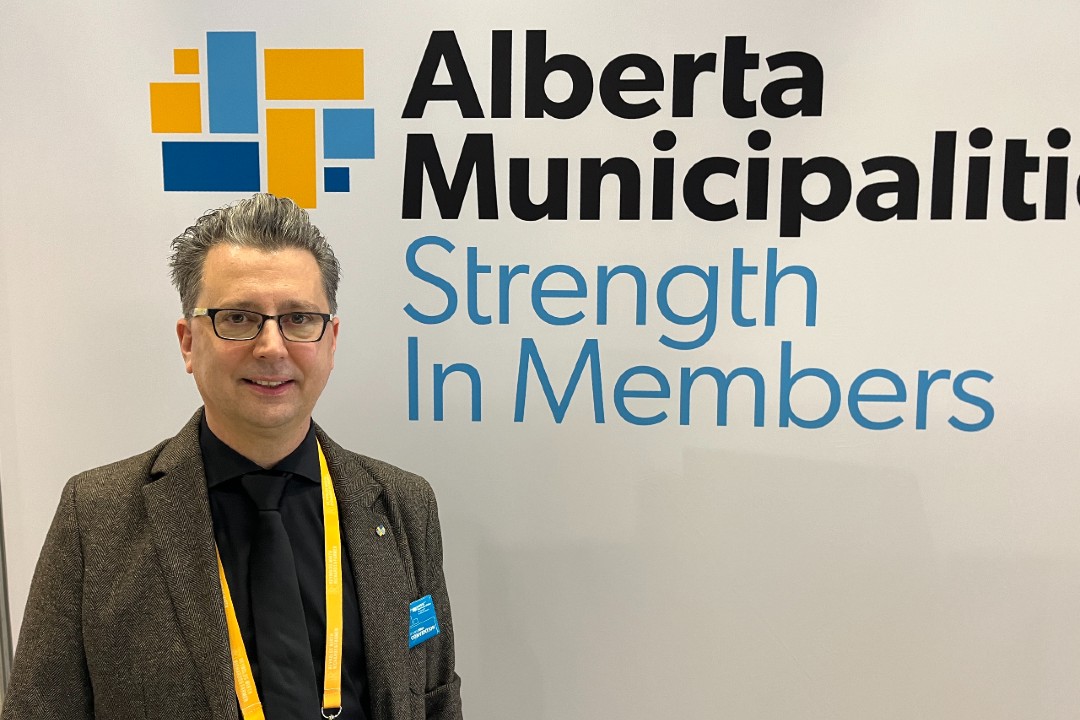
Alberta Municipalities CEO Dana Mackie at the organization's convention and trade show on Nov. 12. (Supplied)
Should the province collect its own property tax?
Another irritant for ABmunis is that municipalities have to collect the provincial education property tax, the size of which is beyond their control.
For example, Edmonton's city council approved a rate increase of 5.7% in 2025. But the city also had to collect the education property tax, making tax bills even higher. On average in Alberta, 13.5% of household spending is on federal income taxes, 6.5% is on provincial income taxes, 0.4% is on provincial property taxes, and 1.4% is on municipal property taxes, ABmunis says.
Those provincial property taxes are on the rise as well, growing from $2.7 billion for 2024-2025 to $3.1 billion for 2025-2026, amid ongoing pressures to increase the education budget.
At the ABmunis convention in Calgary this week, the Town of Rocky Mountain House has moved a resolution asking ABmunis to advocate for removing the provincial property tax from the municipal tax bill. ABmunis commented on the resolution that it aligns with its "ongoing advocacy to improve municipal government finances and transparency in education the public about what services and taxes are a municipal responsibility."
Can feds fill the gap?
Looking beyond the province, Mackie also pointed to promises by the federal government to fund infrastructure in its latest budget. Among them are the Build Communities Strong Fund for $51 billion over 10 years, rolling out in the 2026-2027 spending cycle. (The provincial-territorial stream of the fund makes up $17.2 billion of the $51 billion.)
While the Provincial Priorities Act, passed by the United Conservative Party government in 2024, mandates that municipalities seek permission from the province to receive large amounts from the federal government, Mackie said he hopes Alberta's municipalities will be able to capitalize on the new Liberal budget.
"We'd like to work closely with the province to make sure that our communities are getting our fair share of that federal funding going forward," he said. "That is an increase of funding we're looking forward to."
The Edmonton angle
Mayor Andrew Knack, who has served on the ABmunis board, has said the City of Edmonton must fund what other levels of government will not, regardless of whose jurisdiction it is. The mayor followed through on this with a successful Nov. 3 motion to spend $1 million to expand day shelter capacity.
"That isn't something the city has typically taken the lead on, and yet, this council just unanimously said we want to be involved in this," Knack said on the Speaking Municipally podcast. "I will continue to take a leadership role while I continue to try to find those collaborative opportunities. I'm not giving up on the provincial government."
Share