
As Crimson Herring releases second game, founder calls for provincial tax credit
On the heels of its recent acquisition by a Calgary-based game company, and amidst an increasingly tough funding environment for game development, Crimson Herring Studios is releasing its second PC game in as many years.
The studio, founded in 2020, released Hunter's Moon: A Sovereign Syndicate Adventure on Nov. 24, not long after Calgary's Zugalu Entertainment acquired Crimson Herring for an undisclosed sum, and made the studio's founder, Isaac Otway, Zugalu's chief operating officer.
The acquisition was not in Crimson Herring's original plan, Otway told Taproot, but evolved from challenges during the COVID-19 pandemic, changing investor habits, and increasingly elusive public dollars and missing tax credits for game development.
"There was a lot more funding sloshing around with the low interest rates during COVID," Otway said. "When you take other forms of entertainment off the table (like film and television), it sort of funnelled everybody into the entertainment types that were remaining, like video games."
Hunter's Moon is a prequel to Crimson Herring's first game, Sovereign Syndicate, and saw more than 25,000 Steam (which is basically the Amazon of PC games) users add it to their purchase wish list.
The game will be published in 14 languages, and that's intentional, Otway said. "A part of our business is that the majority of our sales happen all over the world, in currencies and locations that aren't in Canada," he said, adding that video games are tariff-proof when sold as a digital product as opposed to a physical medium.
Sovereign Syndicate, Crimson Herring's first game, is set in a fantasy, steampunk version of Victorian-era London, and has virtually no combat and is largely based in narrative. Hunter's Moon, meanwhile, is a prequel that has more combat and uses a more run-based model, which emphasizes the ability to replay over a narrative beginning, middle, and end. The new game cost $350,000 to make, as compared to Sovereign Syndicate, which cost about $2 million and has since sold more than 40,000 digital copies across more than 100 countries. (Crimson Herring and Zugalu employ a cumulative 12 full-time staff, while about 84 people worked on the new game.)
But Otway said that despite the lower cost, it has been more difficult to fund Hunter's Moon's creation. In addition to tighter purse strings from investors, competition has grown for public subsidies like the Canada Media Fund, he said.
"When we applied and got funded for Sovereign Syndicate, we were applying against somewhere between … 70 and 90 other studios, of which they would fund about 12," Otway said. "In the last intake that we applied for, where we weren't successful in getting funded, there were 162 applicants, but they were still only funding 12. You could say it's now twice as competitive as it used to be to get the same amount of money from Canada Media Fund."
Otway founded Crimson Herring in 2020, when the film and television industry screeched to a halt during the COVID-19 pandemic. Investment in video games, which are easier to make than many other forms of entertainment when people are remote, surged during lock downs but quickly contracted once Hollywood returned to making movies. The short-lived boom, and support from Edmonton Screen and other public money, saw Crimson Herring release Sovereign Syndicate at the start of 2024.
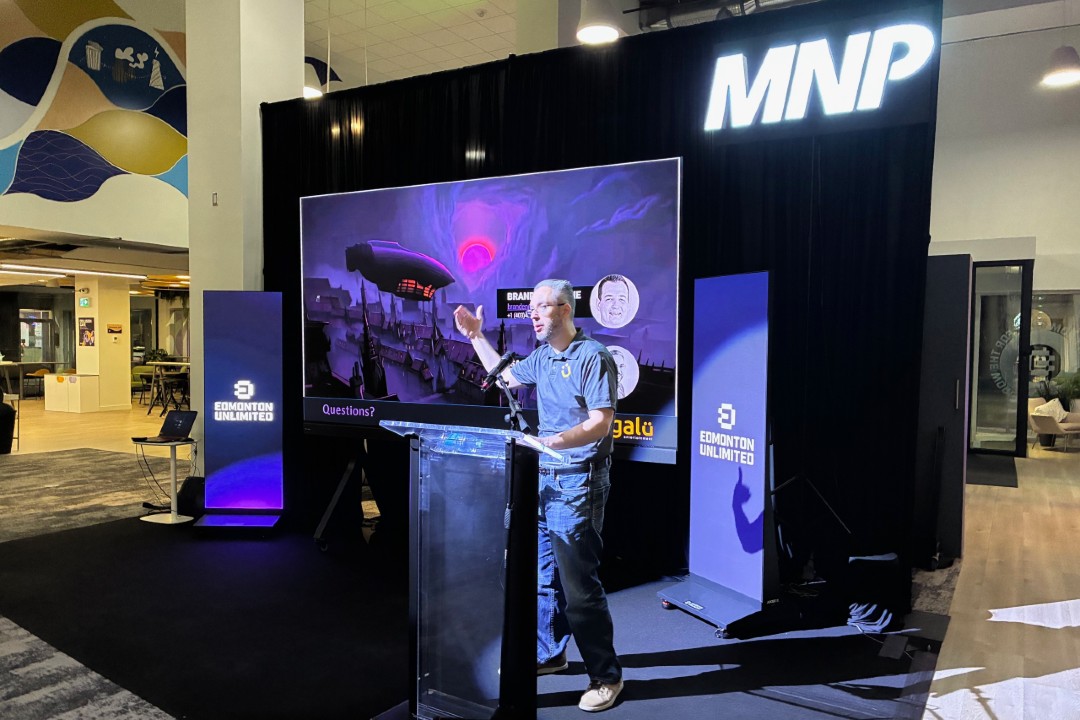
Crimson Herring Studios founder and Zugalu Entertainment chief operating officer Isaac Otway at a launch event for Hunter's Moon: A Sovereign Syndicate Adventure, at Edmonton Unlimited on Nov. 20. (Colin Gallant)
Otway said the Canada Media Fund disproportionately funds film and television compared to interactive digital media (or IDM, for short) — and that provincial incentives in Alberta follow suit. For example, Alberta has a tax credit for film and TV production, but no equivalent for IDM, he said. The former provincial NDP government created such a credit in 2018, but Jason Kenney's UCP government removed it in 2019. In 2022, Premier Danielle Smith asked Technology and Innovation Minister Nate Glubish to explore a new IDM tax credit. Glubish's office has since said Alberta's government has abandoned the tax credit in 2024.
The lack of a tax credit is frustrating, Otway said. "There were a ton of media articles about how great it was to get the The Last of Us TV series in Alberta, but the TV series is based on (an estimated US$200 million budget) video game from Sony that was made down in the United States. So, everybody wants the film and television, but nobody wants the game that it was based on?"
One positive sign for IDM's recognition is that Sovereign Syndicate won the first-ever Rosie Award for Best Narrative Game from the Alberta Media Producers Industry Association in October.
"It was great to be recognized, and it's great to win something like that, but I'm in a room where there's maybe 10 or 12 people from the games industry, and there's hundreds of people from the film and television industry," Otway said. "That shows you the power of having a tax credit … We're not asking for special treatment. We just want the same treatment as the rest of screen media gets."
Acquisitions and jobs
Acquisitions sometimes lead to job losses. Inflexion Games, which was acquired by Tencent in 2022 for an undisclosed sum, laid off at least 66 employees in October 2024. In December, Inflexion COO Scott Nye told Taproot that unmet sales goals for the game Nightingale, and the ongoing absence of a tax credit in Alberta, influenced the layoffs.
BioWare's owner, Electronic Arts, is set for a $55 billion acquisition from a consortium of investors that include a private equity firm run by Jared Kushner, the son-in-law of United States President Donald Trump, and Saudi Arabia's sovereign wealth fund. There has been no word yet on what this will mean for jobs in Edmonton.
Otway said Zugalu's acquisition of Crimson Herring has, on the other hand, been positive on this front, as the company makes its own games while simultaneously offering marketing and publishing expertise for Crimson Herring. Plus, he has a seat at both tables as Zugalu's chief operating officer. "Our team can achieve so much more together," Otway said in a release when the deal was announced in April. "I look forward to helping shape (Zugalu's) future and working alongside this talented team to deliver unforgettable gaming experiences."
Share