ETS 'eager to learn' when it comes to accessibility
Accessibility on transit is improving for Edmontonians who are blind and partially sighted, but there's still work to be done, says an advocate with CNIB.
"If you are blind or low-vision, you don't get to drive," said Taylor Bauer, the program lead for awareness and community outreach in CNIB's Edmonton office. "We rely on transportation to live normal lives because we live normal lives."
CNIB's Get on Board campaign, an advocacy program for transit accessibility across the country, has been active in Edmonton since 2023, gathering insights from the community and conveying information to ETS about barriers.
"Everybody has different needs and each transit ecosystem is a little bit different," Bauer told Taproot. "I really appreciate how ETS is very eager to learn, willing to learn. They wanted to be a part of it."
The Get on Board program took ETS management and CNIB members with varying levels of sight loss on a ride-along encompassing an entire trip from someone's front door to their destination. "We did the whole transit experience," Bauer said.
Following the ride-along and a secret rider survey, CNIB and ETS hosted a town hall to share the findings.
"From there, I provided recommendations for change," Bauer said, noting that ETS branch manager Carrie Hotton-MacDonald had her own suggestions. "(She) raised her hand and came up with a whole list, that was much longer, of all these awesome things that they want to start working on to make transit more accessible."
In a recent interview with Taproot, Hotton-MacDonald mentioned making a slight change to how buses display their route numbers based on feedback from CNIB. Now, on the side panel on a bus, the message just displays the bus route number and the destination, rather than scrolling through messages such as "Parking Ban In Effect" or "Let's Go Oilers" as the front display does. This makes it easier for low-vision riders to know if they're getting on the right bus.
"That's personally really important to me, just knowing that we were listening directly to riders," Hotton-MacDonald said regarding the CNIB consultation. She added that as older buses are replaced, it will be possible to have higher-contrast destination signs.
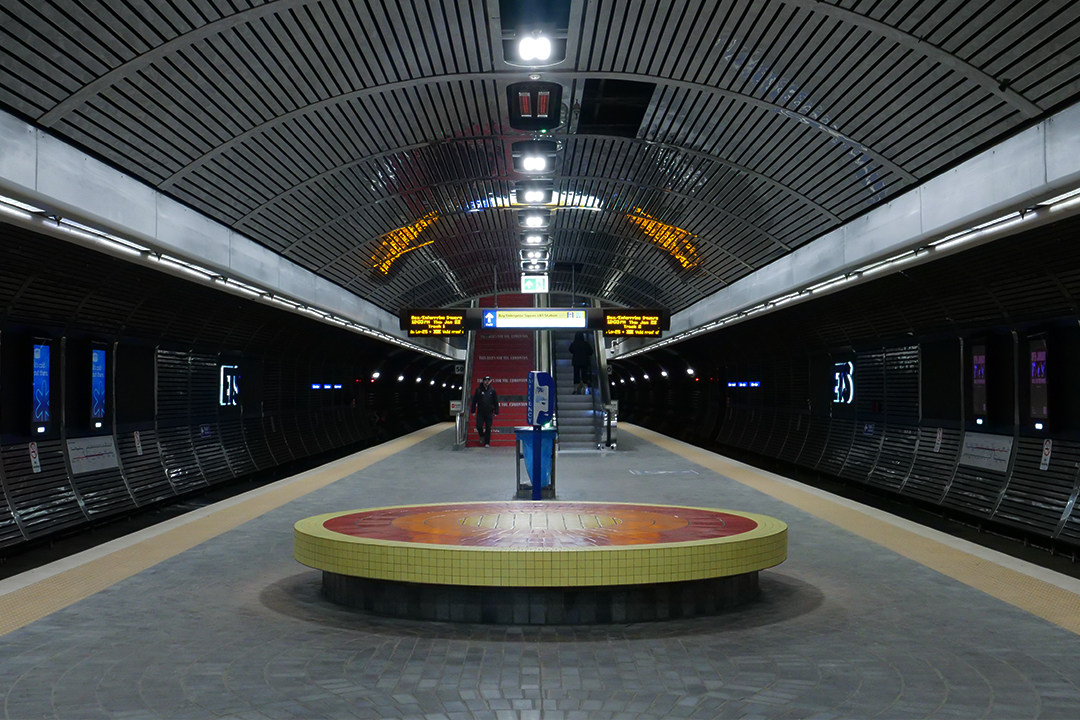
Bright yellow tiles were added to the edges of the round benches at the Bay/Enterprise Square LRT station to make it easier for riders with low vision to perceive them. (Sara Sheydwasser)
Bauer noted some other changes that have emerged from the collaboration:
- LRT announcements: As a train arrives at a station, there is now an announcement stating the line and the direction. As is the case for many accessibility measures, this helps more than just those with sight loss. "If I don't know the city, I just know I need to go south, I know to get on the right train, because that's headed south," Bauer said. "I can use that information to navigate the space a little better to get out of — especially — our underground stations."
- Operator training: "There's still room for improvement, but I think some changes have happened in allowing for some more understanding … so riders can be better supported," Bauer said. Drivers need to know, for example, that riders showing a CNIB transit card are eligible for free or discounted transit. And they need to appreciate what that card means. One survey respondent described showing the driver their CNIB card and asking which bus they were on. "The bus driver pointed and said, 'Go look at the sign.'"
- High-contrast colouring: ETS has increased the colour contrast on benches in underground LRT stations. "These seating areas were just concrete blocks that were tiled in the same tile as the floor," Bauer said. "So it could be a hazard as well as difficult to find if you need to find a seat." ETS consulted with the CNIB and its members to choose what tiling was best for varying degrees and types of sight loss. The team landed on the outer ring of tiles you'll see in yellow at Bay/Enterprise, white-and-black at Corona, and white-and-yellow at Churchill and Central stations.
Some questioned why the re-tiling was necessary. "I know that confused folks," Hotton-MacDonald told Taproot. "It was directly based on feedback from that community saying they needed something higher contrast to actually know that there was bench seating in the stations."
Signage is the area most in need of improvement, Bauer said. It tends to be placed high and printed in low-contrast colouring. Bauer would eventually like to see signage have large, high-contrast print with uncontracted braille in easy-to-locate areas.
Continuous improvement is important because the stakes are high.
"Not having an accessible system in place leads to isolation, leads to unemployment, leads to housing issues," Bauer said. "Having access to accessible public transportation allows people with sight loss to fully be part of society."
To help make transit more accessible for Deaf and hard-of-hearing riders, the Edmonton Transit Service Advisory Board is coordinating a town hall on March 21 with the Edmonton Association of the Deaf and the City of Edmonton's Accessibility Advisory Committee.
Share