Enabling job creation should top mayor's agenda, says cities expert
When Mayor Andrew Knack delivers his first State of the City address, a key message should be what the City of Edmonton is doing to support job creation, says the head of the Cities Institute.
"Cities are labour markets, first and foremost," said Murtaza Haider, executive director of the University of Alberta-based institute focused on city-building. "If you see an urban economy growing, you see people gravitating to that place. If you see the urban economy deteriorating, people start leaving."
When the mayor addresses the Edmonton Chamber of Commerce on May 14, it may be a little early to show progress on how well Edmonton is performing at matching people with jobs and companies with workers since last fall's election. But Haider likes the lens that Knack is applying so far.
"Knack has pointed the city in the right direction by putting economic development near the top of the agenda," says a Financial Post op-ed that Haider co-authored with real estate veteran Stephen Moranis. "The test now lies with the council. Edmonton … needs a deliberate, sustained focus on becoming a city where good jobs are created, wages grow and talent sees a future."
That said, governments are enablers of economic development, not creators, Haider told Taproot.
"The job of governments is not necessarily to create jobs, but to create the enabling environment in which entrepreneurs come in and they start new businesses," he said.
A city that knows it is a labour market seeks ways to set off a snowball effect, Haider said. As jobs bring people, capital is rolled over into different industries. He added that city council should continue focusing on downtown, with development incentives to get more people living in the core being a step in the right direction.
"You need about 40,000 people to be in the downtown Edmonton area, living there and spending their evenings at restaurants and going to movies," Haider said, noting that the core's current population sits at just over 12,000. "It creates that culture, so you need to bring people in."
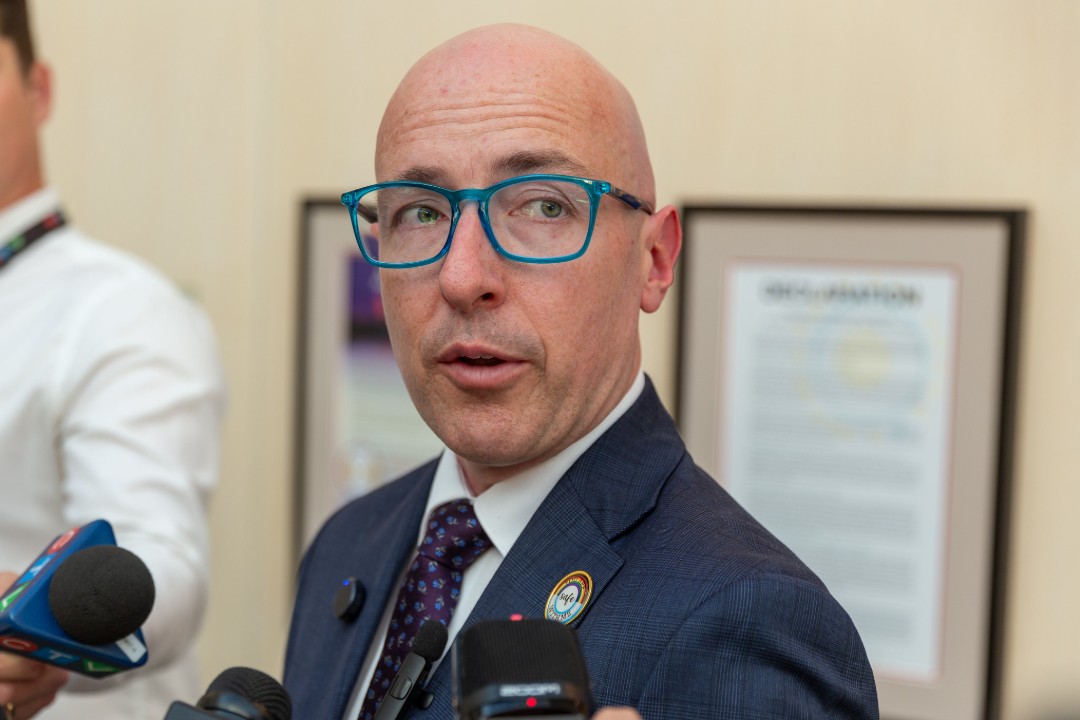
As Mayor Andrew Knack gets set to deliver his first State of the City address on May 14, his focus on economic development is a step in the right direction, says Murtaza Haider of the Cities Institute. (Mack Male/Flickr)
There are encouraging signs, but Haider acknowledged that downtown still has a long way to go. "People who walk through downtown know that we need to do better," he said, noting how many coffee shops are closed by 6pm. "We're telling people we're not open for business."
A key priority should be to do something about Edmonton City Centre, whose owner is in receivership, leaving a huge, underutilized space in the middle of the city.
"It should be the top priority of the mayor and the local MPs and everybody to see how we are going to get this property repurposed, reused, and become a star attraction rather than sitting as a liability on companies' balance sheets," Haider said. "Thinking of cities as a labour market means you look at your assets and say, if they have turned into liabilities, 'Let's put our minds together and turn this thing around.'"
But Haider says the way Edmonton is thought of and spoken about needs to change first. He compared our frigid winters to Dubai's unbearable heat, and how that city has changed the narrative "from sand to glitter" in an otherwise inhospitable desert.
"We have to change this narrative about Edmonton. It can't be cold and distant," Haider said. "If deserts could be turned into attractions, we have far better attributes than a desert."
This story is based on a larger conversation with Murtaza Haider on the May 8 edition of Taproot Exchange, a members-only livestream conversation that goes deep on issues of interest to Edmontonians. Become a Taproot member for access to future livestreams, as well as recordings and transcripts.
Share