
Artist questions CKUA's stance on AI and music
An Edmonton-based experimental artist who uses AI in his creative process is disappointed that his music is no longer welcome on CKUA's airwaves. And Canada's first public radio station finds itself trying to walk a fine line as it develops a formal AI policy.
The story of Ryan McCourt, a sculptor who also creates music under the name The Synthesist, raises a very modern question: In an age when studio-grade music can be produced through the click of a few buttons, what should be played on the radio?
In January, McCourt was overjoyed to hear his music played on Discoveries, an eclectic show hosted by Leo Cripps. "My music was the first thing played, and … I'm over the moon about that," McCourt recalled to Taproot.
In late May, McCourt made a donation to CKUA to directly support an hour of programming for Cripps's show. He provided a list of suggested songs, including two tracks from The Synthesist, created with the help of generative AI. (After this story was published, CKUA clarified that donors may not request a song that benefits themselves or a family member, due to charitable donation rules set by the Canada Revenue Agency.)
On June 2, Cripps wrote to McCourt to say CKUA's policy was to refrain from airing AI-assisted music, conceding that the station was still discussing AI's place in the world of art and music. This surprised McCourt, noting that such a policy did not appear to be publicly available, nor was there a definition of what constitutes AI-generated music. He also felt a blanket ban on music interfered with hosts' autonomy to select music for their programs.
"I have no argument with Leo because he's … got a job to keep, so he's doing what's required of him by his employers," he said. But he disagrees with CKUA's direction. "It's just giving incentive to people to not disclose that sort of thing, to not be honest about it."
On June 11, CKUA published a statement about AI-generated music. Following "conversations internally and with our community, we have made the decision to not knowingly play AI-generated music on CKUA," the statement says, noting CKUA's commitment to supporting artists and art workers. "Playing AI-generated music raises broader questions around authenticity, attribution, copyright, and the value we place on human creative expression." The statement goes on to say that CKUA is developing a formal policy that will be shared "when it is ready."
Listeners on "both fronts" of the AI debate are seeking clarity about CKUA's stance, content director Arianne Smith-Piquette told Taproot. The line between AI as a tool and AI as a replacement for the artist is one of the nuances that CKUA aims to make clear in its policy. And since the policy would affect CKUA's entire organization, including departments that use AI tools to maximize efficiency, CKUA is taking its time to get it right, she added. "I don't have an (estimated time of arrival) on it right now."
Smith-Piquette maintains that human creation must remain at the core of music at CKUA. However, defining what "human creation" means can be elusive. McCourt said he used Suno, a system that generates music from human prompts. Suno has landed Anthropic in legal trouble over the materials it was trained on and has resulted in a flood of AI-generated music on streaming services. McCourt said he also took time and care to edit and splice tunes together, using less controversial tools such as GarageBand.
"There's tons in the whole production experience that I went through that is on the cutting room floor," McCourt said. "It's not just like, 'Please make me a song,' (and) boop, a song comes out."
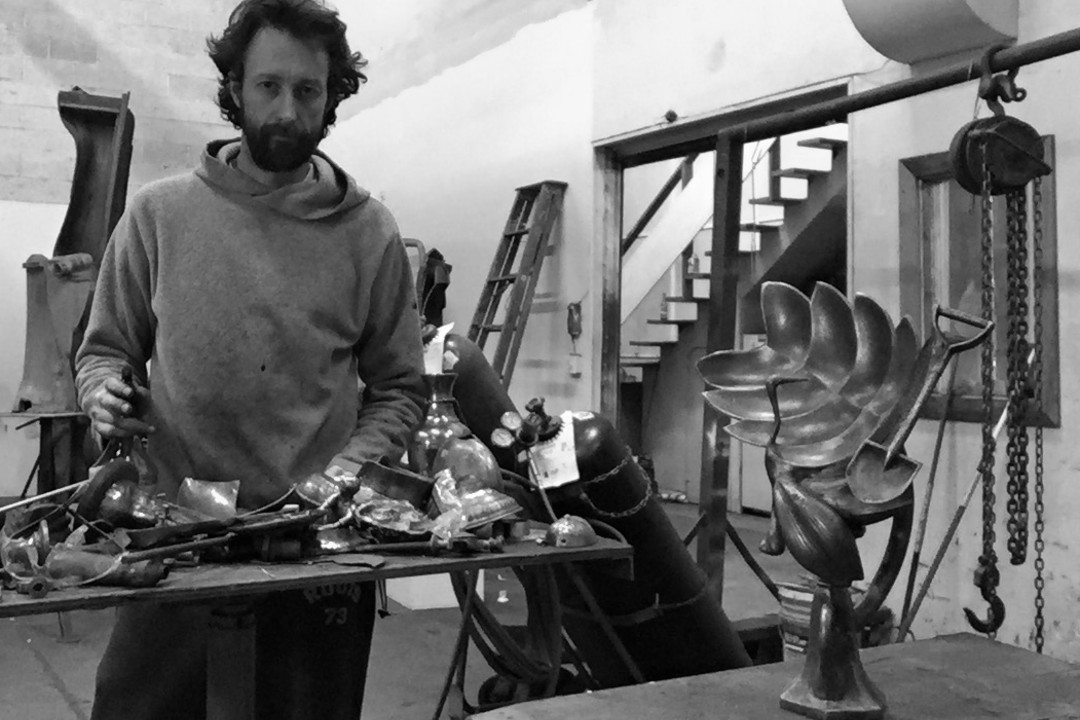
Experimental artist Ryan McCourt, who is best known for his metal sculptures, makes music under the name The Synthesist. (Ryan McCourt)
Kami Van Halst, an Edmonton musician and master's student at the University of Alberta, is researching how public arts funding should respond when AI is part of the creative process. "With AI music, it's a matter of how people are using it," she said.
Although Van Halst's research does not directly examine public broadcaster policy, her research dives into how organizations are approaching the intersection of generative AI and human authenticity.
For Van Halst, live playing is what separates inauthentic "slop" from music created with the assistance of tools that use AI. Performance is "where the connection happens," she said, and that requires human labour. "Being able to perform what you record is going to be hugely, hugely valuable," she said.
However, Van Halst acknowledged that this perspective is not shared by everyone. "Does (music) lose that magic if it's fast food? For me, it does, but for other people, it might not, and that's everybody's choice to make."
Maintaining authenticity remains central to CKUA's brand, whose mission is to highlight Canadian artists. "There needs to be some human creation … at the core of the work for us to promote it, highlight it, share those stories, share that art," said Smith-Piquette.
McCourt is no stranger to controversy. In 2007, an installation called Will and Representation angered members of Edmonton's Hindu community.
He said tools such as Suno allow him to express himself in ways he otherwise would be unable to.
"I'm an amateur, so I'm just kind of using the very basic tools that I have at hand," he said. "I don't let my amateur status hold me back."
Clarification: This story has been updated to include CKUA's policy prohibiting donors from requesting their own songs.
Correction: This story has been updated to correct the name of the show hosted by Leo Cripps and the name of Ryan McCourt's 2007 work.
Share