
Food map seeks to reveal available resources
Local and provincial organizations have banded together to create an interactive map that helps Edmontonians locate free or low-cost food and access related resources wherever they live.
Members of Food Security and Food Justice Ecosystem of Edmonton, or FSFJE for short, created the Edmonton Food Resource Map to help people navigate the city's food support system. Since its launch in June, it has been accessed more than 4,000 times.
Among the map's 250-plus resources are food banks, hamper programs, community pantries, and other sources of free food all over the city, in addition to low-cost groceries, community gardens, and cooking classes. All of the data is verified by a team led by Celia Jingyi Luo, a registered dietitian.
In particular, Luo said she hopes the map can reduce the struggle that many families face when it comes to finding food, especially culturally appropriate items. For someone who has children and relies on transit, Luo said it can be "mission impossible" to get to places such as the Multicultural Health Brokers Cooperative, where she also serves as the food justice action coordinator.
The map allows users searching for support to see what is available near where they are. Users can filter results on the map, and when they click on a specific resource, the map provides a short description of the resource, its address and neighbourhood, and the resource's webpage.
Food insecurity, which Health Canada defines as "the inability to acquire or consume an adequate diet quality or sufficient quantity of food in socially acceptable ways, or the uncertainty that one will be able to do so," affects roughly one-quarter of Albertans. In 2025, Edmonton's Food Bank reported record-breaking numbers of individuals and families needing food hampers in 2025.
"Obviously, we recognize that the food insecurity rate (has) really increased over the past few years … and we only have very limited capacity to support," Luo said. But raising awareness of what is available among those who need it is a positive step.
FSFJE also sought to include resources that reflect the diversity of people who may be in need, given the high levels of food insecurity among recent immigrants to Alberta. "We put special attention to those specialty cultural food shops and farmers' markets," said Luo.
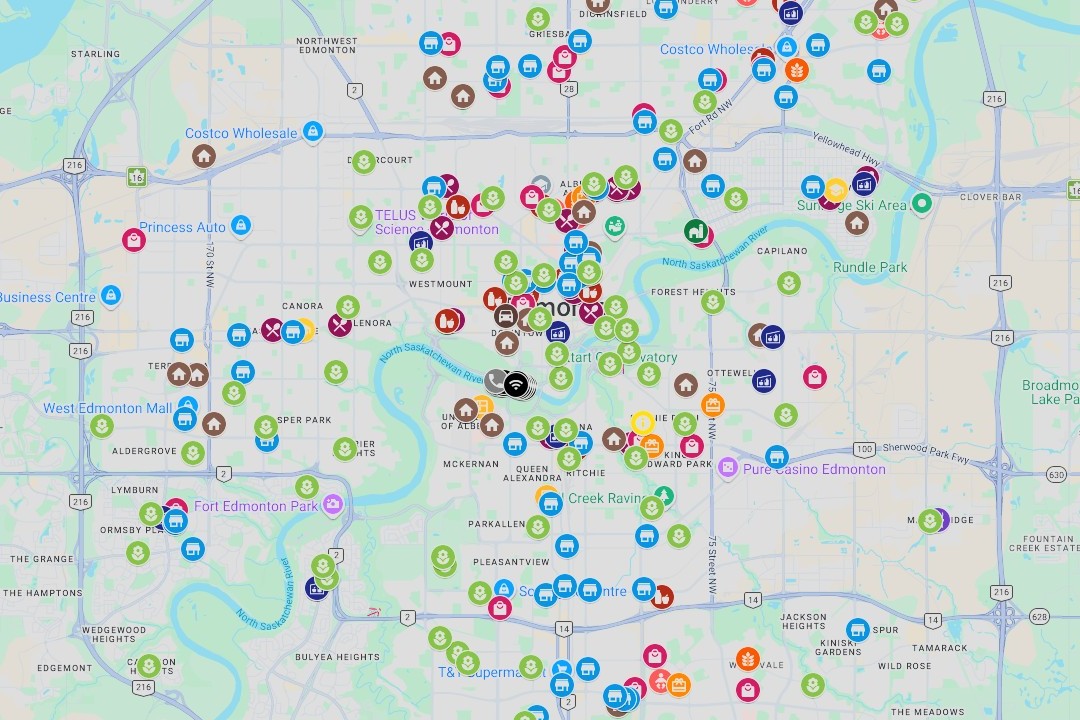
Users of the Edmonton Food Resource Map can filter which food resource they are looking for. Each marker has a corresponding definition, address, and webpage. (Food Security and Food Ecosystem of Edmonton)
The John Humphrey Centre for Peace and Human Rights received a $250,000 grant from the City of Edmonton in 2024, followed by a $50,000 grant in 2025. Such funding enabled the centre to create the FSFJE with several other organizations, and the map as one of the deliverables.
Although this is Edmonton's first online food resource map, Luo's team took inspiration from similar projects. Strathcona County developed its own Food Finder Strathcona map, which launched as a pilot in 2025. Elsewhere, Vancouver launched its Food Asset Map in 2017.
"We were very much trying to learn from other people's experience and try to build this to the best of our ability," Luo said.
FSFJE sought guidance from Simon Fraser University's Food Systems Lab, which recommended keeping things simple by using Google Maps.
Luo hopes the map continues to live through annual updates to keep its information fresh, relevant, and responsive to community feedback. A Google form is linked to the map's landing page, where suggestions, comments, or resources can be shared with the working group for future updates.
"As a working group, we're still trying to really build a solid scaffolding for the sustainability mindset to have more institution support for the maintenance of the map, and we also need the wider community to collaborate with us in the future … so we can build a stronger map together," she said.
Share