
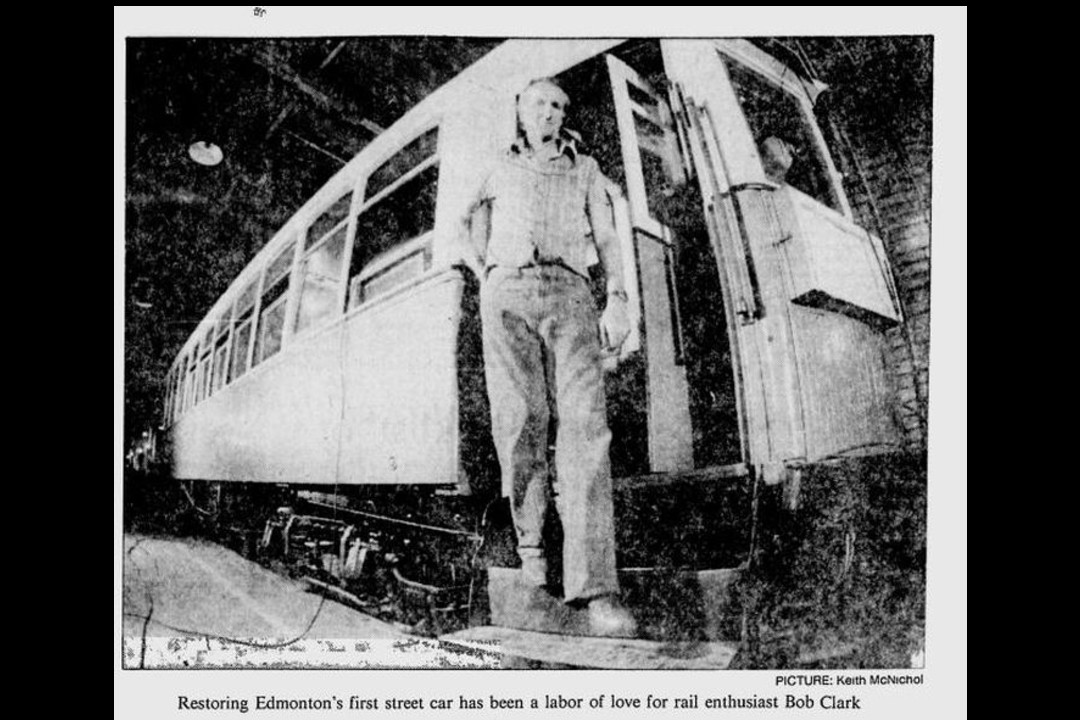
A moment in history: Aug. 8, 1979
By Scott Lilwall
On this day in 1979, Edmonton's first streetcar was resurrected to run the rails once again.
In 1908, when the Edmonton Radial Railway opened, the city became the first on the Canadian Prairies to enter the age of electric transit. The network initially had 21 kilometres of track. Jasper Avenue served as its hub, and multiple streetcar lines fanned out into the city from that street. The lines were served by a fleet of four cars, including Streetcar #1, which was given the name 'Old Faithful'.
The 11.7-metre wooden streetcar certainly lived up to the name. Over its nearly 50 years of active service, Old Faithful travelled an estimated 2.4 million kilometres — a distance that one railway magazine noted is about the same as three roundtrips to the moon. That distance shows just how important the radial railway was to Edmonton in the first half of the 20th century.
A large crowd braved the November day in 1908 to witness the system's grand opening. And on that first day, the system brought in about $150 in fares. At five cents a ride, that translated into roughly 3,000 trips (since transfers weren't introduced until 1909, riders had to pay for each trip) on the first day alone.
Edmonton's early streetcars didn't offer the most comfortable ride. They were run by a driver and a conductor, who would take fares and help passengers board and disembark safely. They had no heat and could handle 40 riders at a time. But despite the spartan conditions, ridership rapidly grew. By 1912, the system had a yearly ridership of 10 million, an impressive achievement for a city with a population just under 55,000. With the opening of the High Level Bridge in 1913, a streetcar line was installed on the top of the span, making it one of the highest streetcar river crossings at the time.
All those new routes and riders needed new streetcars. The city added dozens to its fleet in those early years. While many of them were passenger vehicles, the radial railway also added several specialty cars to its garages. Some were used to maintain the system, like sweeper cars to clear snow or special cars to help construct new routes. Others provided public services unrelated to the railway itself, including sprinkler cars that ran through the city to spray water on unpaved roads to reduce dust. In 1919, the city introduced a car painted white-and-gold that took people on sightseeing tours around the city for 25 cents. But the best-known specialty streetcar has to be the mobile library, which started in 1941 and shuttled thousands of books (and an actual librarian) around the city twice a week to connect with people who couldn't make it to a physical library branch.
Streetcars remained a common sight in the city through the 1940s. But following the Second World War, the transportation demands of the city and its residents changed. The city began to move towards buses and trolley buses, while also removing streetcar tracks to expand streets for private vehicles. In 1951, when the service was eventually closed, Old Faithful, the same streetcar that launched the radial railway, took then-mayor Sidney Parsons and others across the High Level Bridge for a final time.
But that wasn't the last time Streetcar #1 would ride the rails. After spending a decade in storage, which saw the streetcar become heavily damaged by the elements and vandalism, a group of dedicated volunteers worked to restore it to its former glory. In 1979, the newly restored streetcar made another trip across the High Level Bridge with 38 passengers to celebrate Edmonton's 75th anniversary. Streetcar #1 is now stored at Fort Edmonton Park, where it still operates for special occasions.
Almost 75 years after the closure of the Edmonton Radial Railway, many Edmontonians still rely on trains for their daily commutes. The city's LRT system is seeing increasing use, with 60 million riders counted in 2024. The LRT system is in the midst of a long-term expansion plan. Earlier this week, the city received the first of the new LRT cars planned for the Valley Line West expansion, currently under construction.
This clipping was found on Vintage Edmonton, a daily look at Edmonton's history from armchair archivist Rev Recluse of Vintage Edmonton.
Share