
A moment in history: Sept. 12, 1908
By Scott Lilwall
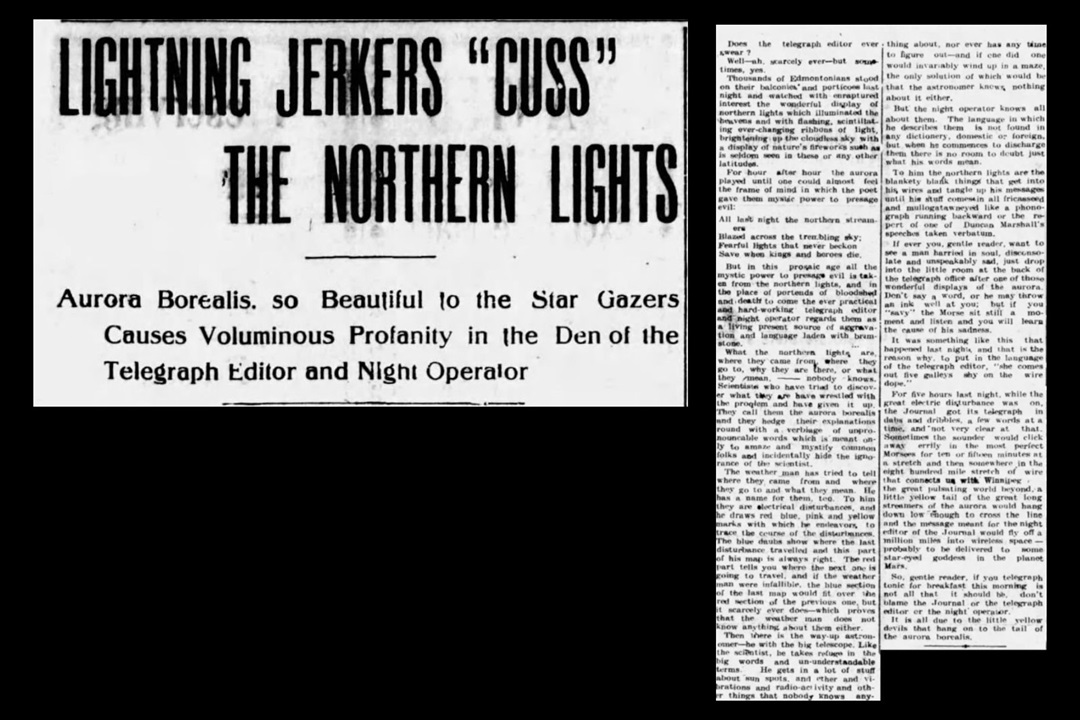
On this day in 1908, an Edmonton telegraph operator was cursing his nemesis — the northern lights.
In a tongue-in-cheek article, the poor beleaguered operator (or "lightning jerker," which was apparently their nickname at the time), was fed up with the aurora borealis. He complained that while the heavenly light show might fascinate scientists and capture the attention of sky watchers, the magnetic phenomenon also leads to garbled telegraph messages.


In our ultra-connected world of 2025, it's funny to think about a poor lightning jerker shaking his fist at the sky and cursing the northern lights. But as antiquated as the telegraph is now, it's easy to forget just how important the technology was to early Edmontonians.
When telegraph service first came to the growing settlement in 1879, Edmonton was connected to the telegraph station in Hays Lake, Alberta. It would still be a few years until rail service arrived in Edmonton, meaning it could take months to receive information from the eastern part of the country via land or river travel. But then, in 1879, more than 2,000 kilometres of telegraph line connected Edmonton to Winnipeg, allowing for fast updates on the news in the rest of Canada and the world.
But telegraph communication didn't always work. For the first few years, the system was notoriously unreliable. In addition to disruptions from the northern lights, the telegraph service was frequently interrupted by poles falling over due to high winds or unstable ground. (In fact, apparently winter was the most reliable time due to the poles freezing in place.) Eventually, the line across the Prairies was rerouted to follow newly constructed rail lines, eliminating some of those problems.
The first operator for the government-owned Dominion Telegraph Service was Alex Taylor, a businessman who would play some part in most of Edmonton's public utilities. It took a while for Taylor to establish a permanent place for his telegraph office — it was temporarily set up in the log cabin of businessman John Walter, before being moved to Fort Edmonton. Eventually, Taylor would move to a small, meagerly equipped building and slowly build up the telegraph infrastructure.
The residents of Edmonton were hungry for news from the east, and Taylor made good use of his connection. He would compile updates from Winnipeg and send them along to the store owned by Frank Oliver for customers to read. These updates would eventually become the town's first newspaper, the Edmonton Bulletin.
The telegraph also kick-started the technology that would eventually replace it; Taylor encouraged the Canadian government to build Edmonton's first telephone line between the telegraph office and St. Albert. New lines would soon connect to Fort Edmonton and, eventually, private businesses. The lines would eventually be sold to the city in 1904, becoming its first public telephone company.
The telegraph remained an important part of keeping Edmonton connected into the start of the 20th century. However, as telephone technology improved and radio broadcasts became more commonplace, the usefulness of telegraph service started to decline. The federal government would eventually discontinue the service in 1923.
Communication is an often-overlooked part of a city's history, but technologies like the telegraph and later the telephone were a vital link for Edmonton to the rest of the world. The way these technologies keep us connected continues to be a subject of fascination for us — earlier this summer, a telephone-based public art installation based around these themes received international recognition.
This clipping was found on Vintage Edmonton, a daily look at Edmonton's history from armchair archivist Rev Recluse of Vintage Edmonton.
Share