
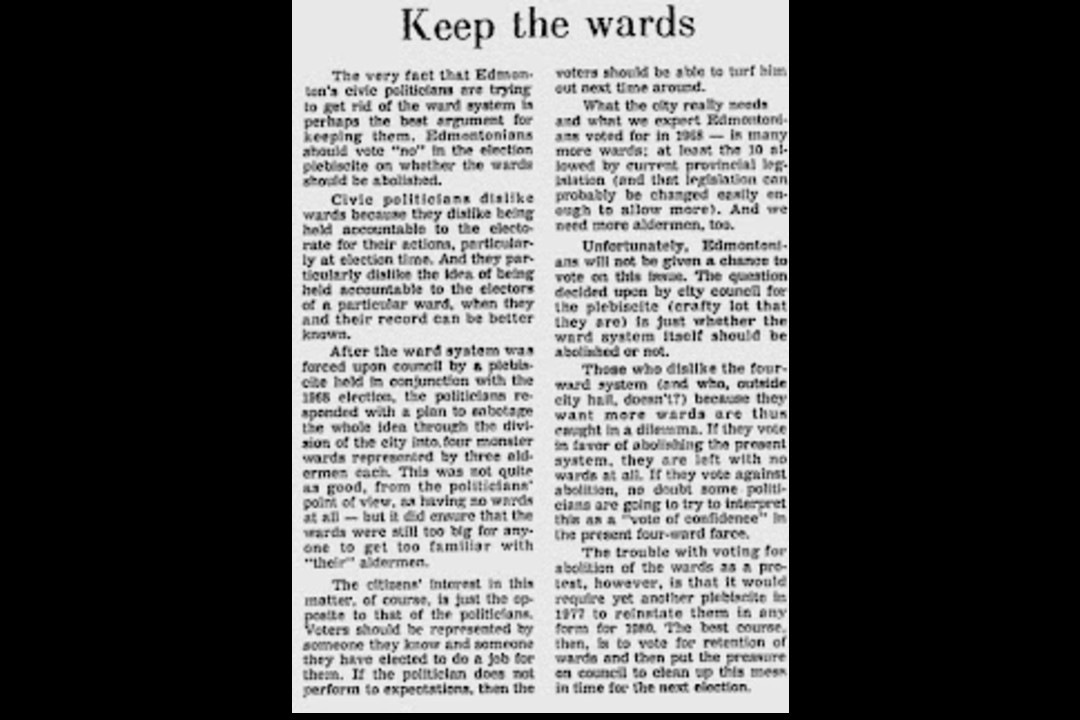
A moment in history: Sept. 26, 1974
By Scott Lilwall
On this day in 1974, some were calling for Edmonton's new ward system to be scrapped before the next municipal election.
The way Edmontonians elect their municipal government has changed significantly over the last century. One of the biggest changes is how often we vote. For much of Edmonton's history, residents voted in municipal elections far more often than today.
For the first six years after Edmonton became a town in 1892, council elections were held every year for both a mayor and six aldermen. But no one ever actually cast a ballot for the town's first mayor, Matthew McCauley. For each of McCauley's three terms, he was acclaimed as the only candidate seeking the position. The aldermen were elected at-large, meaning that all eligible voters could vote for any candidate, no matter where they lived. Eligibility as a voter was highly restricted back then: You had to be either a man or an unmarried woman, and a citizen of the Commonwealth.
In 1898, the terms for aldermen were extended to two years and the elections were staggered, meaning half would be elected one year and the other half the next (though the mayor was still elected annually). In 1904, when Edmonton was established as a city, two more aldermen were added, making eight.
In 1912, Edmonton amalgamated with Strathcona, creating one city. The new city residents south of the river were worried about not being represented, so as part of the amalgamation agreement, city council was expanded to 10 aldermen, two of whom were guaranteed to represent the area south of the river. This would be the first hint of a ward system in Edmonton. In 1936, the number of aldermen guaranteed to represent residents south of the river was increased to three. The idea was dropped altogether in 1960.
The city's elections continued to be complex after that change, with the size of the council changing, aldermen continuing to serve two-year staggered terms, and the mayor elected annually. To add to the confusion, the mayor and councillor elections even used different voting systems.
In 1968, both aldermen and the mayor saw their terms expanded to three years, due to provincial laws. And in 1971, Edmonton adopted the ward system, where voters in each ward elected three aldermen to represent their area. Those wards first split the city into four thin, vertical slices, so each ward would contain voters from each side of the river. In 1980, it was changed to six wards, with two councillors each.
It wasn't until 2010 that Edmonton adopted the current system of 12 wards, each represented by one councillor (the alderman title was dropped in 1995). The only change since then was four years ago, when the wards were given names to reflect the Indigenous history of the land the city was built on. Municipal voters also now go to the polls far less often than before. When residents elect their next council and mayor this October, it will be for a four-year term.
This clipping was found on Vintage Edmonton, a daily look at Edmonton's history from armchair archivist Rev Recluse of Vintage Edmonton.
Share