
The Pulse
Sept. 26, 2025

Here's what you need to know about Edmonton today.
Essentials
- 17°C: Sunny. Wind becoming northwest 30 km/h gusting to 50 near noon. High 17. UV index 3 or moderate. (forecast)
- Blue: The High Level Bridge will be lit blue for International Deaf Awareness Week. (details)
- 5pm, Sept. 27: The Edmonton Elks play the Saskatchewan Roughriders at Commonwealth Stadium. (details)
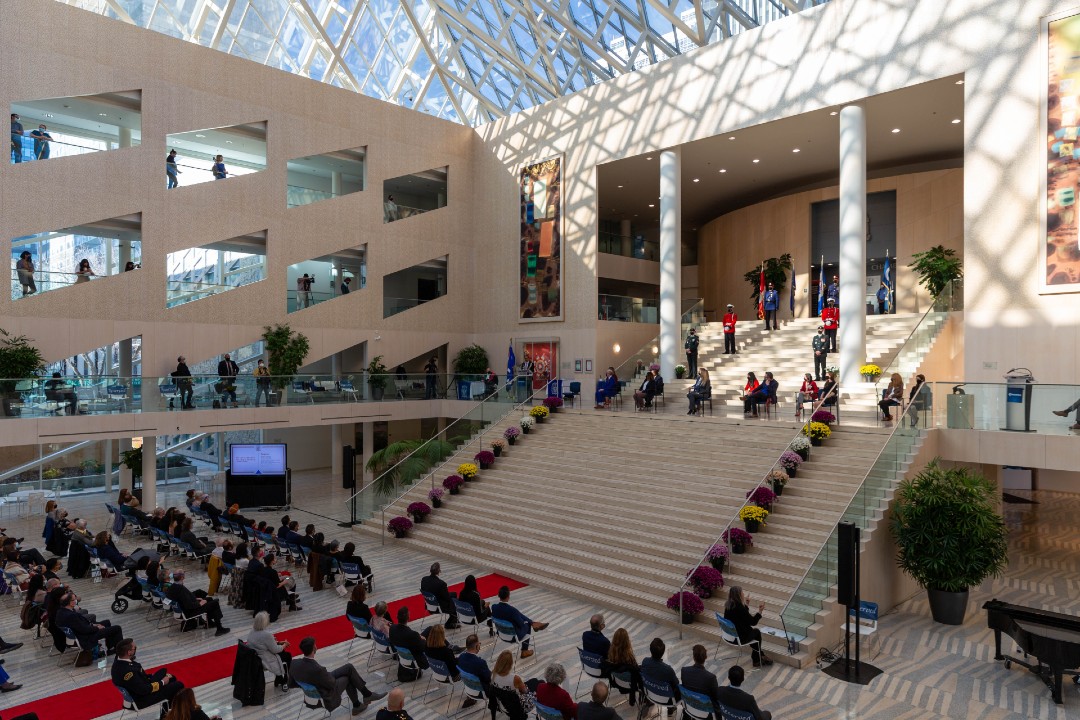
Edmonton city council passed big decisions and final motions before ending its term
The 2021-2025 council has met for the final time, and the official campaign period for the municipal election on Oct. 20 has begun. But before calling it a day, the current council tackled several big policy changes, agreements, and final motions that may get lost in the election campaign. Here's a synopsis.
Zoning bylaw
In late June, council started a public hearing to examine proposed changes to the zoning bylaw that would end up stretching into council's summer break. Councillors voted to amend some parts of the zoning bylaw while keeping other parts intact, and they also directed administration to prepare amendments to the zoning bylaw and district policy that could be decided on by the next council. This followed months of mounting discontent with infill development in the city among a segment of the population, with some residents feeling that their neighbourhoods were changing without their input. Taproot examined this in July.
Administration prepared amendments to the zoning bylaw that would, among other changes, restrict the number of units that can be built on mid-block infill sites in the small-scale residential zone from eight to six. Nearly 200 people signed up to speak at the public hearing. Many expressed frustration at how infill construction has changed their neighbourhoods, though some residents said the city was on the right track and urged council not to give up.
After hearing from the speakers, Mayor Amarjeet Sohi introduced a motion to strike the unit maximum from the amendments, thus keeping the limit at eight units. The motion barely passed; Sohi, plus councillors Aaron Paquette, Keren Tang, Erin Rutherford, Anne Stevenson, and Jo-Anne Wright voted to keep the eight-unit limit. But the idea of reducing mid-block infill to six units isn't gone forever; council has asked administration for a report analyzing how that change would affect the financial feasibility of infill and the number of units that would be constructed.
Council did, however, vote to change some design policies for mid-block infill in the small-scale residential zone. Council voted to approve reducing the maximum size of a building and the number of entrances that are permitted to face neighbouring properties. It also voted to approve changing the required design for the facade of infill buildings. Council also directed administration to bring forward funding options for reinstating the infill liaison team during the next budget adjustment, which will be decided by the next council.
Fan park deal
At the last meeting of the term on Sept. 19, council officially approved the deal between the City of Edmonton, the provincial government, and Oilers Entertainment Group to build an event park and housing near Rogers Place (council essentially approved the agreement in late August but gave the bylaw its second and third reading on Sept. 19). The deal, using the Community Revitalization Levy, will also see money go to the demolition of the Coliseum and the development of Exhibition Lands near the Edmonton EXPO Centre. The total value of the deal is $408.2 million, to be split between the province, city, and OEG. Council passed it with a 9-4 vote, with councillors Michael Janz, Andrew Knack, Rutherford, and Wright voting against.
The deal was contentious, with proponents suggesting the city should welcome any funding it can get from the province, along with investment from the private sector. But Knack, who is also running for mayor, said the deal was rushed and put the city in a weak negotiating position. "A gun is to our head right now, saying, 'No, don't dare amend this agreement, because if you amend it, we don't have enough time to fix it. It's going to be thrown away,'" Knack said. "We've been given no choice. You either have to say, 'Yes, we want some of this money'... or you could try to amend it and then potentially risk the whole piece."
New police chief
Also on the very last day of meetings on Sept. 19, council unanimously voted to ratify the new chief of the Edmonton Police Service, Warren Driechel. The Edmonton Police Commission had chosen Driechel and presented its selection to council for a vote. Driechel had been working as co-interim chief alongside Devin Laforce since former Chief Dale McFee retired in February.

Mayoral Candidate Virtual Forum — You're Invited!
Hear from Edmonton's mayoral candidates on Oct. 9 at 6pm. Join a free online event where candidates share their visions and answer your questions. This nonpartisan forum goes beyond debate to focus on real community issues. Don't miss this chance to make an informed vote.
Headlines: Sept. 26, 2025
- Edmonton municipal election candidates are calling for special voting measures for the Oct. 20 election, which coincides with Diwali celebrations, to ensure South Asian communities are not disenfranchised. They suggest mobile polling stations to allow families to vote while celebrating. Edmonton Elections said the provincial Local Authorities Election Act sets the election date but highlighted multiple voting opportunities, including special ballots available since Aug. 1 and advance voting from Oct. 7 to 11, to ensure an accessible election for all Edmontonians.
- Bike Edmonton and the broader cycling community in Edmonton is mourning the loss of well-known ICU doctor Darren Markland, a cycling advocate who died at the age of 54 on Sept. 21. Markland succumbed to injuries after a crash while mountain biking in Nordegg, Alberta, an incident the RCMP is investigating. A passionate mountain biker, Markland was a vocal advocate for health care during the COVID-19 pandemic and promoted cycling as active transportation in Edmonton.
- Edmontonians can now cast their votes for the 2025 Urban Design Awards People's Choice Award. This year's competition drew 51 submissions across categories including civic design, climate resilience, housing innovation, urban architecture, and student projects. Round one voting runs until midnight on Oct. 2, with finalists advancing to a second round from Oct. 3-10. All submissions are also on display at City Hall from Sept. 29 to Oct. 10. Winners will be announced at City Hall on Nov. 20.
- The Edmonton Police Service has issued Canada-wide warrants for 41-year-old Abraham Alfonso Chavez, suspected in a fatal hit-and-run that killed a 13-year-old cyclist in southeast Edmonton. Chavez faces charges including manslaughter, dangerous driving causing death, and hit and run causing death. The incident happened on May 29, 2024, on 34 Avenue between 48 Street and Mill Woods Road. Authorities are seeking the public's help to locate Chavez and identify witnesses.
- In an opinion piece published in Postmedia, Business Council of Alberta (BCA) President Adam Legge wrote that business leaders in the province are highly concerned about crime and safety in their communities. A BCA survey found that 94% of its members worry about issues ranging from social disorder in downtowns to vandalism in rural areas. This erosion of safety threatens to displace companies and push businesses online, impacting vitality and property tax bases, Legge wrote, calling on Alberta's civic leaders to make crime and safety a top priority as municipal elections approach.
- Edmonton resident Darryl Learie has started a petition against the province's changes to the Assured Income for the Severely Handicapped program. Learie initiated the petition to voice the disabled community's strong disapproval of the proposed revisions. The UCP government is changing the program to shift some recipients to the Alberta Disability Assistance Program.
- The Edmonton Elks announced the death of owner Larry Thompson on Sept. 25, due to complications after surgery. Thompson, who realized a lifelong dream by purchasing the team in August 2024, invested heavily in the club and expanded its community outreach. He acquired the Elks after selling his Spruce Grove-based Thompson Construction Group in 2023. His wife, Deb Thompson, will continue his vision to rebuild the franchise as a pillar in the Edmonton sports scene and community.
- Alberta Court of Justice Chief Justice James Hunter has launched a review after an analysis revealed Gordon Kenneth Hatch and Daniel Robert Pahl, whose names are identical to two sitting Alberta judges, made donations to the United Conservative Party. The Investigative Journalism Foundation reported that Hatch donated $262.50 in 2022, and Pahl gave $3,535 between 2018 and 2023. The Court confirmed an investigation to the IJF, citing the Judicature Act for potential disciplinary measures like reprimands or referrals to the Judicial Council.
A moment in history: Sept. 26, 1974
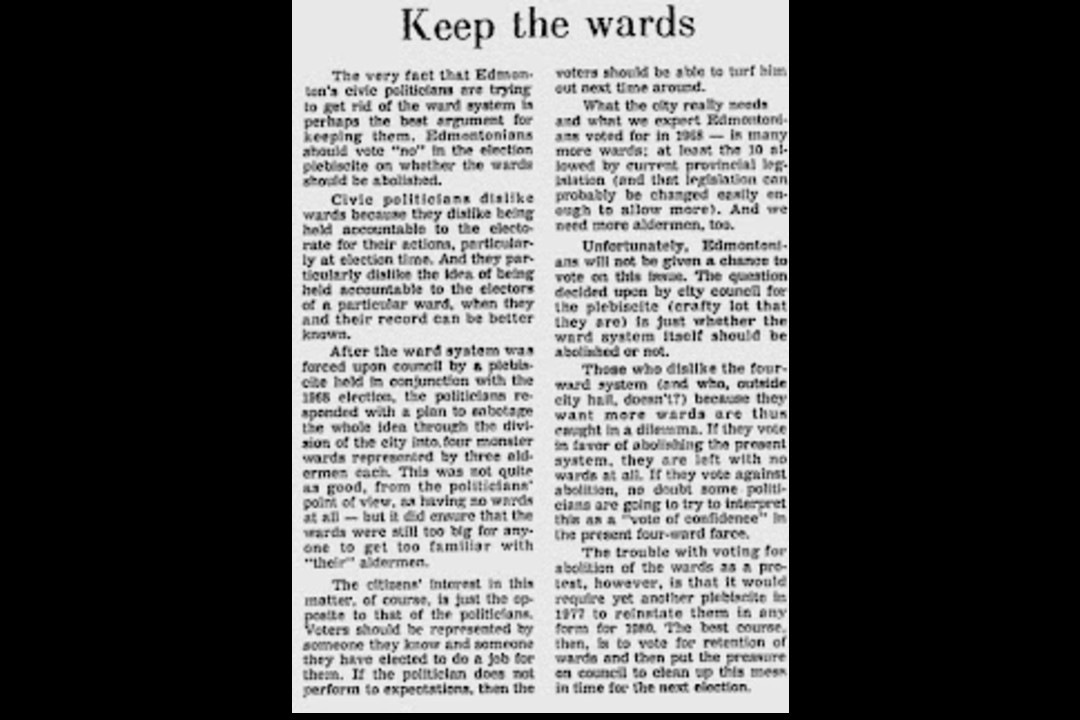
On this day in 1974, some were calling for Edmonton's new ward system to be scrapped before the next municipal election.
The way Edmontonians elect their municipal government has changed significantly over the last century. One of the biggest changes is how often we vote. For much of Edmonton's history, residents voted in municipal elections far more often than today.
For the first six years after Edmonton became a town in 1892, council elections were held every year for both a mayor and six aldermen. But no one ever actually cast a ballot for the town's first mayor, Matthew McCauley. For each of McCauley's three terms, he was acclaimed as the only candidate seeking the position. The aldermen were elected at-large, meaning that all eligible voters could vote for any candidate, no matter where they lived. Eligibility as a voter was highly restricted back then: You had to be either a man or an unmarried woman, and a citizen of the Commonwealth.
In 1898, the terms for aldermen were extended to two years and the elections were staggered, meaning half would be elected one year and the other half the next (though the mayor was still elected annually). In 1904, when Edmonton was established as a city, two more aldermen were added, making eight.
In 1912, Edmonton amalgamated with Strathcona, creating one city. The new city residents south of the river were worried about not being represented, so as part of the amalgamation agreement, city council was expanded to 10 aldermen, two of whom were guaranteed to represent the area south of the river. This would be the first hint of a ward system in Edmonton. In 1936, the number of aldermen guaranteed to represent residents south of the river was increased to three. The idea was dropped altogether in 1960.
The city's elections continued to be complex after that change, with the size of the council changing, aldermen continuing to serve two-year staggered terms, and the mayor elected annually. To add to the confusion, the mayor and councillor elections even used different voting systems.
In 1968, both aldermen and the mayor saw their terms expanded to three years, due to provincial laws. And in 1971, Edmonton adopted the ward system, where voters in each ward elected three aldermen to represent their area. Those wards first split the city into four thin, vertical slices, so each ward would contain voters from each side of the river. In 1980, it was changed to six wards, with two councillors each.
It wasn't until 2010 that Edmonton adopted the current system of 12 wards, each represented by one councillor (the alderman title was dropped in 1995). The only change since then was four years ago, when the wards were given names to reflect the Indigenous history of the land the city was built on. Municipal voters also now go to the polls far less often than before. When residents elect their next council and mayor this October, it will be for a four-year term.
This clipping was found on Vintage Edmonton, a daily look at Edmonton's history from armchair archivist Rev Recluse of Vintage Edmonton.

Edmonton Startup Week returns Oct. 6 to 10
Edmonton Startup Week runs Oct. 6–10, 2025 — five days of panels, pitches, meetups, and community events that bring founders, builders, and boosters together to move ideas forward. If you've been waiting for a nudge to plug into the ecosystem, this is it.
Kick things off with pancakes and coffee at the Pancake Kickoff Breakfast on Monday, Oct. 6 at Edmonton Unlimited. It's a great chance to connect with entrepreneurs, investors, and community champions before the week hits full speed.
The flagship Launch Party 16: Under the Stadium Lights takes over RE/MAX Field for the city's biggest celebration of tech startups — food, drinks, and a showcase of companies stepping up on the main stage. Don't miss the daytime Launch Party 16 Showcase earlier in the week to hear from this year's cohort.
Want a behind-the-scenes look at the brilliant minds behind some of Edmonton's most notable startups? Join the Startup Crawl (North and South tours) for guided bus visits to Future Fields, Grengine, Zero Point Cryogenics, and Drivewyze.
Explore and register for sessions (most are free) via the calendar.
This is your invitation to STEP IN and finally take action on that idea you can't shake. To STEP UP and give back — whether as a mentor, investor, or champion for our entrepreneurial community. And to STEP FORWARD with bold moves that push your startup, your team, and yourself to the next level.

Happenings: Sept. 26, 2025
Here are some events happening this weekend in the Edmonton area.
- Sept. 25-Oct. 4: Edmonton International Film Festival
- Sept. 26-27: Papillon at Mile Zero Dance
- Sept. 26-28: Alberta Game Jam Edmonton 2025 at Edmonton Unlimited
- Sept. 27: Saskatchewan Roughriders vs. Edmonton Elks starting at 5pm at Commonwealth Stadium
- Sept. 27: Black Tie Bingo starting at 6pm at Edmonton Inn and Conference Centre
- Sept. 27: Malarkey Murders: An Improvised Whodunnit starting at 7pm at Grindstone Theatre
- Sept. 27: Storytime Soirée: The Story Begins starting at 7:30pm at Edmonton Public Library (Stanley A. Milner)
- Sept. 28: Fit for Tech starting at 9:45am at Black Tusk Athletics
- Sept. 28: Campio Brewing Drag Brunch starting at 10am at Campio Brewing Co.
- Sept. 28: Indigenous Arts Market starting at 11am at Art Gallery of Alberta
- Sept. 28: Rethinking Edmonton Infill: The Next Chapter starting at 2pm at Parview Community Hall
- Sept. 28: From a Root a Flower Opens starting at 3pm at McDougall United Church
And here are some upcoming events to keep in mind:
- Oct. 6-10: Wills Week
- Oct. 9: Uniquely Me 2025 at Chateau Lacombe Hotel
- Oct. 15: Power in Pluralism: The U of A and Democracy at Horowitz Theatre
Visit the beta version of the Taproot Edmonton Calendar for many more events in the Edmonton region.
Life Sciences Week is a free, community-led event that connects industry leaders, policymakers, researchers, innovators, and students to ignite collaboration and spotlight cutting-edge breakthroughs. It takes place from Sept. 22 to 26. Register today


The Taproot Mini - No. 59
Test your crossword prowess and deploy a little of your Edmonton knowledge. Complete the puzzle.
Need a clue? This may help with 3-Down.
The Taproot Mini is brought to you by ATB, your homegrown source of good advice to help conquer life's tougher puzzles. Learn how.
