Economic development: Where the candidates stand
By Colin Gallant
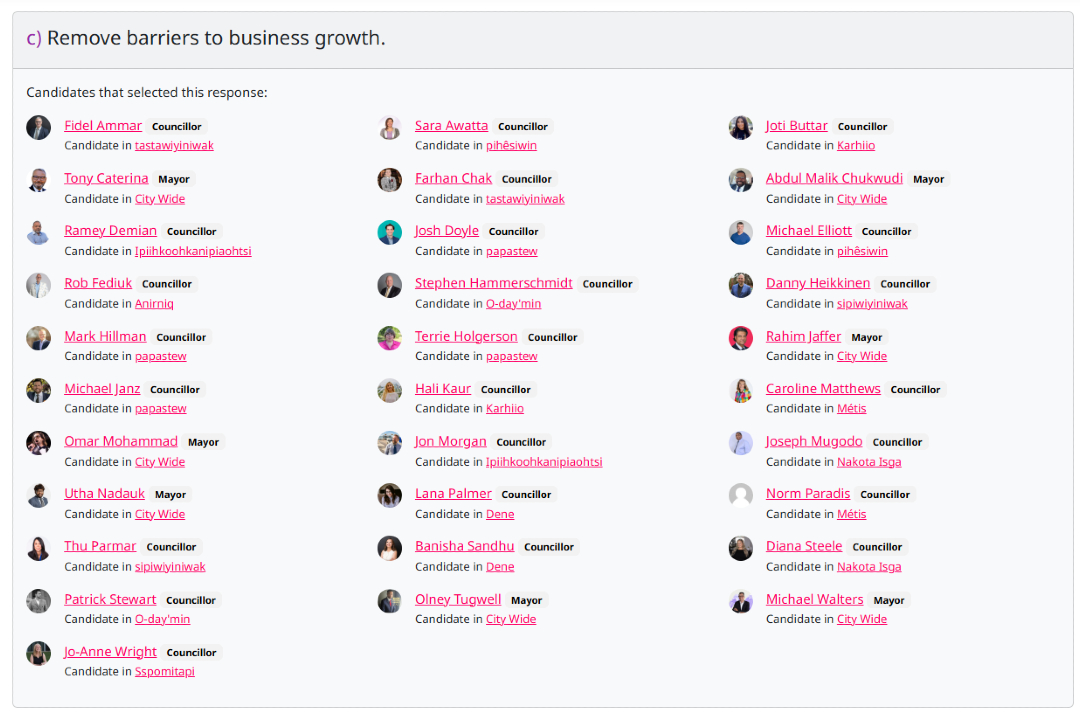
When it comes to their approach to economic development, a slim majority of candidates for council and mayor said they would Remove barriers to business growth when answering Taproot's candidate survey.
Thirty-one candidates chose this option. Among candidates for mayor, Tony Caterina, Abdul Malik Chukwudi, Rahim Jaffer, Omar Mohammad, Utha Nadauk, Olney Tugwell, and Michael Walters answered this way. Among candidates for council, incumbent candidates Michael Janz and Jo-Anne Wright said the same.
Twenty-six candidates chose the Invest in entrepreneurship and local businesses option. Mayoral candidates Paul Bakhmut, Tim Cartmell, Vanessa Denman, Andy Andrzej Gudanowski, and Andrew Knack chose it. Ashley Salvador was the lone incumbent council candidate to pick it.
Fourteen candidates said they would Invest in attracting new businesses to the city. This was the least popular answer among mayoral candidates, with only Ronald Stewart Billingsley, Jr choosing it, but it was the most popular among incumbent candidates for council. Aaron Paquette, Erin Rutherford, Anne Stevenson, and Keren Tang all selected this option.
Candidate Rozalia Janiszewska in Ward papastew and Jordon Woodruff in Ward Nakota Isga said they have no position on this issue.
As of this writing, 21 candidates for council and mayor have not yet completed the survey.
Edmonton has created multiple tools to develop its economy, including Edmonton Unlimited, its formative support to create Edmonton Global, its investments in startups and small businesses through the Edmonton Edge Fund, and its 2022 work on its Business Licence Bylaw, which was created to streamline processes. Council has, during this term, worked to improve processes that slow permitting and licensing. Regardless, business leaders often point to city planning, timelines, construction decisions, parking policies, tax rates, and other decisions as being central to their fortunes. During this council's term, concerns about Edmonton's non-residential tax rate, which is higher than surrounding municipalities, began to be discussed, as did the city's increasing reliance on residential property taxes due to its industrial tax base shrinking in relative terms.
Share