
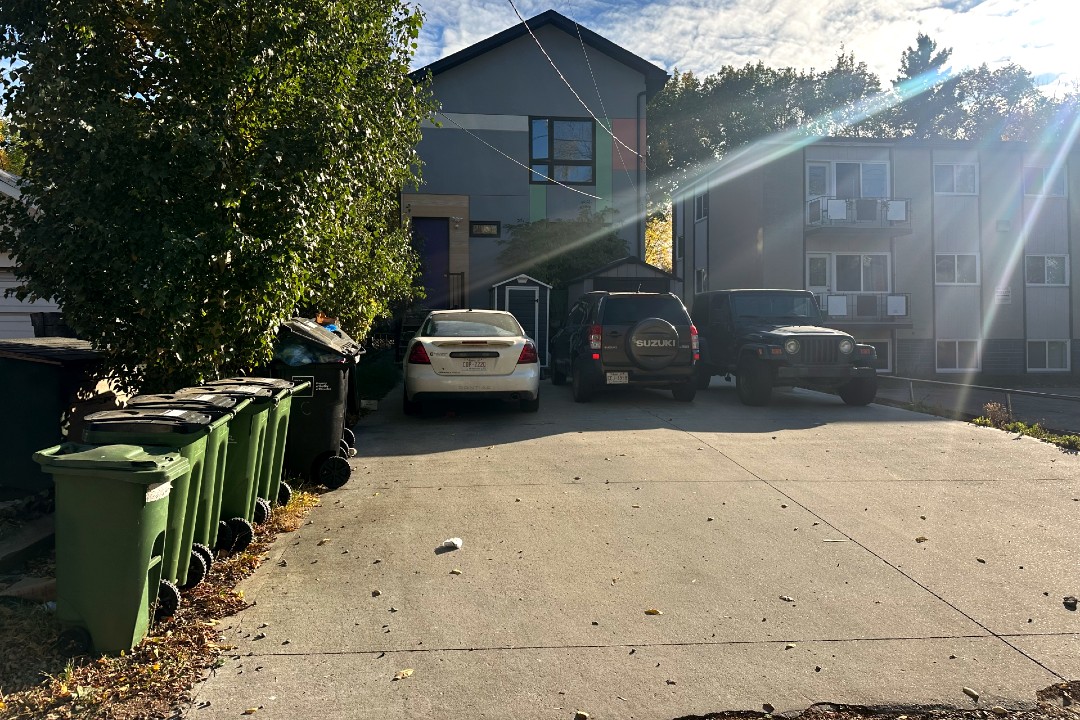
Garbage carts have proliferated at infill developments in Edmonton, like at this location in Strathcona. (Stephanie Swensrude)
How Edmonton is managing infill garbage-cart creep
The city is adapting how it collects waste from infill housing to address concerns about alleyways becoming cluttered with garbage carts.
The clutter the carts create is a big, stinking problem that's repeatedly raised at public hearings when a multi-plex is proposed in a neighbourhood. It was raised by Sean Sedgwick, the Infill Development in Edmonton Association's executive director, when he was appointed last year, and it's even outlined on anti-infill signs from SaveYeg.com. Typically, a single-family house receives a set of carts that includes one black 240-litre cart for garbage and one 120-litre green cart for food scraps, and an apartment building receives just one large bin or dumpster, Vahid Rashidi, the City of Edmonton's project manager for apartment and condo waste collection, told Taproot. Many infill developments take up the same footprint as a single-family house but host as many tenants as a small apartment building, which adds complexity, Rashidi said.
As a default, properties are supposed to receive one set of carts per dwelling unit, but since the new zoning bylaw went into effect in January 2024, the city's waste services department has worked to improve the waste collection situation that is, to some eyes, now cluttering alleyways in mature neighbourhoods.
"There's certain things that were developed since the zoning bylaw was worked on and, since it was approved last year, that were specifically just for infill developments as a result of either feedback we heard from residents or from what our team saw, and we noticed that we need to do something before it becomes a challenge," Rashidi said.
For each infill development, the city determines whether a lot is big enough to offer curbside collection for each unit. Rashidi said curbside collection, where each unit receives two carts like a single-family property would, is preferable to a dumpster because it encourages better sorting habits. "If there's enough space for us to give curbside collection, we do, and what that means is every unit would get two carts," Rashidi said. However, that could result in eight to 16 carts on a lot where neighbours had been used to seeing only two.
"Now, looking at that and recognizing that the carts are too many, or there could be situations where residents (living on the site) don't need the carts, there are two programs that residents could benefit from," Rashidi said.
In the green cart equivalency program, the city would essentially halve the number of food scraps carts by providing one 240-litre food scrap cart per two units, instead of two 120-litre food scraps carts. The waste department also allows for an exemption to the minimum spacing required between carts. Typically, the city requires one metre of space between carts for collection, but if there is still not enough space on the property after reducing the number of carts, they can be placed half a metre apart. If there is still not enough space, and the property is on a corner, bins could be placed on a side street instead of in the alley.
If there is still not enough space following these approaches, the property would be allowed to use a dumpster for communal collection, like what is used at many existing apartment and condo buildings.
City administration is also creating a new standards document for waste collection, both at infill sites and in new suburban developments. "We have a team that reviews all the development permit applications that come in, and in communication with developers, we learned that it would be great if this document is available before they send their development permit application so that they already know what they need to take into account, instead of waiting for waste services to tell them," Rashidi said.
Correction: This story has been corrected to clarify how many carts a household receives in the green cart equivalency program.
Share