
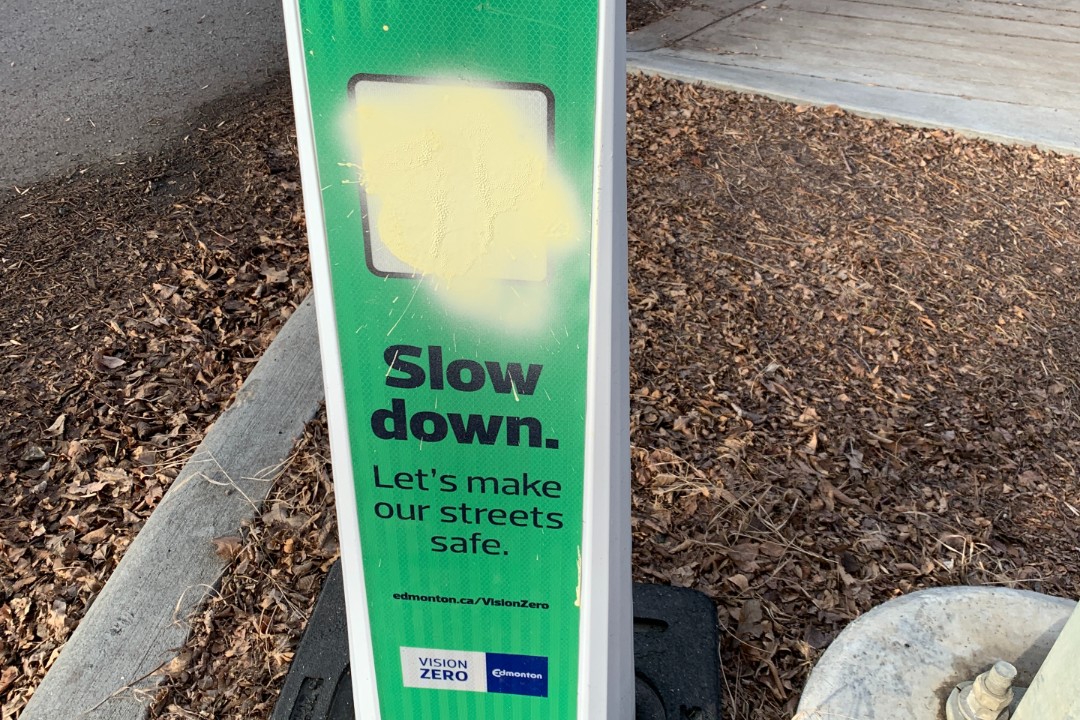
A Vision Zero sign that has had its 40 km/h speed limit vandalized. (Tim Querengesser)
Noted: Surplus money, surplus speed, and private chats
As Edmonton's new city council sits to discuss the fall budget adjustment, with administration suggesting a 6.4% increase to property taxes, the co-hosts of Episode 334 of Speaking Municipally looked at some surprising developments within what was an otherwise routine week for our municipal government. Here's a snapshot.
Surplus
The co-hosts discussed the big reveal of the 2025 fall budget adjustment season, which is that Edmonton has a surplus. But co-host Mack Male was quick to temper expectations. "Before you, dear listener, get all excited thinking, 'Aha, that means we can have a lower tax increase,' that's not what they're planning to do with it," he said.
Co-host Stephanie Swensrude, who spent time at city hall to observe the new council at its new job, agreed and said the details matter on this one. The surplus is for 2025, she explained, and is the result of the city collecting more revenue from membership and admissions to city facilities, franchise fees for EPCOR, and tax penalties than it anticipated.
"So, at the end of the year, they're projected to have about $15.7 million more than what they had budgeted," Swensrude explained. "But instead of putting that to reducing the tax levy, what they're going to do instead is put it towards the financial stabilization reserve."
A vision back to zero
In 2015, Edmonton made news in Canada and even globally for being the first major Canadian city to adopt the Vision Zero strategy, which European cities successfully implemented starting as early as the 1990s to reduce and even eliminate deaths on city streets from collisions between users. But a new city report on Vision Zero notes that when Edmonton adopted the strategy in 2015, fatalities began to fall, only to start increasing again. In 2024, the report notes, fatalities hit 24. As of Dec. 2, they are at 31 in Edmonton.
Swensrude noted the report has found that drivers are speeding far more than before the provincially-mandated removal of photo radar to enforce speeds, and that the largest increase is among those who are travelling between 20 to 29 km/h faster than the posted limit. Swensrude added the city found that half of the fatal incidents involved someone speeding.
Male was taken aback. "They say this is pervasive — like (there's) increased speeding at 82% of the city's monitored intersections," he said. "So, on the one hand, this is not surprising at all. You take away the photo radar, the automated enforcement, you would expect to see speeding go up … But perhaps a bit surprising is how much it's gone up and, and how the severity of the speeding has gone up."
Privacy, please
Swensrude noted a trend for some of the budget discussion on how administration hopes to cut structural budget variances and therefore reduce the tax levy was held in public, but a large portion was held in camera.
"They mentioned two examples of things that they were proposing to cut, and then they said, 'We'll discuss the rest of these in private,'" she said.
The Nov. 28 episode of Taproot's civic affairs podcast also includes discussion of ongoing construction projects and LRT. Listening and subscription options are all right here.
Share