
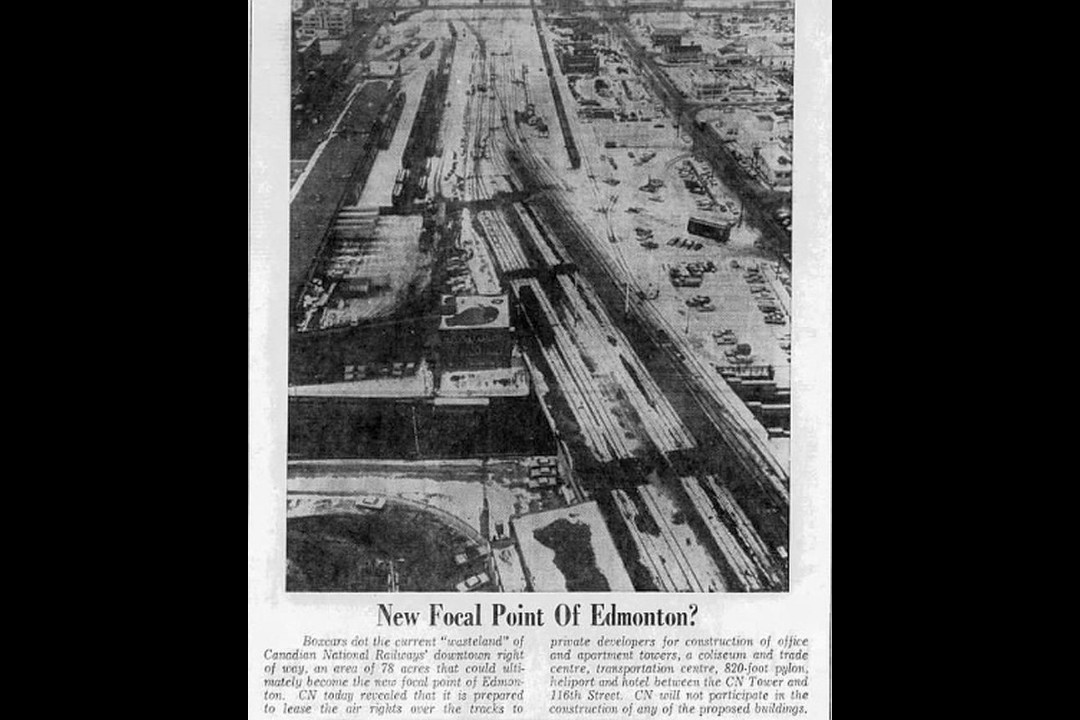
A moment in history: Jan. 23, 1968
By Scott Lilwall
On this day in 1968, there were questions about what would happen to the "wasteland" of railroad right-of-ways that snaked through downtown Edmonton.
The history of Edmonton is intimately tied to the steel rails that once ran through the city's core. Edmonton's first railway was the tiny EY&P Railway, which connected it to Strathcona via the Low Level Bridge in 1902. But the city's first major connection to the rest of Canada came in 1905 with the arrival of the Canadian Northern Railway (which later became CN Rail). When the company connected Edmonton to its transcontinental line, it laid tracks along the north side of 104 Avenue, leading to a two-storey station at 100 Street.
That station would become a hub of both passenger and freight travel for the growing city. Brick warehouses began to spring up on the western edge of downtown as manufacturers, textile companies, and other industries took advantage of easy access to the railway. This only accelerated when the competing Canadian Pacific Railway opened a station on the edge of downtown, near Jasper Avenue and 109 Street.
All that industrial growth meant more freight cars, which led to more rails to carry them. It wasn't long before the CN railyard along 104 Street grew to massive proportions, with nearly two dozen sets of tracks threading through downtown and stretching to 121 Street.
The CN railway supercharged the growth of downtown Edmonton, but it also put limits on it. Crossing the thick cord of tracks was difficult, and the railyard created a clear divide between downtown and the northern parts of the city.
In 1927, the city built a two-lane tunnel under the 22 CN tracks that crossed 109 Street near 104 Avenue. Officially, the crossing was dubbed 109th Street Subway, but Edmontonians would eventually give it a not-so-affectionate nickname: The Rathole. The tunnel was infamous for being narrow and frequently flooding in the spring, and it would become the site of many accidents.
CN's original 1905 station was replaced by a new building in 1928. That station would be demolished a couple of decades later to make way for the CN Tower, which opened in 1966. In 1968, when this photograph was published, CN revealed that it was "prepared to lease the air rights over the tracks to private developers for construction of office and apartment towers, a coliseum and trade centre, transportation centre, 820-foot pylon, heliport and hotel between the CN Tower and 116th Street," the Edmonton Journal reported. The accompanying story said CN also offered tracks and equipment to "start operating a rapid transit system for Edmonton if the city will pick up any annual loss on operation." That didn't happen.


The tracks that shaped downtown remained in place for a surprisingly long time. They were in operation until 1988, and the rails and associated infrastructure survived until the late '90s. When the trainyard and its associated tracks were eventually pulled up, it opened up a massive amount of land in the city's core. CN donated some of it to the college that eventually became MacEwan University to build its main downtown campus. Now, Rogers Place, the Royal Alberta Museum, and many other commercial and residential buildings sit on what was once railway tracks.
Three decades after the tracks were removed, that work still continues. The Station Lands, a major mixed-use development, is underway near 101 Street and 105 Avenue on the site of the old railyard. The recently opened Roundhouse Park at the property was highlighted by Edmonton's annual design awards in November.
This clipping was found on Vintage Edmonton, a daily look at Edmonton's history from armchair archivist Rev Recluse of Vintage Edmonton.
Share