
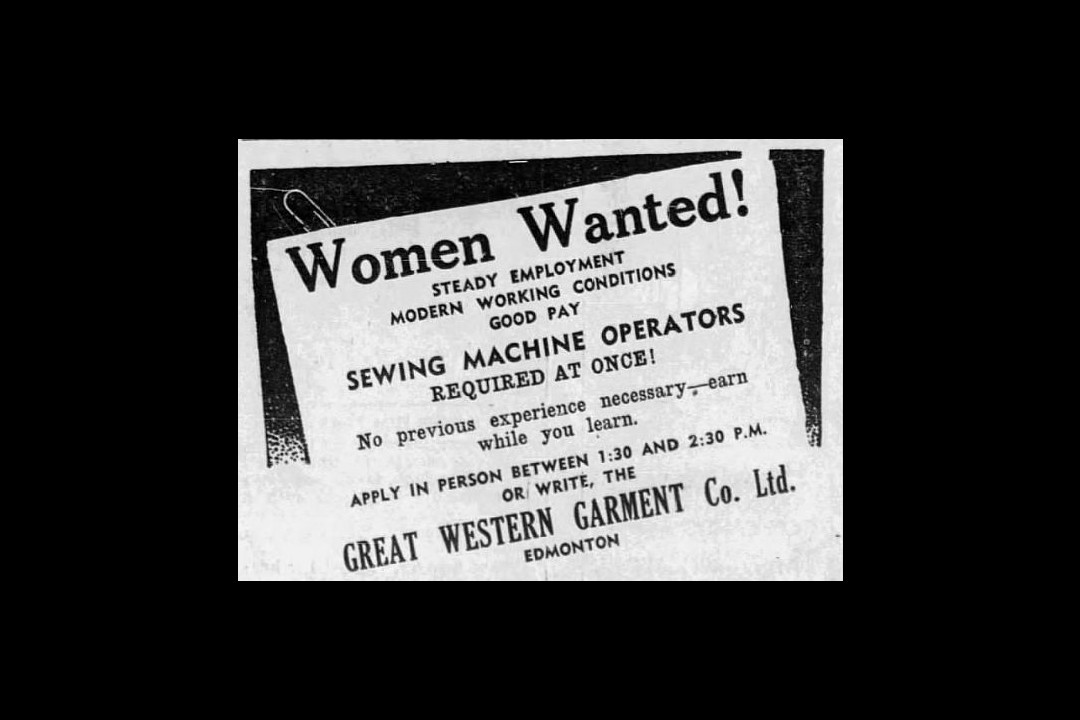
A moment in history: Sept. 4, 1947
By Scott Lilwall
On this day in 1947, Edmonton's Great Western Garment Company was advertising for new workers.
GWG was once a massive name in the clothing industry. But when the company was founded in 1911, it started with just 15 workers and eight sewing machines. Alberta's first premier, Alexander Rutherford, along with Alfred E. Jackson and salesman Charles A. Graham, started it. The garment maker targeted farmers, ranchers, and other workers with affordable, durable clothing under the motto "They wear longer because they're made stronger."
Shortly after the company's founding, its staff unionized, forming Local 120 of the United Garment Workers of America at Edmonton. GWG recognized the union. Workers secured conditions like an eight-hour workday and a 44-hour workweek, which were rarities in the notoriously employee-unfriendly garment industry. And GWG was able to market its clothing as union-made, which likely helped with its working-class customer base.
The company grew quickly. Within a year, it had more than 100 employees, most of whom were women, as clothing was one of the few industries that would employ them at the time. In 1917, the company moved to a new factory in a former department store on 97 Street and 103 Avenue. GWG continued to grow throughout the 1920s, expanding both its workforce and its factory. During the 1930s, the company weathered the Great Depression by adding lines for women's wear and children's clothing, as well as making uniforms for city workers.
By the time the Second World War broke out, GWG was reputed to be the largest garment manufacturer in the British Empire. During the war, the company's workforce swelled to 500, and it was producing up to 12,500 uniforms a week. Most of them were destined for the Canadian military, but GWG also sent tens of thousands of garments across the Atlantic to outfit the Netherlands' armed forces in 1946. The emphasis on military uniforms and cotton rationing caused a shortage of GWG clothing in retail stores. The company still advertised heavily, telling customers that their garments were durable enough to last them through until peacetime.
During the war years, the company also put a great emphasis on efficiency and speeding up the manufacturing process. This philosophy continued into the post-war years, with GWG quick to adopt new technologies and seek automation whenever possible. It also saw the company open a 100,000-sq.-ft. factory on 85 Street in 1953.
GWG is also credited with several firsts in the history of blue jeans. It was the first in Canada to sell pre-shrunk jeans in the 1920s, and the first to sell pre-washed jeans, called Scrubbies, in 1972. They became one of the company's most popular products.
Jeans giant Levi Strauss bought a large portion of GWG in 1961, and then gained full ownership in 1972. The '80s and '90s saw the company lose much of its share in the Canadian jeans market, as competition rose. Rounds of layoffs marked those decades, and the new owners shifted some parts of production to factories in Ontario and Mexico.
Finally, in 2004, Levi Strauss shut down all of its North American factories. Four hundred and eighty-eight Edmonton workers were laid off, down from GWG's peak workforce of 1,600. During its nine-decade history, Great Western Garment Company became one of Alberta's largest industrial employers and introduced many innovations — both technical and related to labour conditions — into the garment industry.
The former GWG factory building on 97 Street is listed for lease after a number of attempted reuses, including as the site of the Downtown Farmers' Market from 2019 to early 2024. While Edmonton is no longer the hub of garment manufacturing it used to be, it is still home to various independent designers and manufacturers, many of whom are advocating for a more sustainable and local clothing industry.
This clipping was found on Vintage Edmonton, a daily look at Edmonton's history from armchair archivist Rev Recluse of Vintage Edmonton.
Share