
Voters told Taproot they want a more walkable city
The growing responses to Taproot's listening work in the lead up to October's municipal election reveal that many voters want the city to be more walkable, meaning the pedestrian experience is safe, pleasant, and convenient.
Earlier this year, Taproot launched our listening campaign at several in-person and virtual events, and we posted a 2025 election question on our site. We have been gathering responses ever since, and at last count, more than 925 people have provided them. The listening was built around a simple question: "What issues do you care about as you consider who to vote for in the 2025 municipal election, and why?"
At least 121 people referenced walkability in their responses. Many said walkability is essential to access necessities, including groceries, throughout Edmonton.
"I will vote for someone who is committed to increasing walkability in all parts of the city, not just the core," one person said. Another said they "want to know how we can make more small, walkable neighbourhoods with local shops and restaurants."
Several respondents touched on walkability downtown. One noted that walkability isn't just about sidewalks and multi-use pathways, because pedestrian infrastructure and areas must feel welcoming to be truly walkable. "Downtown is supposed to be beautiful and walkable, but right now, it is scary, unsafe, and I avoid going there if I can," they said.
Many also linked walkability to how the city does, or does not, clear snow and ice, which Taproot has already covered in an earlier explainer based on reader responses. One reader linked pedestrian infrastructure with cycling and those with disabilities who require mobility devices.
"For non-drivers, crossings are brutal for weeks on end," a respondent said. "Bikers, without bike lanes, are left with few options beyond the sidewalks, but then are forced to make dangerous road crossings, as well, through four-to-six inches of mush. (I can't imagine what the experience is like for people who use mobility devices)."
Though few respondents criticized or praised the current council's specific work on walkability, Taproot has worked to explain some key developments since the 2021 municipal election.
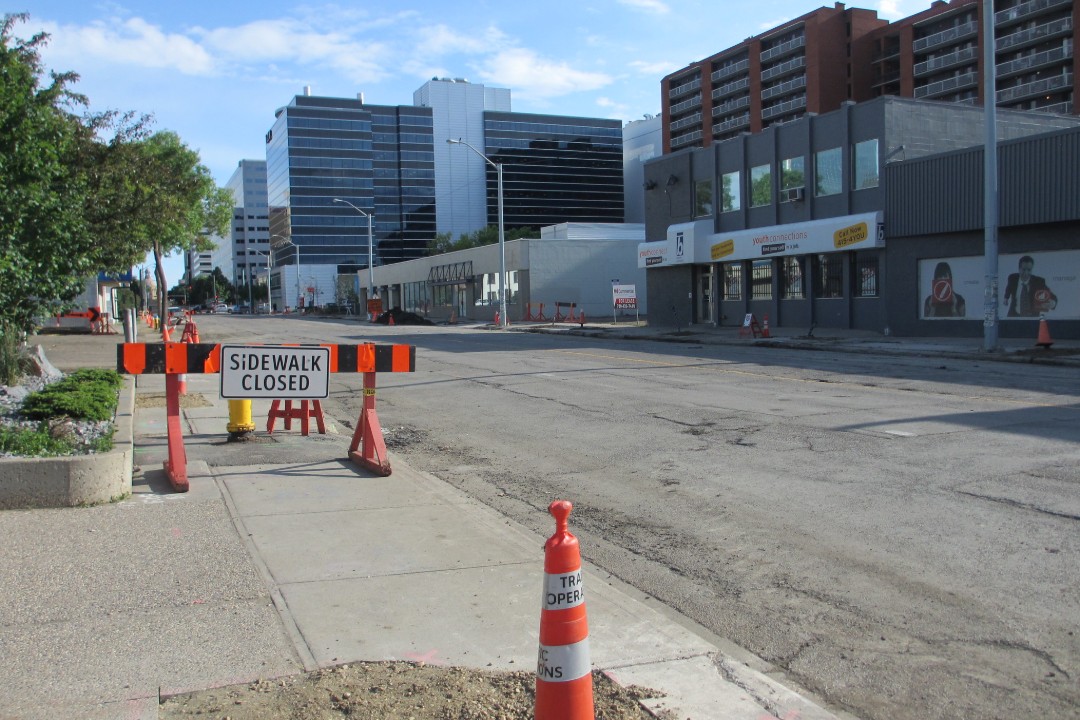
A file photo of a sidewalk closure. (Mack Male/Flickr)
New street design standards approved this summer
In June, Natalie Lazurko, the city's director of transportation planning and design, told Taproot about the city's plans to update its complete streets policy. The changes will apply to new and existing streets, and include more mandatory traffic calming measures and shared-use pathways for some collector roads that connect arterial roadways with quieter streets. City council's urban planning committee unanimously approved the changes in June. Edmonton was the first city in Canada to adopt the Vision Zero program, in 2015, and Lazurko said she hopes the complete streets updates can put the Vision Zero Street Labs team out of business.
New downtown pedway due in 2026
Construction of another pedway in downtown Edmonton, this one to connect the Royal Alberta Museum, the Churchill LRT station, and the Station Lands development along 103A Avenue with the larger pedway network, began in March 2024. The project is expected to finish by the end of 2026. The project's current budget is just more than $42 million, according to a posted sign, which also includes streetscape improvements along 99 Street. Its original budget was $26.5 million.
Is this an investment in walkability? Pedways may offer climate-controlled environs for people on their feet, but whether they add to walkability, in the sense of being inviting, safe, or navigable, is up for debate. Pedways take people off the street, diminishing that street's overall vibrancy. The pedway at the Alberta Legislature was closed from October 2023 to May 2024 due to the number of security incidents that happened within it. As for the downtown pedway network, which is a hybrid of municipal and private ownership, the city is launching the Pedway Unique Identifier Program, which gives first responders a more precise location when responding to calls for assistance by pedway users.
Streets for people
The city has established two entertainment districts in downtown Edmonton that see it close street segments to vehicles on select days (usually Saturdays) and open these spaces up to pedestrians. The first, on Rice Howard Way, launched in summer 2024. The other began this past summer along 104 Street, and is open in conjunction with the Downtown Farmers' Market. The Edmonton Downtown Business Association oversees both districts on behalf of the city. Taproot reported in June that business owners on the 78 Avenue portion of Happy Beer Street (between 99 Street and 100 Street) are working with the city to explore their own car-free entertainment district. Ward papastew Coun. Michael Janz, whose jurisdiction includes this stretch, said he'd like to see other entertainment districts close to Whyte Avenue, too.
Neighbourhood renewal
The City of Edmonton has operated its neighbourhood renewal program since 1987. The program sees the city assess one quarter of city streets (and curbs and sidewalks) each year to determine which neighbourhoods need repairs, improvements, and preventative maintenance the most. Part of the goal is to make sidewalks more usable for pedestrians, or in some cases, add them where they were previously missing. Residents can check for updates on when their neighbourhoods are up for renewal on the relevant city webpage.
Great policies but middling action?
On Episode 324 of Speaking Municipally, Taproot's civic affairs podcast, co-hosts Stephanie Swensrude and Mack Male discussed closures to streets due to construction that have recently frustrated west-end drivers. During this, Male offered the lesser-discussed point — that construction disruptions often put pedestrians out far more than they do drivers, and that Edmonton continues to lag on this walkability point versus other cities. "Lots of other cities do construction and maintain access," he said. "And this is a bigger problem: I find, for pedestrians (there are more closures) than … for cars actually, right? But you can do work without closing sidewalks, and in Edmonton, we just always close sidewalks."
Edmonton's City Plan explicitly points to its intention to move Edmonton towards being a city where 50% of all trips are made without private vehicles, including walking.
Share