Andrew Knack: 'Edmonton chose independent leadership'
Andrew Knack is set to become Edmonton's 37th mayor, leading a council that will have many of the same people he served with previously, as well as a few members of the Better Edmonton party.
"Edmonton chose independent leadership with real solutions that will lead us to a stronger city together," Knack said in a victory speech on Oct. 21 from his campaign headquarters off Whyte Avenue. "I will always meet in good faith, and I will be clear about what Edmontonians need and how the city will lead. We won't agree on everything, and that's OK. What I will push for is how we work together, by listening to one another, by being open, by learning from one another, to do the work to build a stronger Edmonton."
While several polls remained uncounted even by the end of the day on Oct. 21, Knack had a big enough lead that his closest rival, Tim Cartmell, conceded by 2pm.
"Last night didn't turn out the way we hoped, but I can tell you this: I have never been more proud of the people standing beside me and the work we accomplished as a team over the last year," said Cartmell, who ran under the Better Edmonton banner with a full slate of candidates.
Knack, the three-term city councillor who bowed out of municipal politics last fall, only to re-emerge as a mayoral candidate, had an early lead over Cartmell that only grew as results trickled in.
Michael Walters finished third, followed by Omar Mohammad, Rahim Jaffer, and eight other candidates.
"While this isn't the result we were hoping for, I am very proud of the campaign we ran over the past three months," Walters said in a statement. "Andrew is a man of character who will work hard every day."
Of the nine incumbent councillors seeking re-election, only Jennifer Rice in Ward Ipiihkoohkanipiaohtsi was at risk of losing. She trailed independent Jon Morgan by 3.5 percentage points with 19 of 21 polls reporting. Find the most up-to-date vote counts on Taproot's results dashboard.
The three wards with no incumbent were leaning toward Better Edmonton candidates at press time, though the race in sipiwiyiniwak was exceptionally tight — only six votes separated Darrell Friesen and Thu Parmar with all polls reporting. A recount is expected. Reed Clark was ahead of Rajah Maggay by 3.5 percentage points in Nakota Isga with 20 of 22 polls reporting, and Michael Elliott led Jackie Liu in pihêsiwin by 9.7 percentage points with 16 of 20 polls reporting.
The rest of the returning councillors had comfortable leads and will serve another term: Aaron Paquette in Dene, Keren Tang in Karhiio, Ashley Salvador in Métis, Michael Janz in papastew, Karen Principe in tastawiyiniwak, Erin Rutherford in Anirniq, Anne Stevenson in O-day'min, and Jo-Anne Wright in Sspomitapi.
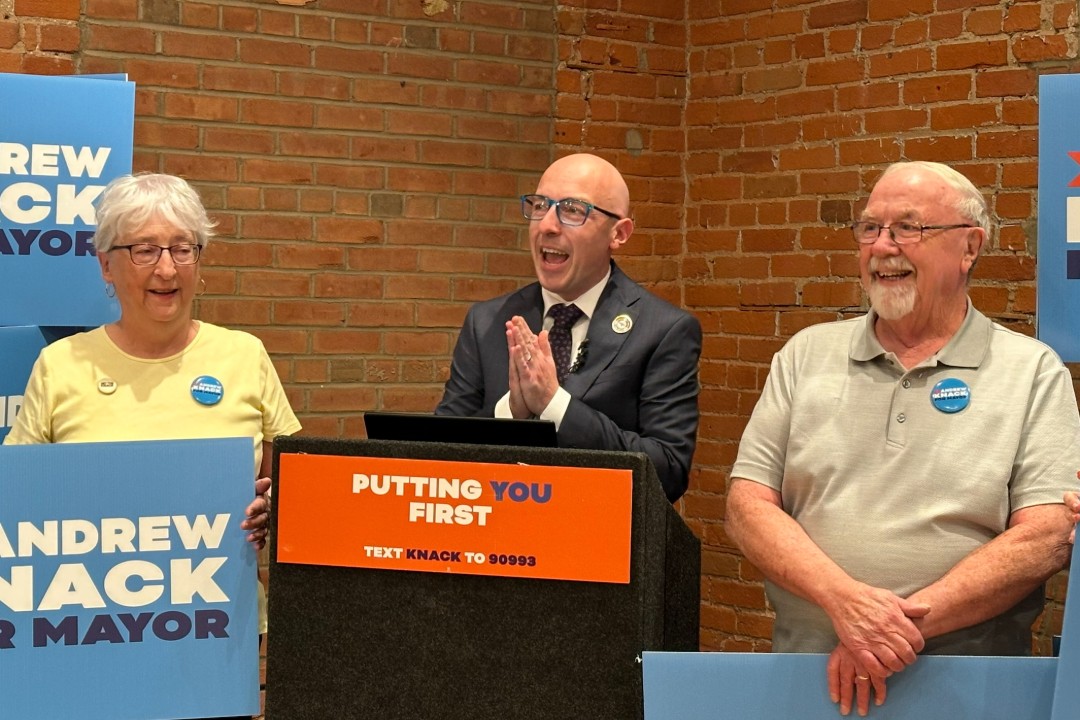
Andrew Knack, who's set to become Edmonton's 37th mayor, stands with his parents at his campaign headquarters on Oct. 21. (Stephanie Swensrude)
The 2025 election was a waiting game throughout. Polls were supposed to close at 8pm on Oct. 20, but many had to stay open for up to two hours extra due to the number of voters who were in line and yet to cast their ballots. The first results didn't come in until just before 10:30pm on Oct. 21, and counting was paused at 1am, resuming at 9am the following day.
Results did not start to drip out of the City of Edmonton until 10:26pm on Oct. 20, or roughly two hours after Edmonton voters knew the unofficial results in 2021.
"Multiple factors impacted our procedures for both voting and the counting of ballots, including a labour shortage, power outages and technology issues," Edmonton Elections said in a statement. "We know it is taking longer than initially anticipated, but we are working to ensure the confidence and integrity of the vote."
Changes to election laws created by the United Conservative Party government through Bill 20 and other changes to the Local Authorities Election Act meant every vote had to be counted by hand. The UCP government also mandated that advance voting was limited to five days in 2025, as compared to 10 days of advance voting Edmonton held in 2021.
Municipal Affairs Minister Dan Williams told CBC Edmonton that because municipalities have known about the new election rules for over a year, officials had plenty of time to develop a plan for efficient voting and counting.
"If a municipality's election authority was unable to come up with an effective plan, it is up to the local authority to explain to voters and candidates why long waits have developed," his statement said.
Voter turnout in Edmonton was pegged at 30.3%.
This story was updated several times to reflect new information as it became available.
Share