
Business associations receive close to $1M in city grants to manage social disorder
The Old Strathcona Business Association has launched Old Strathcona On-Call, a 10-person team from Hiregood that responds to calls and maintains a proactive presence on the area's streets from Tuesdays to Sundays.
The business association is one of 10 eligible to receive close to a cumulative $1 million from the City of Edmonton through its Enhanced Services Grant, signalling a shift toward funding these organizations to play a role in managing social disorder in their neighbourhoods.
"We've done member surveys for the past three years, and every time, safety and security is a primary concern," Andrea Donini, the interim executive director of the OSBA, told Taproot. "There used to be … broken window repair grants available to businesses, and there no longer are. (Our member businesses) feel the cost of some of this social disorder a little bit more directly now than they did previously."
Donini previously worked as an independent consultant to build the on-call program for the OSBA (she has since become the interim executive director). She said she was hired for the safety program work because of her experience with EndPovertyEdmonton (which recently relaunched), and was careful not to replicate a social program with Old Strathcona On-Call.
"We are not a social agency, we're a business membership association," Donini said. "We ended up going with a design that was more about the idea of security with dignity."
The city's $850,000 Enhanced Services Grant was funded through fall budget adjustments in 2024, with money reallocated from the community safety and well-being profiles to the community standards budget. The program is meant to be annual, and the funding is meant to pay for cleaning and/or community outreach teams. The grant opened in March to all BIAs, but was not open to those participating in the Centre City Optimization program, which includes the Edmonton Downtown Business Association, Chinatown and Area Business Association, and the North Edge Business Association.
Stony Plain Road's outreach navigators
Over at the Stony Plain Road Business Association, two outreach navigators will be on the neighbourhood's streets as of November for a four-month pilot that could lead to a permanent program, Todd Janes, the executive director, told Taproot.
"If there's a problem with graffiti, or an encampment, or people sleeping, our navigators will be trained and empowered to deescalate a situation," Janes, who is also the chair of the Edmonton BIA Council, said. "But (they are) also partnering with The Mustard Seed and Jasper Place Family Resource Centre in our area to really look at listening to individuals that may be in crisis, whether it's the business or other individuals, and finding other pathways for them."
Janes said the organization will refine the program once the navigators begin, and the pilot may evolve as time goes by. At first, he expects the program to be reactive, but hopes coordinators can eventually be proactive. For example, they may work with member businesses on security improvements to prevent problems from happening. The BIA received $81,000 for the project.
Navigators will be in the field four days a week, with a fifth day for training, administration, or recharging. "If I'm sending people out on the street, I want them to be the best that they can be," Janes said. "I want them to be aware and able to function the best way possible."
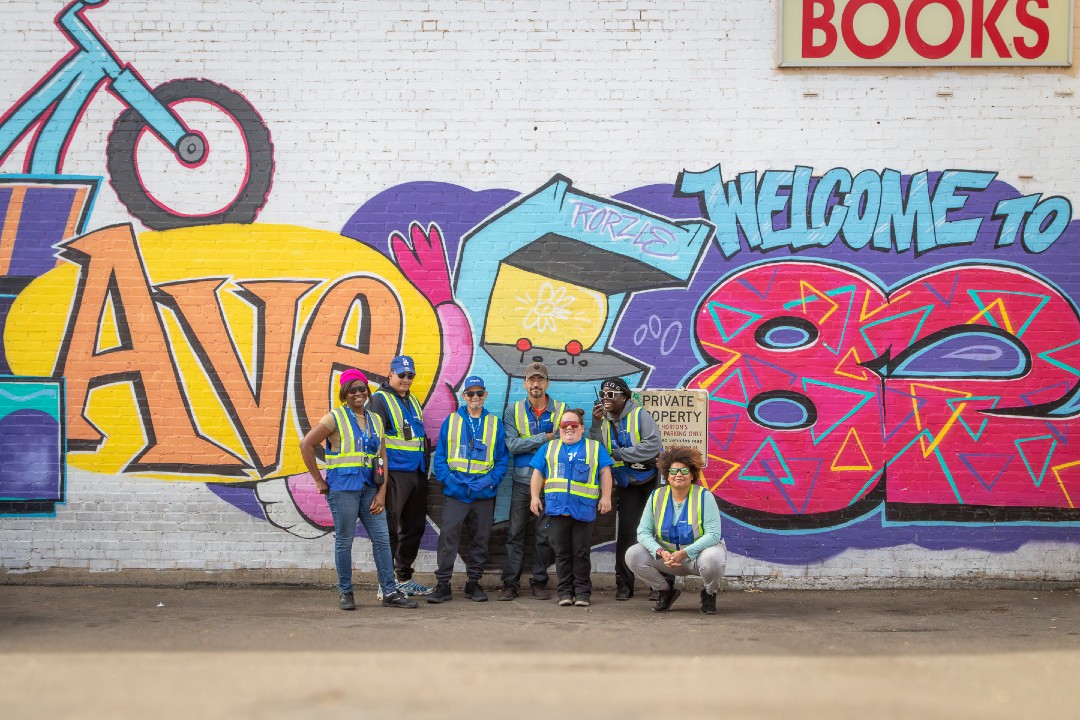
The new Old Strathcona On-Call team is a partnership between the Old Strathcona Business Association and Hiregood made possible by a grant for community safety initiatives by the City of Edmonton. (Supplied)
Is social disorder a BIA responsibility?
Edmonton has a police service, peace officers, and social agencies. All are in some ways tasked with handling social disorder.
Taproot asked sources whether work on social disorder is appropriate for a BIA, especially when some feel overburdened and underfunded already.
"The mandate of a BIA is fairly broad, because we're intended to create an environment that's conducive to thriving economies, and that can take any number of shapes and forms," Donini in Old Strathcona said. "From that perspective, I see (Old Strathcona On-Call) as a natural extension, and that this may be necessary at different times and periods. We know that these types of issues can ebb and flow over time, and … I think we happen to be at a bit of a high point right now."
Street teams managed by BIAs are not uncommon in Canada, Donini said. The OSBA consulted with 15 different street team and outreach programs in Canada, as well as the downtown BIA about its Core Patrol program, which is also a partnership with Hiregood. (The Core Patrol was established in 2023 and expanded its hours in 2024, but after grant funding dried up, it has constricted those hours to only nighttime service.)
While the on-call program is a pilot, it will produce evidence with long-lasting value for other service providers, Donini said.
"(It will) give us some really strong data and increase the reporting capacity that we had, because anecdotally, we've been hearing from members and others around Old Strathcona that they just stopped reporting things (to the police)," she said. "They didn't see a point in doing that, because they weren't going to catch anyone. But what that means is, for a data-driven police service or data-driven service delivery, there's no data there to say that we actually need service."
Janes, meanwhile, said he believes BIAs make for natural contributors to the "huge gaps" in community safety. "I've always said economic development is community development in many ways, (though) they're not inseparable," he said. "It's also about building on the idea that safety and community well-being begins with community. It begins with our community leagues. It begins with our property managers or businesses."
Like Donini, he said workers like the outreach navigators might be the right step for the right moment.
"(There's a common narrative of), 'Let's build as much housing as possible,'" Janes said. "That takes time, and there's a long list, and people are at different stages in their lives, so we're trying to re-envision the outreach navigators as an additional tool to help."
Edmonton's webpage on its 13 BIAs suggests their role is to support vibrancy, economic vitality, and appeal.
Taproot reached out to the City of Edmonton to confirm the amount received by each BIA but they declined to say which BIAs received money or how much, citing disclosure restrictions within grant agreements.
Beyond the enhanced services grant, the city has grants for BIA members for property improvements, and the city funds graffiti removal for businesses.
Share