Knack talks plans to include more voices, bikes, and regional collaboration
Mayor Andrew Knack told Taproot he plans to work with council to develop a strategic plan, hopes to re-establish regional collaboration, and aims to finish building out Edmonton's bike plan.
And during an interview with Taproot at his new office at city hall, Knack also said he wants to include people who lost in the recent election by potentially partnering them with councillors.
"I'm sort of coming up with a few different ways of (asking) 'How do we include those voices in the ongoing success of our city?'" Knack said. "I talked about building a stronger Edmonton together. The together part's really important — I want to make sure that we're bringing in people that supported me and people that didn't support me in building that stronger Edmonton."
Knack said he wants to consider bringing back council initiatives, where a councillor is assigned a "portfolio" to work on during their term. He said this, and other traditions, fell away during the COVID-19 pandemic.
One of those was strategic planning. Knack said he plans to develop a strategic plan with the rest of council. While former Mayor Don Iveson led council through a version of this in the past, Knack said his will be publicly available so that council can hold the city manager accountable, and Edmontonians can hold council accountable.
Knack added that the 2021 to 2025 council wasn't able to create a similar plan because it was thrust into action in the middle of a pandemic. "I think what would have really helped us in the last four years — and there's a lot I appreciate of (former) Mayor (Amarjeet) Sohi, and so this is the minor critique — I wish we would have had (a strategic plan) to be able to then say, 'All right, we just finished reacting to this pandemic. Now what?'"
He said his long-term plans also include bikes. When a year-round cyclist, like Toronto's Olivia Chow, is elected mayor of a major Canadian city, it often makes news, but Knack — who has commuted by bike for more than a decade — said he doesn't want it to be seen as unique. He didn't commute by bike when he was first elected, in 2013, but the beloved late advocate Darren Markland invited him for a ride early in his time on council.
"I remember going on that bike ride, and that was the beginning of a transformation. I've now spent the last 11 years biking," Knack said. "Even when I started biking (in winter), it felt pretty weird to do that. And with the infrastructure that we've invested in now, with the increase in ridership that we're seeing, I think we're at the point now where this should actually just be seen as sort of one way of commuting.
"If you see the guy with the bright blue helmet, that's probably me, and you'll see me biking across the city, because that's a great way to experience the city, and it's a great way to find new ice cream shops and cool little side paths."
The 2021 to 2025 council approved spending $100 million over four years to expand Edmonton's active transportation network. However, that only funds about half of the city's projected cost to implement the entire bike plan. Knack said he would like to fund the other half of the expansion.
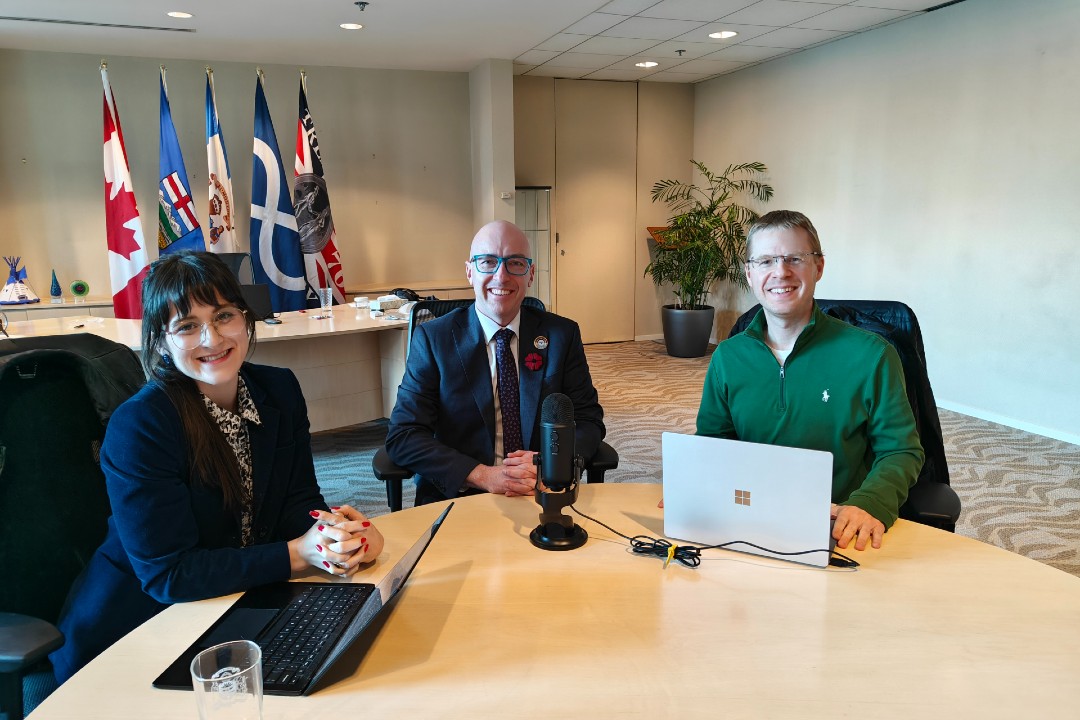
Mayor Andrew Knack spoke with Taproot at his office at city hall, and the interview can be heard on the Nov. 7 episode of Speaking Municipally. (Nicola Doherty)
"How do we make sure we're funding that, along with all of the other priorities that we have, recognizing that this council is going to be going into a four year budget with a significant constraint in capital funding unless we see a substantial increase in funding from the provincial or federal governments, which I don't expect will be happening anytime soon?" Knack said. "I don't know if we can do the same scale of investment in all of our transportation system, but we should still continue to invest in those options."
Knack has long been a cheerleader for regional collaboration. During the 2023-2026 budget deliberations, he introduced a motion to provide $13 million in annual funding to the Edmonton Metropolitan Transit Services Commission (he was on the board), to establish a shared regional transit system, but the motion failed, and the regional transit plan died. Regional collaboration received another blow in 2024, when the provincial government said it would stop providing funding for growth management boards in Edmonton and Calgary, and that membership would no longer be mandatory. The Edmonton Metropolitan Region Board dissolved in 2025.
Knack said he wants to re-establish a strong regional approach, especially when it comes to attracting investment. He referenced an EMRB report that said the whole region experiences uplift when the municipalities work together to create an investable region, rather than fight with each other to attract investment. "We were so busy bickering over this small pie, we didn't realize that if we actually just went out to the world and competed regionally, that we could get 10 times the investment across every municipality, and then we wouldn't have to worry so much about fighting each other for for what almost felt like scraps," Knack said of the region's former approach.
"If you are presenting this united front, and giving people a great opportunity to say, 'Yeah, you can set up your business in one part of the region, your workers might live in another part of the region, they might spend their recreational time in completely different part, and that's okay,' because as long as we're growing the entire pie overall, it's going to work out for us," he said.
The Nov. 7 episode of Taproot's civic affairs podcast also features a discussion about the derelict property tax, roadway expansion, and what Stardew Valley can teach us about running a city. Listening and subscription options are all right here.
Share