
Connection seen as the key for healthy community leagues
Calls to action from community leagues should be framed as an invitation to build social ties, not just a plea to keep the lights on, suggests the executive director of the Edmonton Federation of Community Leagues.
"This is where you meet people, this is where you might find out about a job for your teenager because someone down the road's got a small company, right?" Laura Cunningham‑Shpeley told Taproot, emphasizing the value of connections and relationships. "That's what I think is what will call people, as opposed to 'Come and volunteer.' It's more 'Come and connect, come and build those social connections.'"
That's what inspired Riley McGinn to run for a position on the King Edward Park Community League at a special meeting on Feb. 22. The league had warned it was in danger of closing, with just a handful of volunteers keeping it running and not enough directors for quorum under its bylaws.
McGinn said they learned the league was in danger through a friend who was planning a birthday party. They realized some of the classes they take at the community hall would also end if the league shut down. "I just wanted to step up," McGinn said. "I really enjoy the community that I live in, it's a great neighbourhood."
Once it became clear to people that the community league needed help, dozens flocked to the meeting to elect a new board, creating its own challenges. "Two hundred people need ballots, and then 200 people need to vote, and then you need to collect all of those ballots, and then you have to count all of them," Cunningham-Shpeley said. "We were there for some time. It was democracy in action."
As a self-professed "spreadsheet nerd," McGinn is now the league's treasurer and said they will focus on solid data governance in their new role. McGinn was born and raised in Edmonton and was familiar with community leagues, but said they always thought they were geared towards families with young kids.
"I guess I had kind of taken the community leagues for granted," they said. "But I'm a single adult without kids who rents my home and still benefits from connecting with community."
The Feb. 22 meeting elected a board to hold the league over until the next annual general meeting in May, when there will be another round of elections. The league has launched a survey (open until March 13) to help shape programming and events in the neighbourhood.
It's important to have representatives of different backgrounds involved in programming decisions to make sure more community members feel called to participate, Cunningham‑Shpeley and McGinn agreed. "If I want things that are programs that are accessible to myself, to people in my demographic, then I've got to help … and even just say that this is something that I'd be looking for," McGinn said.
Meanwhile, EFCL and Sport Edmonton have entered into a memorandum of understanding with the goal of providing sport and recreation opportunities to kids close to where they live.
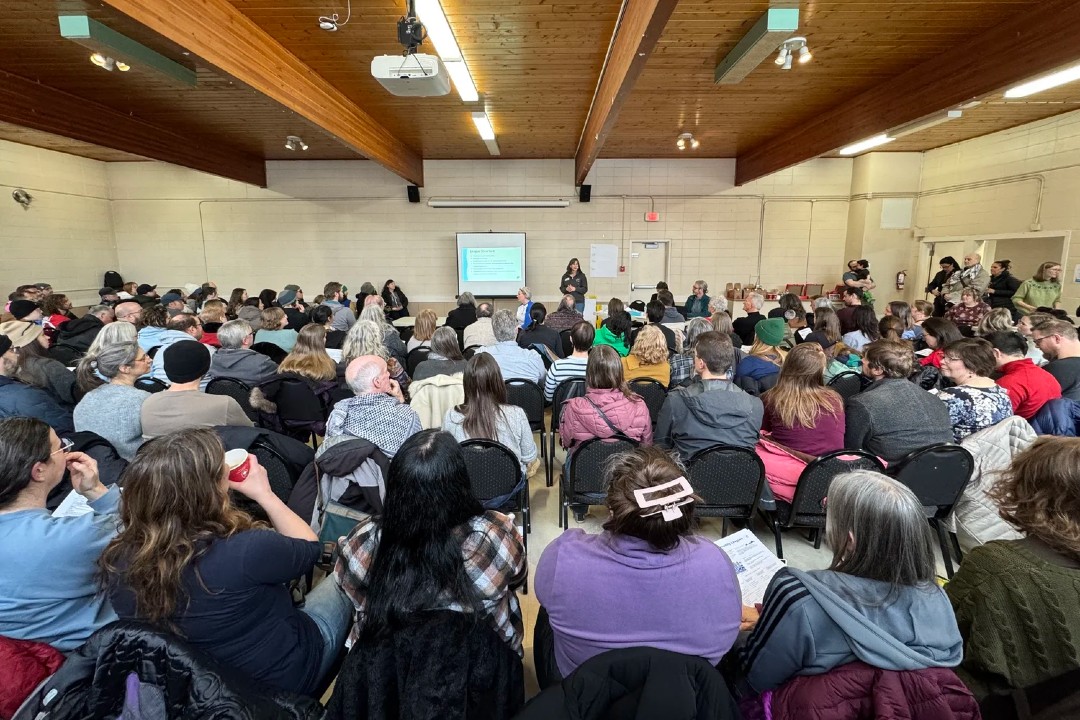
About 200 people showed up at a special general meeting in King Edward Park on Feb. 22 to help save their community league. (King Edward Park Community League)
Sport Edmonton will act as a connector between leagues and sport partners to envision, develop, and deploy sports programs, focusing on kids 10 and under. Evan Daum, CEO of Sport Edmonton, told Taproot the MOU aims to make sport more accessible both financially and geographically.
Daum is a parent of two children under seven years old and said he often has to drive across the city for their sporting activities. "That's what we're trying to avoid, particularly at young ages, because having little kids is taxing," he said. "The last thing you want to do is be driving all over the city for them to participate."
The system that the MOU envisions is already used with community league soccer programs. For example, a family living in Avonmore will join the Avonmore All-Stars and play against the Bonnie Doon Blazers. That model is part of the reason why soccer is so popular among families with young kids, Daum said.
"You get to play with your local neighborhood kids on whatever community league team you're on, and I think that's a real powerful model in terms of introducing people to the sport, and it does build that sense of community and get people to see each other on a recurring basis," Daum said. "You're more neighborly when you know somebody — you're always more open and kind to somebody that you know lives down the block from you, and maybe if they didn't shovel their sidewalk one day, you're not cursing them. You're walking down the street to shovel it, because you saw them at soccer back in the spring."
The MOU is still in early stages, and the organizations are still working out how exactly the programs will be funded and delivered, with programming driven by community need. Daum and Cunningham-Shpeley will say more at a March 12 announcement.
Laura Cunningham-Shpeley and Riley McGinn spoke to Taproot on the March 6 edition of Taproot Exchange, a members-only livestream conversation that goes deep on issues of interest to Edmontonians. Become a member for access to future livestreams, as well as recordings and transcripts.
Share