
Companies pitch defence applications as government funding swells
With $1.2 million from the Alberta government joining the growing pot of funding for defence, companies are finding ways to tailor their existing work for that industry.
"The experience that we've had involves that unique (place) between things that are defence-related and things that are infrastructure- or community-related," RUNWITHIT Synthetics CEO Myrna Bittner said during her winning pitch at the Rapidly Enabling and Advancing Disruptive Innovation (or READI) competition, which took place during the Alberta Aerospace & Defence Summit in Edmonton on May 4. Bittner cited work with American government agencies that straddles the line between defence and other fields.
The winning pitch earned Bittner a plaque made from Morinville grain elevator wood and the prestige of being selected in a room full of industry leaders. The competition was judged by representatives of Boeing Canada, SkyAlyne (which manages training for the Royal Canadian Air Force), and BDC. Vancouver's M2M Tech, which provides secure AI for mission-critical industries, came in second. SpectraCann, Elementiam, and Phase Metron also pitched at the summit, put on by Alberta Aviation, Aerospace and Defence.
RWI, as it's called for short, makes synthetic twins, which combine geography and multi-layered datasets to produce visualized simulations to model the future. Their latest covers all of Canada.
"If you've ever wondered what would happen if you put Google Earth together with SimCity, and you got to play as grownups, dial forward, have some agency in the future, look for opportunities to invest better, to have more resilience, to respond to security scenarios and develop civilian infrastructure — that's been our life for the last 12 years," Bittner said.
The company has worked with the American government and defence bodies such as the U.S. Air Force, the Department of Homeland Security, the Federal Emergency Management Agency, and the National Aeronautics and Space Administration. Much of that work took place before interest in dual-use technologies heated up. In February, the federal government released Canada's Defence Industrial Strategy, backed by billions in spending.
At the summit on May 4, the province announced $1 million for Alberta Aviation, Aerospace and Defence to support a new initiative called Leading Industry Forward Together, or LIFT. It's meant to "help position Alberta-based businesses as key players in growing the sector and competing for national and international defence industry contracts." Another $200,000 went to Community Futures Entre-Corp for work on a drone testing range in southern Alberta.
"Alberta's government is investing in defence and dual-use industry development to help grow innovation, support jobs and position Alberta companies to compete in domestic and global markets," Joseph Schow, Alberta's minister of jobs, economy, trade, and immigration, said in a release. "With strong industrial capabilities, skilled labour and innovation capacity, Alberta is well-positioned to support Canada's defence and security objectives while building a more resilient and diversified economy."
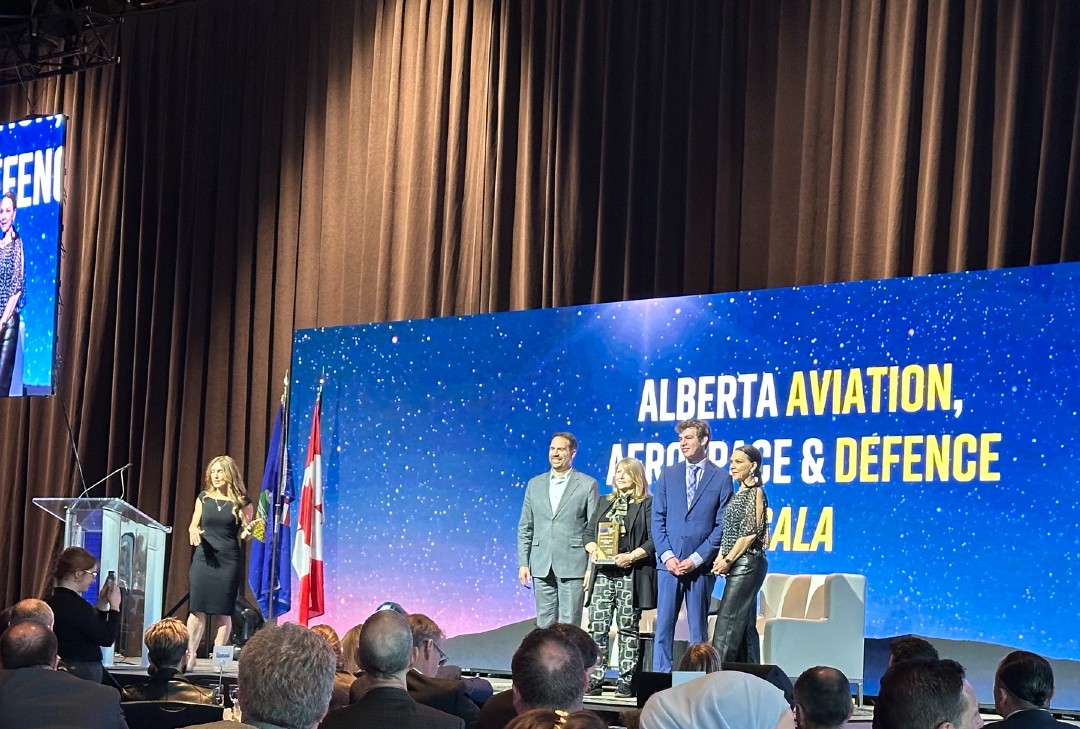
RUNWITHIT Synthetics co-founder and CEO Myrna Bittner holds a plaque presented to her company for winning a pitch competition held during the Alberta Aerospace & Defence Summit in Edmonton on May 4. To her left is Magnus Lanoil from the runner-up company M2M Tech. (Supplied)
The SpectraCann pitch outlined work to develop more uses for the company's advanced breathalyzer test, which has been focused primarily on drug-testing. It could detect any biomarker SpectraCann has access to, co-founder and CEO Leyla Kara said. She added that the Canadian Armed Forces has shown initial interest in trying the tech.
"We are focusing on premium applications and high-stage applications," she said, noting that defence applications require "really fast response time as well as ultra-sensitivity, like for chemical warfare agents, toxic industrial chemicals, as well as emerging threats."
Meanwhile, Elementiam's pitch detailed how it builds the "eyes and brains" for industrial robots through its Element X software system, which is compatible with older robots to improve the manufacturing efficiency of industries such as aerospace. That means manufacturers don't have to buy new robots to up their game. The other local, Phase Metron, is developing its advanced satellite antennae for improved telecommunication connectivity in civilian and military vehicles.
The Edmonton region has shown itself to be eager to take advantage of the moment, with the formation of Edmonton Region Defence Alliance, made up of Edmonton Global, Alberta's Industrial Heartland Association, NAIT, the University of Alberta, and Edmonton International Airport. The alliance's goal is draw billions of investment to the region, which Mayor Andrew Knack supports.
To that end, the airport has hired lobbyists to help convince Ottawa to spend here. They include former Edmonton Global CEO Malcolm Bruce, former city manager Andre Corbould, and political strategist Hal Danchilla, who once served as an adviser to former Premier Jason Kenney.
Share