
CANDLE Lithium set to bring extraction tech to the world
An Edmonton-based startup with a successful pilot under its belt is now taking its direct lithium extraction technology global.
"Western Canada is the perfect place for us to start these pilot projects because of proximity and ease of transportation," said CANDLE Lithium founder and CEO Salman Safari. "But we have multiple international projects, (and) these are all high-profile projects."
CANDLE Lithium (whose name is derived from "Canadian direct lithium extraction") pulls lithium out of brines rather than mines. Lithium is typically mined from hard rock or extracted from brines using an evaporation-and-capture method. Direct lithium extraction differs because it can pull lithium out of highly salinated water rather than evaporating it; CANDLE then gives the water back to the energy company for deep-well injection or fracking.
CANDLE completed its first pilot at an active energy site this year with an unnamed natural gas producer as part of Venture Pilots: Built World Tech, a program at Edmonton Unlimited to connect startups, investors, and industry partners to drive innovation in the built environment. Safari and CANDLE had results in the lab, which formed the basis of a pitch at the finale of Startup TNT's investment summit in November of 2024. Built World Tech gives companies the opportunity to translate research to real-world situations, and CANDLE went on to do just that.
"Here, we showed that we can extract lithium, and our process is efficient," Safari told Taproot. "Without doing this pilot, we didn't know whether our process would work on a live industrial operation."
There is a race to corner the direct lithium extraction market. Safari said his company's tech is different because it can handle complex oil and gas brines with minimal treatment, making it cheaper than the alternatives. It can run continuously and start to pull lithium within 30 minutes. Safari would not say how the lithium itself is commercialized, noting the competitive landscape of direct lithium extraction.
Why should anyone care about lithium or how it's extracted? For starters, it's in the batteries that most of us use every day, and we will need more of it soon.
"Batteries are being used in a lot of applications — laptops, cellphones, electric vehicles," Safari said. "They use a lot of lithium product components in their batteries, and (lithium has been used) more recently in stationary energy storage systems for backup energy storage for data centres that are being built worldwide."
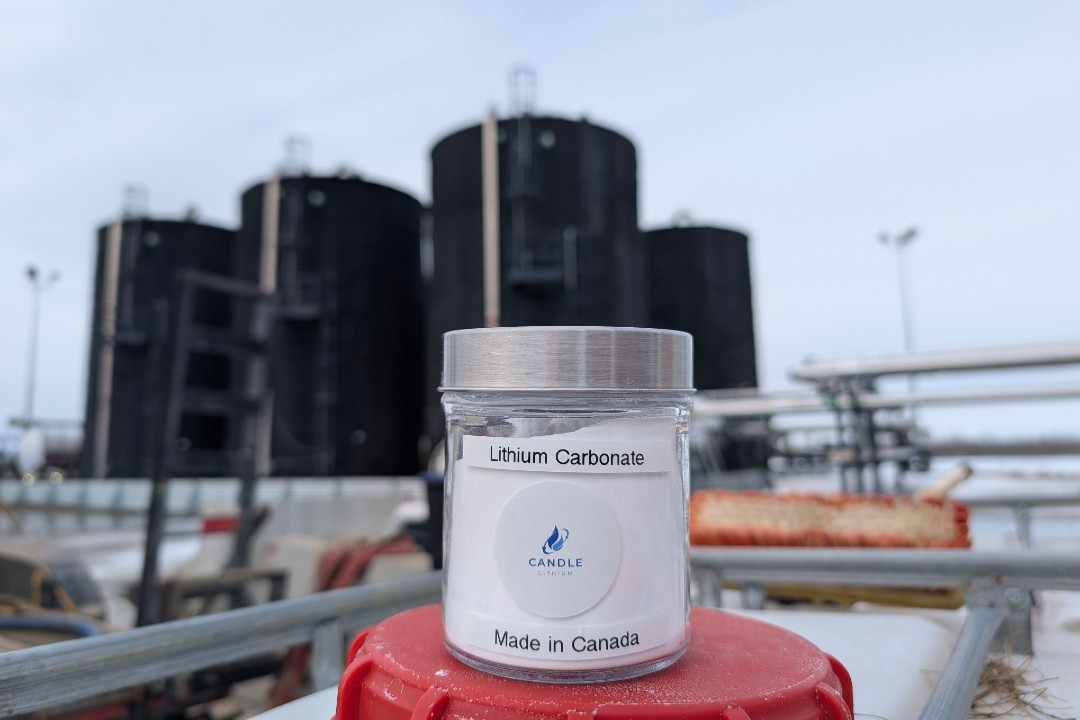
A jar of lithium carbonate captured by CANDLE Lithium using direct lithium extraction. Founder and CEO Salman Safari said a pilot with a natural gas producer this year proved the company's tech is viable in the field, not just the lab. (LinkedIn)
Precedence Research measures the global lithium market at well over $10 billion. The institute expects that to triple by 2035, due largely to growing demand for EVs.
Here in Alberta, the Alberta Energy Regulator's Alberta Geological Survey recently published a resource estimate for lithium in Alberta, pointing to the Devonian Leduc Formation as a potentially lucrative source of brine-hosted lithium. Emissions Reduction Alberta, another provincial body, awarded $5 million for a direct lithium extraction pilot by Calgary's E3 in 2024.
Globally, lithium mining practices have depleted water supplies and wreaked other environmental havoc. Safari warned that the evaporation method has its own environmental consequences, results in a 50% lithium loss, and it takes about 18 months. (Plus, it doesn't work in cold climates like ours.)
"We don't (even) want to use that kind of process here," Safari said.
For now, Safari said his pilots with "major oil and gas companies" in Canada and abroad are part of the plan to reach commercial demonstration scale.
"It is much larger than our pilot and is very near commercial operations," he said. "It will produce a much larger amount of lithium, it will extract a lot more lithium from a larger volume of brine, and it will go on for a longer period of time at the industrial scale."
Share