
Swift Charge seeks rapid but thoughtful growth
An Edmonton-born electric-vehicle charging company is now focusing on maintaining excellence while pursuing measured growth after landing a whale of a client.
Swift Charge has secured a contract with InnVest Hotels to set up at least 300 EV chargers at more than 70 hotels across Canada. InnVest is the largest owner-operator of hotels in the country, with a portfolio that includes brands under the Marriott, Delta, and Hilton umbrellas, as well as a few fair Fairmonts. The first InnVest property to install Swift Charge tech was the Fairmont Hotel Macdonald.
Swift Charge seeks to be one of the reasons that an EV-driving traveller will choose a place to stay.
"We don't want people to think of Swift Charge when they get to the hotel; we want to be that white-label solution that sits behind the scenes that offers these amenities," said Sheldon Zhang, the co-founder and CEO of Swift Charge. "It's an edge to help the hotel operate better, and in our business model, that's just as important as the technology aspect … The hotel doesn't get profit from the charger itself — the hotel gets profit from having this amenity to attract EV drivers to the property, who are going to pay them $200 a night."
Swift Charge was spun out of the University of Alberta in 2020. By 2022, it was named one of the most investable cleantech companies by Foresight Canada, and it made the finals of a Startup TNT investment summit. The company also participated in Alberta Accelerator by 500 and the Plug and Play Alberta accelerator, and received about $1.6 million in non-dilutive funding from Alberta Innovates, Edmonton Edge Fund, and other government agencies.
Today, the company has around 160 charging stations, mostly at hotels. A staff member from Swift Charge's team of six oversees every installation, but after that, it's pretty hands-off. Most troubleshooting can be done digitally, and contractors can handle physical repairs. Zhang told Taproot that the company's success means it will have to gradually diversify its customer base.
"We're already starting to see the ceiling as a hotel-focused operation," Zhang said, noting that the portfolios of Swift Charge's clients account for at least 10% of all hotels in Canada. "We're significantly winning in the hospitality segment in Canada already, so we have to expand beyond hotels."
There is market potential in areas such as multi-unit residential and post-secondary institutions, he said; Swift Charge already serves both in the region, including at the University of Alberta and NAIT.
Zhang spoke from China, where he was visiting manufacturers in Shenzhen for quality assurance and to give input on gradual improvement. He is interested in bringing manufacturing to Canada one day, perhaps even for direct current (or Level 3) chargers. Swift Charge predominantly offers Level 2 chargers, which take four to 10 hours to fill a battery; a Level 3 charger can do that in just 25 to 30 minutes, making it ideal for use at rest stops for travellers on the go.
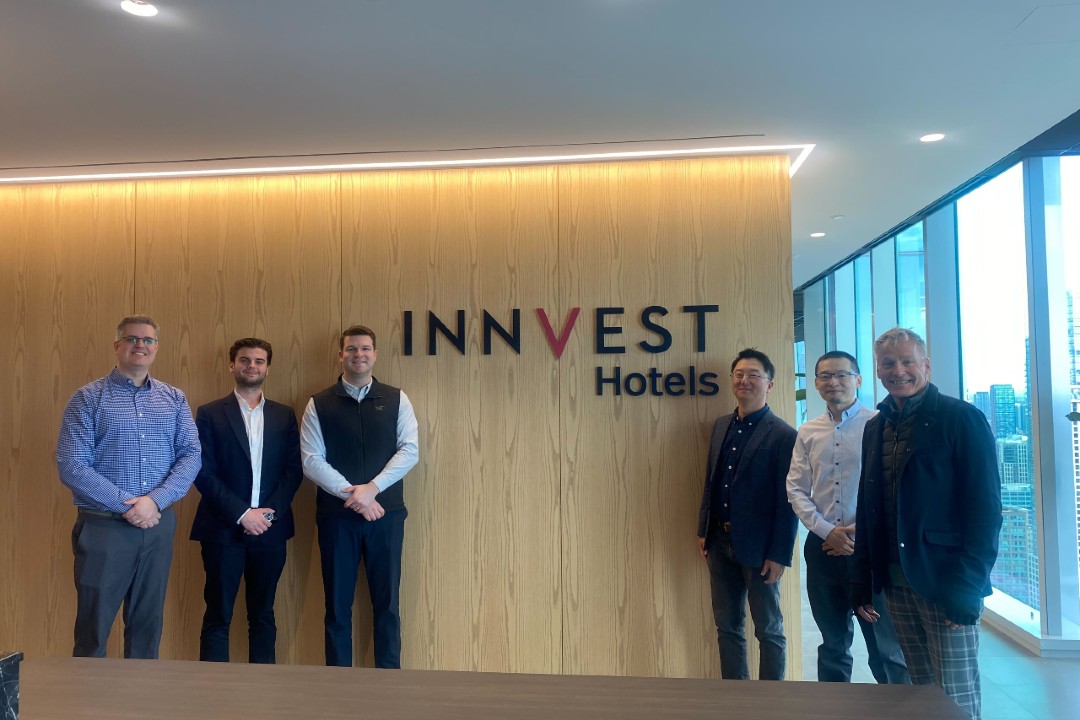
Swift Charge CEO Sheldon Zhang (third from the right) stands with two members of his staff and three representatives of InnVest Hotels (on the left). The companies have partnered to bring at least 300 electric vehicle chargers to more than 70 hotels in Canada. (Supplied)
There's no rush to get fast chargers into market, however. InnVest makes up 35% of Swift Charge's client base, and hotel groups are primarily interested in Level 2 chargers, Zhang said.
Zhang is also working to expand Swift Charge's presence in the U.S., where the "very iconic" Fairmont in San Francisco became its first foreign client in 2024. Zhang moved to the Bay Area that year to lead U.S. operations. But when Donald Trump was elected president, he reversed pro-EV policies.
Between that, tariffs, and supply chain disruptions, Swift Charge decided to pause U.S. expansion, but it has recently revived that part of its business, shipping chargers to a client in Washington, D.C.
"There are other markets that we're going into, the United States included," he said. "Our strategy run is usually very focused on becoming the expert in a small area rather than becoming a jack of all trades for everything electric-vehicle-related."
While Zhang explores diversification in terms of speed, geography, and clientele, he suggested Swift Charge could benefit from the insatiable demand for electricity by hyperscale data centres because his technology runs light on juice.
"Our company was founded around the idea of reducing the infrastructure requirements by using technology, such as load management and energy storage," he said. "With the potential to be fighting for power with AI data centres — and maybe other increasing electric demands — I think that would put our technology more front and centre, and potentially give us an advantage, given that we have collaborated with utility companies across Western Canada."
Correction: This story has been updated to more accurately reflect the sources of Swift Charge's early-stage funding.
Share