
Carbon-capture project on hold at Edmonton cement plant
Diminished interest in incentivizing reductions in carbon dioxide emissions has delayed an Edmonton project once touted to be the world's first cement plant with full-scale carbon capture and storage.
In 2023, Heidelberg Materials signed a partnership with the federal government to support a $1.36-billion project to bring a full-scale carbon capture, utilization, and storage system to its cement plant in northwest Edmonton. The company said then that it would be capturing 1 million tonnes of C02 annually by the end of 2026.
But the project, which the federal government called "a major step forward in establishing Canada as a global leader in the production of low-carbon concrete," is not on track to be done this year, despite a successful pilot of the technology, and it's not clear when it will be.
The price of carbon emissions is "not an insignificant" element when determining the viability of a full-scale CCS project, said David Perkins, vice-president of sustainability and public affairs for Heidelberg Materials.
"Originally there was discussion around $170 a tonne by 2030," he told Taproot. "The (federal) government has backed off of that now. The province has backed off of that to a much lower level."
Coun. Keren Tang was surprised to hear that the carbon-capture project was delayed when she toured the plant during the Pacific Northwest Economic Region summit in July.
"(Heidelberg said) we're not quite there yet, and I think that's true for … a lot of other developments that had a lot of excitement, but were slowed down because of the market, because of global trends, because of policy," Tang said in an interview. "I was just a bit surprised because I haven't had that update, but it was good that (Heidelberg was) able to answer some of our questions."
In the meantime, Heidelberg's CCS project at a cement plant in Norway was completed last year, making it the world's first.
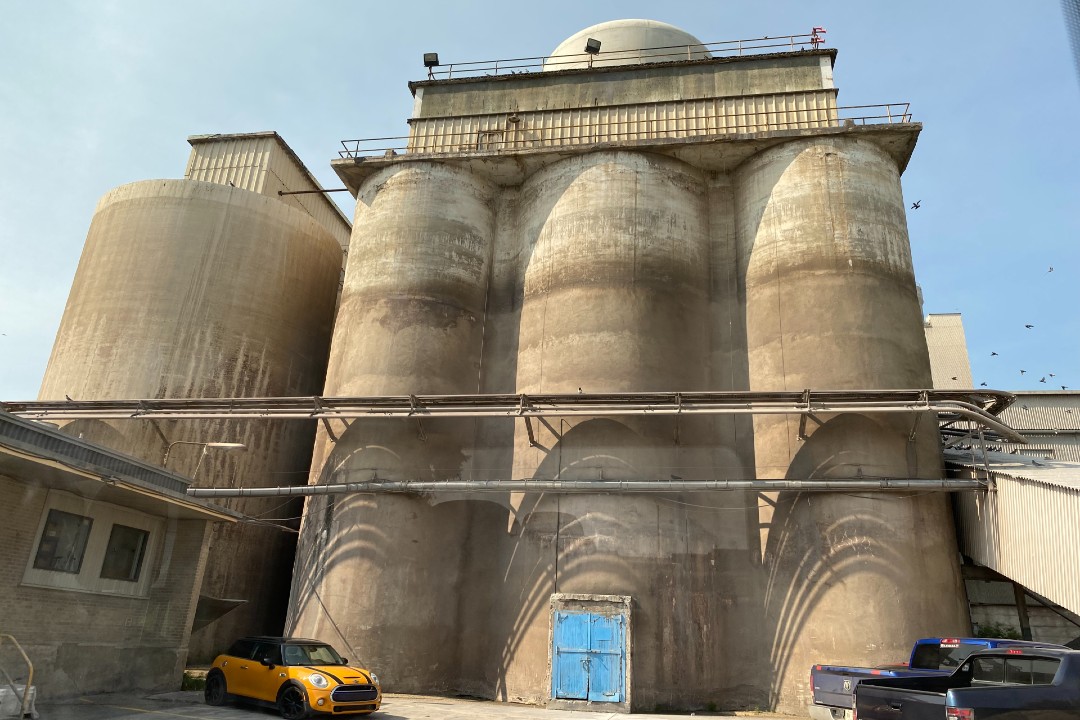
The massive size of Heidelberg Materials' Edmonton cement plant makes vehicles look like toy cars. Inside, raw materials are heated to 1,400 degrees Celsius. (Darcy Hoogers)
Heidelberg's Edmonton CCS project would take carbon dioxide produced during the cement production process and transport it by pipeline to the Open Access Wabamun Carbon Hub in Parkland County, which is expected to be completed by 2027. In addition to transporting carbon to the Wabamun Hub, energy captured through the CCS process would be used to help power the cement plant.
Currently, industrial polluters in Alberta are charged $95 per tonne of carbon emitted. In May, Alberta agreed with Canada to eventually raise this charge to $140 per tonne of carbon.
Corporations can purchase carbon credits or earn carbon offsets, which can be bought and sold on an open marketplace. Carbon credits in Canada are currently traded around $45 per tonne, which Perkins said is too low to justify the costs associated with Edmonton's CCS project, given a capital investment of up to $2 billion.
Heidelberg has qualified for a tax credit that equates to US$85 per ton of carbon captured at its plant in Indiana, notwithstanding the Trump administration's lack of interest in climate action. "Even at that $85 level, there's still some challenge in being able to meet the operational viability," Perkins said.
Significant work has been done to evaluate the viability of Heidelberg's Edmonton CCS project. In a report on the pilot project, Heidelberg concluded that it can house a CCS project that would capture one million tonnes of carbon emissions per year. However, the same report identifies that initial cost estimations were too low, and that "policy uncertainty" continues to delay the full-scale project.
Policy changes in Canada have reduced the ambitions of other carbon capture projects. The Oil Sands Alliance reduced its goal for the Pathways project from 40 megatonnes of stored carbon per year by 2050 to 16 megatonnes per year by 2045. In Edmonton, Varme Energy's $400-million waste-to-energy project, also billed as the first of its kind, is increasingly uncertain as lowering the price of carbon lowers what the company can sell credits for.
While Heidelberg's CCS project is in wait-and-see mode, Perkins highlighted a completed project that Emissions Reduction Alberta helped finance to turn wood-based waste at the plant into low-carbon energy instead of sending it to the landfull. "We can take that material, use the thermal value, and use it as a supplement to our traditional fossil fuels," Perkins said. Emissions Reduction Alberta contributed $2.34 million toward the $45.9-million project, which is expected to reduce nearly 25 kilotonnes of carbon per year.
"There's a lot of great opportunities for us to continue to innovate and transform what we're doing," Perkins said. "We've got a lot of work to do, but we're making some good progress."
Tang shared similar hope for the future, despite the setbacks. "Yes, disappointed that we're not quite there yet, but I think I'm actually glad that it's not forgotten, and people are trying to work towards that goal," she said.
Share