
'Beyond Barriers' report explores challenges of 2SLGBTQ+ founders
Queer and trans people in Edmonton often choose entrepreneurship out of necessity, and support that takes their identities into account is needed, says a new report from the Alberta 2SLGBTQI+ Chamber of Commerce.
"Queer folks and trans folks are more likely to hit barriers within established organizations, what we call a 'lavender ceiling,'" said Elli McDine, the chamber's executive director. "They may not be able to move forward, and so they may become frustrated within larger organizations and decide that they want to become their own boss."
While trans and queer people can be pushed to leave traditional careers because of ceilings or discrimination, the pull towards entrepreneurship can often be because they are their own first customer, McDine told Taproot. For example, a transmasculine person might start a business after designing a better binder to flatten the chest. Or a family might create an event space that not only tolerates queer and trans people, but celebrates them.
But navigating the business world, whether it's to obtain a business licence or access grant funding, can be challenging for someone who might not have institutional knowledge or a support system around them, says the report, which McDine's organization produced with Action Lab
To help close that gap, the chamber will be launching an interactive resource guide in September, and McDine said she will meet with policy-makers over the coming months to contextualize the report's findings within government systems. There will also be a networking and social event at Frank's Community Pub on Aug. 22 after the Edmonton Pride parade, with an information session on how to join Rainbow Registered, an accreditation program for 2SLGBTQI+-friendly spaces.
When entrepreneurs seek funding, some might have to decide between coming out yet again or refraining from centring that part of their identity. "Sometimes you're leaning in and saying, 'I'm a queer trans woman, and I live in Edmonton, and this is the kind of thing I'm trying to build,'" McDine said. "But if I'm going into a different grant or a different funding body, I might leave that element off because I'm worried that it may count against me."
Research from the Women's Enterprise Organizations of Canada found that a third of queer and trans entrepreneurs hide their identities professionally, and a quarter face discrimination or lose opportunities due to being out. None of the small business founders in Edmonton that the chamber spoke to had ever accessed a conventional small-business loan.
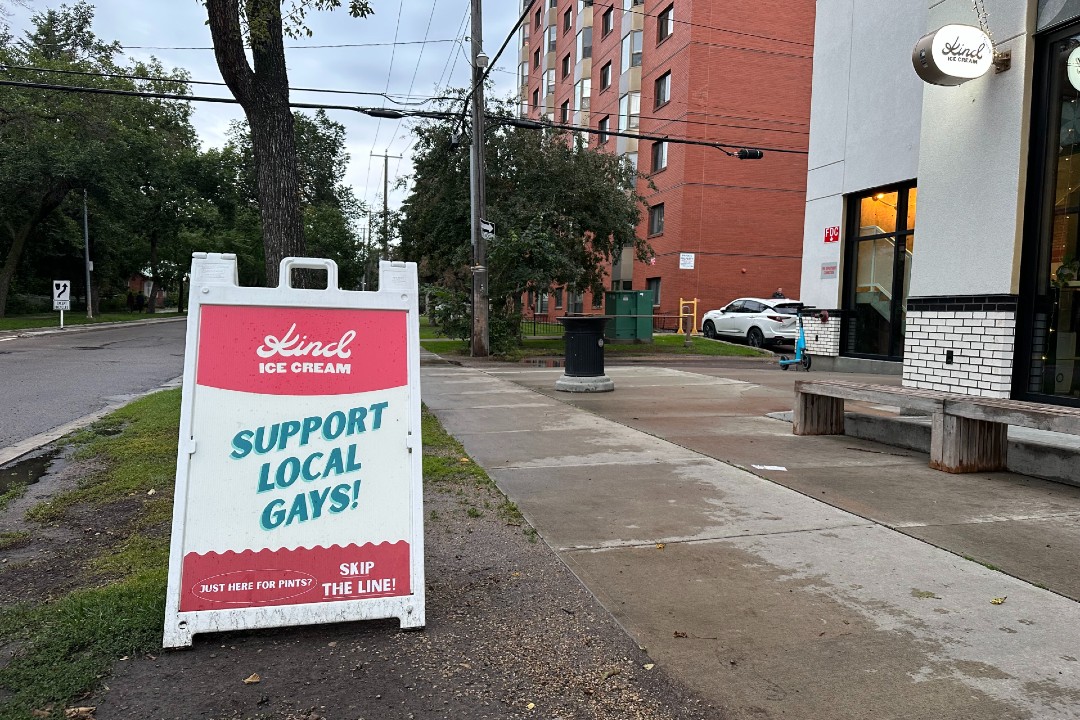
The Kind Ice Cream shop in Wîhkwêntôwin makes the fact that it is a queer-owned business part of its marketing. (Stephanie Swensrude)
McDine said the queer and trans business community demonstrates that entrepreneurship doesn't have to look like the stereotype of competitive Silicon Valley tech founders.
"I think when people think about what an entrepreneur looks like, they're often thinking of Elon Musk or Sam Altman or others, but that's really only one model of what it could look like," McDine said. "What our members really show is that there's a lot of different ways of being an entrepreneur in the world, some of which are similar to those tech founders, but a lot of them are actually quite distinct, and their goals are very distinct."
The report found that trans and queer entrepreneurs often build structures, relationships, and ways of working that aren't common in the traditional business world.
"There are folks in our queer community who are really trying to build something very big, and they want that growth, and they want to experience that success and more of a traditional entrepreneurship journey," while others are in search of more balance, McDine said. "It's not that growth just for growth's sake. A lot of folks are really thinking about how they can be in more harmony with the community and more harmony with the environment."
Part of Edmonton's advantage is in its artist community, with lots of opportunities for pop-ups and small-scale events and festivals where founders can test their products, McDine said.
"I would like to see us do more and more of those things to make it easier for early-stage founders and early-stage entrepreneurs to be able to test their products, to be able to go to the market, to be able to support themselves and trial these things," McDine said.
Share