
Robotics researchers build on Edmonton's AI legacy
A new company has spun out of a University of Alberta research lab to make robotic prosthetics work better for people with limb difference.
Prismecha Robotics was founded by Michael (Rory) Dawson, the lead research engineer at the BLINC Lab, an interdisciplinary project whose name stands for Bionic Limbs for Improved Natural Control.
"This is an emerging area that's exploding right now — people wanting to use robots with machine learning — but they're not necessarily designed for that purpose," Dawson told Taproot at the International Conference on Biomedical Robotics and Biomechatronics in Edmonton in August. "We've been doing that all along."
Prismecha is just getting started, having incorporated in April of this year. But it's building on years of research and a deep understanding of the power and possibilities of machine learning, nurtured by Dawson's mentor Patrick Pilarski, a multi-hyphenate robotics expert who co-leads the BLINC Lab.
"In robotics, there are many different fields that are coming together to actually create change, to create viable innovation, and to create product," Pilarski told Taproot at the BioRob conference. "We're starting to see this sort of rising water line of AI capability, which is increasing people's ability to design the fundamental elements that go into a robotic system."
The confluence of reinforcement learning and hardware is unlocking new potential devices, demonstrating a use for artificial intelligence beyond what most of us see every day, Dawson suggested.
"Now that the AI world has exploded, but mainly text-based or image- or video-based things on people's computers," he said, "the next phase that people are looking at to scale this out into the real world has to come through some sort of robotics."
The Alberta Machine Intelligence Institute will further explore how artificial intelligence is reshaping the future of healthcare at the AI + Health Forum on Sept. 25, part of Life Sciences Week.
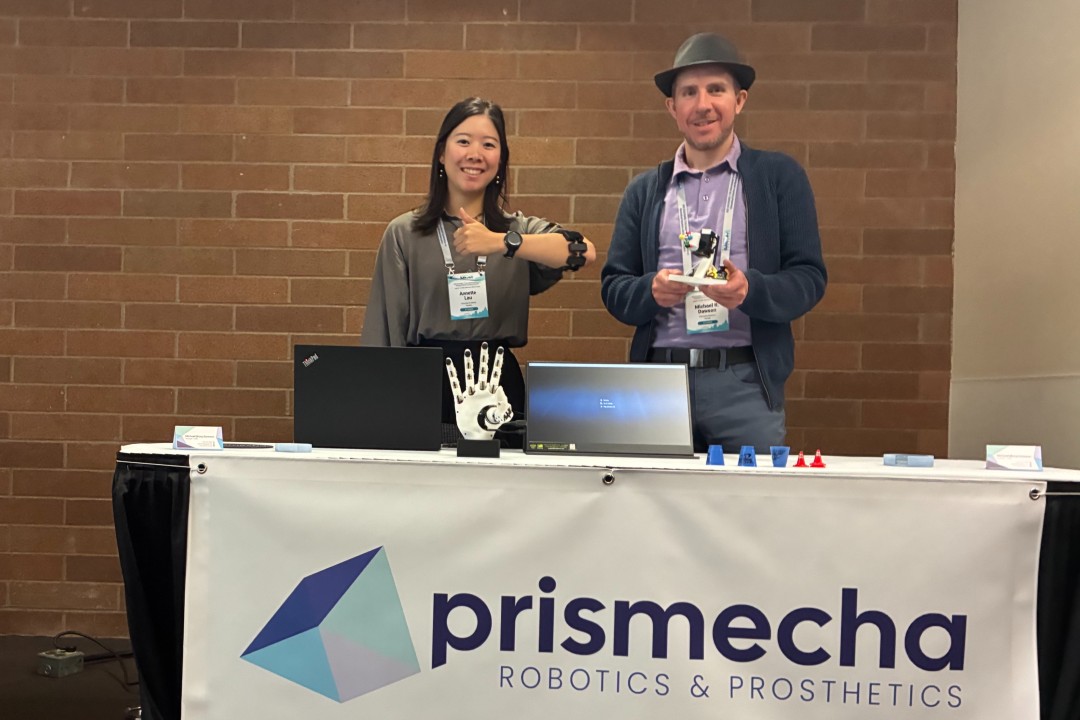
Annette Lau and Michael (Rory) Dawson of Prismecha Robotics showed what they've been working on during the BioRob conference at the Edmonton Convention Centre on Aug. 2. (Colin Gallant)
Neither BLINC nor Prismecha are part of that event, but they come from the same spirit of inquiry nurtured by Amii and Turing Award winner Rich Sutton, with whom Pilarski has worked closely.
Dawson is part of the next generation of researchers in this realm. He developed the Myoelectric Training Tool with the support of a grant from the Glenrose Rehabilitation Hospital. The resulting Bento Arm continues to help patients practice controlling a prosthetic device before transitioning to their own.
Dawson showcased Prismecha at BioRob with Annette Lau, a master's student associated with BLINC Lab who is currently an intern at Sarcomere Dynamics, an Edmonton company working on giving robots near-human dexterity.
Lau's interest in robotic hands dates back to when she was in junior high and ended up with tendonitis from repetitive strain. "I was very into playing video games and playing piano and drawing and doing all sorts of things with my hands," she said. "My hands were very much my outlet to the world and to access all my hobbies." The experience made her want to help those who lose a hand or are born without one.
The University of Alberta is also home to the Rehabilitation Robotics Lab, a project led by Martin Ferguson-Pell that explores simulation and extended-reality technologies to improve quality of life. At a Life Sciences Week session on Sept. 22, he will be part of an event to publicly launch Post-Stroke Spasticity Care for Rural Albertans, a two-year pilot in conjunction with the Glenrose Rehabilitation Hospital to connect rural patients to specialist assessment virtually.
Share