
Data centre campus proposed in northeast Edmonton
An American company has applied to amend planning documents to make it easier to build data centres in northeast Edmonton, as Edmonton city council is set to debate further regulating and restricting the facilities.
Walton Global Investments has submitted an application that would enable a data centre campus in the Edmonton Energy and Technology Park (EETP), which is north of Anthony Henday Drive and west of Manning Drive. The Arizona-based company plans to facilitate "a master-planned, hyperscale-ready digital infrastructure project within the City of Edmonton, designed to become one of the largest data centre and compute-oriented industrial districts in North America."
The EETP is part of the Industrial Heartland's Designated Industrial Zone, as is Meta's in-progress AI data centre in Sturgeon County.
The City of Edmonton is reviewing Walton's application to amend the area structure plan for the EETP, submitted by Stantec's consulting arm. The company proposes adding data centres as a permitted use in the medium industrial precinct. It also proposes changing about 250 hectares of land from the petrochemical precinct to the medium industrial precinct.
Edmonton's city administration is seeking online feedback on the proposed changes until Oct. 25. Council will then debate whether to amend the plan at a public hearing. If the area structure plan is amended, the applicant would need to submit a rezoning and text amendment application before development of a data centre and power generation facility in the medium industrial precinct would be possible. Large-scale data centres are already permitted as a major industrial use in Edmonton and would be allowed in the EETP under the petrochemical precinct.
The proposal comes as city council is poised to debate regulating and restricting large-scale data centres in Edmonton. Ward Métis Coun. Ashley Salvador is set to introduce a motion at the Oct. 6 council meeting asking for a report on regulating and restricting large-scale data centres, including an analysis of land-use and environmental impacts of the facilities. The report would include information about jurisdictional authority, regulatory framework, and governance, as well as options to remove data centres from standard industrial zones. The motion will also ask for information about how data centres in the wider region could impact the City of Edmonton.
Data centres are being hotly debated nearly two years after Technology and Innovation Minister Nate Glubish announced a plan to attract $100 billion in data centre infrastructure to Alberta by 2029. As of March, there are 22 data centre facilities operating in Alberta.
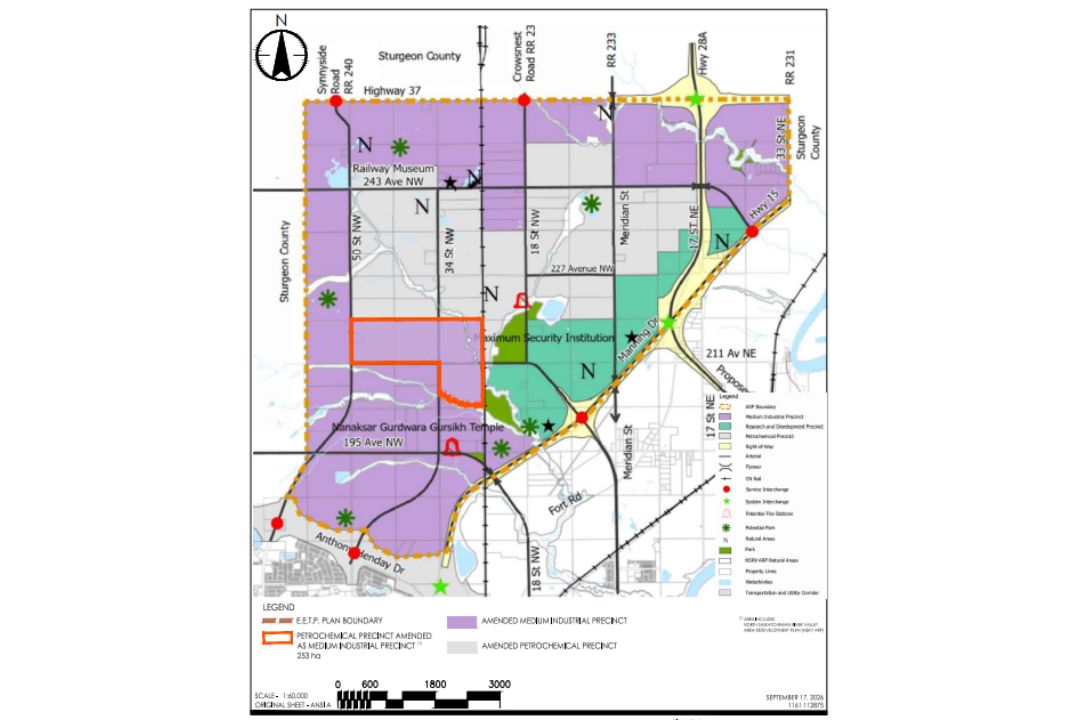
Walton Global Investments has proposed amending part of the Edmonton Energy and Technology Park's area structure plan, outlined in red, to facilitate a hyperscale-ready digital infrastructure project that would support a large data centre campus. (City of Edmonton)
Surveys show the facilities are unpopular, with respondents citing environmental impacts, electricity costs, noise, farmland loss, and general disdain for AI and its effect on society. Just 7% of respondents to a CBC-commissioned poll said they strongly support data centres, while 31% said they strongly oppose them and 26% said they mostly oppose them but accept some projects.
Those concerns have been particularly visible in Sturgeon County, where Meta is developing a $13-billion data centre and an accompanying $4.6-billion power plant. Hundreds of protesters gathered outside the county office in August, and provincial representatives faced boos and jeers during a data centre town hall held in Redwater on Aug. 20.
Supporters argue the facilities can create construction work, permanent jobs, infrastructure investment, and municipal tax revenue. Meta representative Matt Sexton told an Alberta's Industrial Heartland Association conference on Sept. 10 that the Sturgeon County project would support 3,000 construction jobs and 300 permanent positions, as well as ongoing maintenance work.
Sturgeon County Mayor Alanna Hnatiw welcomed Meta's project, saying it will "create opportunities for our residents, diversify our tax base, and support our community for years to come." County council later introduced its own principles for data centre development.
Why the EETP?
The application to amend EETP's area structure plan says it has not developed as it was originally envisioned when the ASP was approved in 2010. Demand for petrochemical facilities has decreased in the region, and the underuse of these lands has stalled development in the entire area, it says, noting that developing this land would help the city increase non-residential tax revenue.
In 2024, city council approved the Industrial Investment Action Plan. The IIAP is predicated on the idea that industrial investment is critical to the city's finances. Industrial land is taxed at a higher rate than residential properties and can theoretically lessen the tax burden on residents. Edmonton's share of the region's non-residential properties decreased from 72% in 2008 to 60% in 2022.
The application says a significant data centre campus "is a critical opportunity for the city to ensure it capitalizes on a multi-billion dollar investment to kick-start development in a historically underdeveloped area."
The EETP represents the city's largest amount of unserviced industrial land, and stakeholders have indicated that the park likely won't see investment until the appropriate infrastructure is in place to attract companies. Most parties interested in the EETP are companies looking for shovel-ready land, according to the IIAP.
Walton has experience in turning land over to companies that build data centres. Last May, Walton sold a 1,515-acre parcel to Tract in Texas to build a data centre mega campus. (Texas Governor Greg Abbott recently barred the state's environmental agency from issuing new data centre permits until regulators complete an audit of the facilities.) Last September, Walton sold a 30-acre parcel to PowerHouse to expand its data centre campus in Virginia.
Walton is also currently selling a separate, 393-acre plot of land just south of the proposed data centre campus.
Share