
Calgary energy company revives long-range H2 fuel in Edmonton
Azolla Hydrogen is bringing longer-range hydrogen fuel back to Edmonton after an American company's 700-bar station closed and was sold off during bankruptcy proceedings.
"Three years ago, hydrogen was supposed to solve all problems, and there was a lot of hype around it," Chad Badry, Azolla's vice-president of business development, told Taproot in September. "There were a lot of people talking about doing things that they probably shouldn't have been, because they didn't really know (what they were doing), and they just wanted to be part of that hype."
Badry wasn't talking specifically about Nikola, the company that operated a 700-bar fueller at Blackjacks Roadhouse for less than a year between 2024 and 2025, but the situation he described maps well onto what happened there. Even though Nikola admitted to faking some of its vehicle demonstrations in 2020 and founder Trevor Milton was sentenced to four years in prison for fraud in 2023, the station Nikola built at the Nisku roadhouse opened with significant fanfare in March 2024. Less than a year later, Nikola filed for bankruptcy protection, and the station came down shortly afterward. Milton went on to be pardoned by U.S. President Donald Trump, and he is now appealing the bankruptcy claim of US$70 million.
Azolla is bringing 700 bar fuelling back to Edmonton with a $12.5-million project, $3 million of which will come from Emissions Reduction Alberta.
The return of 700-bar means trucks and other hydrogen vehicles will be able to travel twice as far as the average of 280 kilometres that 350-bar fuel makes possible. The latter "isn't enough to even get between Calgary and Edmonton," said Badry, who has worked in business development for Linde, Svante, OnQuest, and Air Liquide.
The Alberta Motor Transport Association confirmed that less-than-700-bar fuelling from Azolla at the time limited the tests it could conduct under its Alberta Zero Emission Truck Electrification Collaboration: "AMTA did use fuel from Azolla for the (AZETEC) project," AMTA's Terri Johnson told Taproot in an email. "Unfortunately, the fuel that was available in Alberta was at 350 bar — meaning that we were only able to fill to 50% and achieve ranges of 280 km with the vehicles deployed in Alberta." The AZETEC project was supported by $7.3 million from Emissions Reduction Alberta.
Calgary-based Azolla, which produces hydrogen from methanol, has a strong track record, Badry said. Azolla fuelled the first of Canadian Pacific Kansas City's hydrogen trains, and has worked with the City of Edmonton on a hydrogen-bus pilot that began in late 2023. Edmonton city council's executive committee voted unanimously on Oct. 2 to extend its agreement with Azolla for three years, while keeping spending details confidential to fulfill its obligations for third-party financial information.
The $3 million in funding from Emissions Reduction Alberta for Azolla to grow its fuelling options will also include a 350-bar fueller in Calgary, extending the hydrogen corridor in Alberta. Azolla is also working with the City of Winnipeg. But Edmonton has a special place in Azolla's heart, Badry said, as the partnership has led to further opportunities, and its agreement allows Azolla to use the infrastructure for the private sector.
"Being in industry for over 27 years, I would say (the City of Edmonton has) been, quite honestly, one of the best clients I've ever seen," Badry told Taproot. "They're transparent. They're supportive. They've got a mandate. They're working in that direction. They're communicating about it."
Indeed, Badry credits Azolla's relationship with Edmonton for progress in Winnipeg — and beyond. "(Winnipeg) trusted us to do what we needed to do because they saw what we did in Edmonton," he said. "Now, Edmonton is asking for a second plant, and we're doing that. We've got opportunities worldwide now."
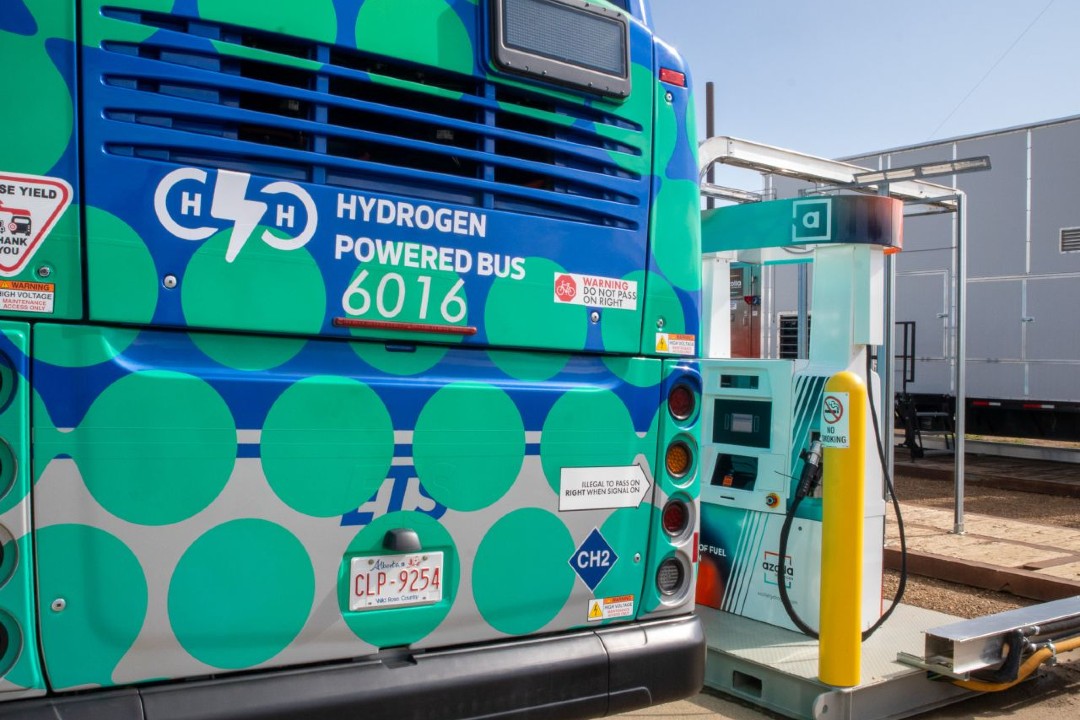
An Edmonton Transit Service bus next to a 350-bar Azolla Hydrogen fuelling station. Azolla is now working on a 700-bar fuelling station that will allow vehicles to travel double the range of those fuelled by 350-bar. (Supplied)
Hydrogen fuel remains much more expensive than diesel, and Edmonton city council members have said the 2027-2030 budget is already tight. So why bet on hydrogen?
Badry said H2 fuel prices are predictable, at least, whereas diesel rates are increasingly volatile. Plus, the city has another budget to balance — the carbon budget. It is already struggling to meet 2030 and 2050 goals, and Badry thinks it has little choice but to get on board with hydrogen as part of its lower-carbon mix. An experiment with electric buses did not go well, and the city's hydrogen bus pilot found that while battery electric is suitable for most uses, hydrogen performs better in severe cold.
Regardless of the mix, Badry said the city needs to act quickly.
"If they're going to meet obligations in 2050, they need to understand how hydrogen works and what it looks like before 2030, because a lot of those buses that they buy could last between 15 and 20 years," he said. "That means they literally have to stop buying diesel buses by the end of this decade."
While the hydrogen bus pilot technically concluded in June, Patrick Baltazart, corporate lead of the City of Edmonton's zero emissions vehicle strategy, told Taproot the experiment will continue through at least 2029.
"While our hydrogen buses have demonstrated good levels of performance and reliability, the pilot project also evaluates the entire ecosystem required to keep the vehicles on the road," he wrote in an email. "Several years of data collection are still required to properly evaluate all operational benefits and constraints applicable to not only vehicles, but also maintenance facilities and fuelling equipment."
Azolla has an edge over some vendors, Badry said, because it specializes in on-site production and fuelling, cutting down costs and emissions. Alberta's hydrogen fuel has historically been diesel-trucked from central Canada, often in a straight shot that adds a driver-exhaustion problem to carbon concerns.
"That's (roughly) 3,900 km from Bécancour, and probably around 3,500 km — one way — from southern Ontario," Badry estimated. "And guess what? You have to go back."
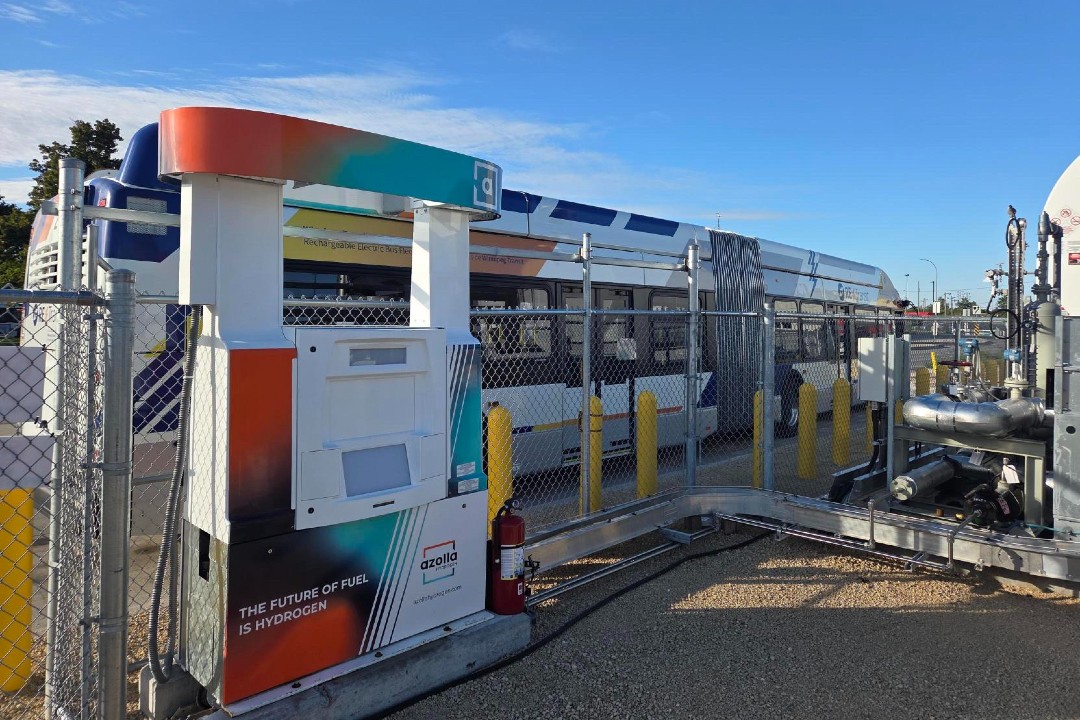
Azolla Hydrogen's recently installed hydrogen fueller in Winnipeg, about halfway between Edmonton and the common hydrogen supply city of Bécancour, QC. (Supplied)
Badry acknowledged that while there are fewer favourable policy incentives for decarbonization and a stretched-thin pool of investment in hydrogen, the Day 1 players are in it for the long haul.
"Now, the community is condensed down to people who are really focused on hydrogen and are really good at it," he said. "You really do have to know what you're doing; it's not a let's-learn-as-we-go-type application."
His comments echo those made by representatives from AMTA, CPKC, the Edmonton Region Hydrogen HUB, and the Pacific Northwest Hydrogen Association during the Edmonton-hosted Pacific Northwest Economic Region summit in July. While some are retreating from the hydrogen space, panellists said, those who are still in are all the way in.
Kyle Mulligan of CPKC told PNWER attendees that the rollercoaster of carbon policy may not be on the same track as commerce, but CPKC is committed. It started running hydrogen trains in 2021 and currently has eight hydrogen-powered locomotives in its fleet. More are planned by the end of the year, spokesperson Terry Cunha told Taproot in an email.
"It's very easy to get on this hydrogen train and say that you can take some fuel cells and some batteries and put them into an automobile or an aircraft or a train or a truck," Mulligan said at the PNWER event. "Ultimately, the integration and moving that into a production environment, dealing with all of the various faults, the various altitude conditions, grades, and such — it requires a significant amount of tuning and adjustment."
Chris Green from the Pacific Northwest Hydrogen Association told the summit that price parity is paramount for hydrogen's success. Badry of Azolla agreed there is less tolerance for paying more for hydrogen right now, even if it's cleaner.
"What has reduced in my opinion is industry's willingness to pay a premium for near-zero-carbon hydrogen," he wrote. "Reducing carbon intensity adds significant cost, and these higher costs are offset by incentives that can be difficult to navigate amid changing policy priorities."
But Johnson of AMTA said non-financial goals are important, too. The motor transport association has worked with Loblaw, Bison Transport, and others for its hydrogen testing. Big players have priorities in addition to profit, she said, while smaller companies in trucking are not an ideal customer for the fuel at this juncture.
"They have environmental-social-governance responsibilities to the world as a large organization, and those large organizations are the ones that are going to bear the majority of these high costs," she said. "We're not going to be able to go to a trucking organization that has five employees and three trucks and say, 'You need to use hydrogen; you need to be filling at (a higher) cost.'"
Badry expects the 700-bar station to open in Edmonton during the first quarter of 2027. Calgary's station is still subject to partnership agreements and location scouting.
Want to test-ride a hydrogen bus before 700-bar arrives? Keep an eye out for buses 6016 and 6017 in Edmonton and Strathcona County.
Share