
Downhole data company earns Startup TNT investment
RECON Intelligence, a company that helps oil and gas companies know what's going on underground, won Startup TNT's fall investment summit on Nov. 12.
While the money will no doubt help, just participating in the program was victory enough, co-founder and CEO Jonathan Prill said after learning that he and co-founder Nasim Morawej had won the Top 6 pitch competition.
"Even if we (hadn't) gotten anything out of this program, we got everything from the meetings with all the investors," he told the audience at the Citadel Theatre. "The amount of stuff we've identified and fixed, and made ourselves investable, has been awesome."
The company, founded by seasoned oil-and-gas professionals, gives enhanced downhole drilling data using sensors and software.
"You can't really fix what you can't measure," Prill said during RECON's pitch, adding that data has traditionally been conveyed to the surface slowly and in a way that is difficult to interpret. RECON gathers lots of information, quickly, and interprets it, with plans to add real-time telemetry by 2029.
The company has generated $478,000 in revenue in the past 12 months, said Morawej, who is the company's COO. "Our customers, they save many times what they pay," she said. "That's why they come to us."
Startup TNT convened 35 investors, who pledged $5,000 each for the winner of the summit, meaning RECON will get at least $175,000 towards the $350,000 it is looking to raise by February of 2027.
Investors also awarded two side deals: one to MagnetaMR, which is developing a portable, AI-informed, low-field MRI device that could cost as little as 10% of conventional, fixed-place MRI, and another for Rosette Robotics, which speeds up accurate seed analysis using robotics, high-resolution cameras, and artificial intelligence.
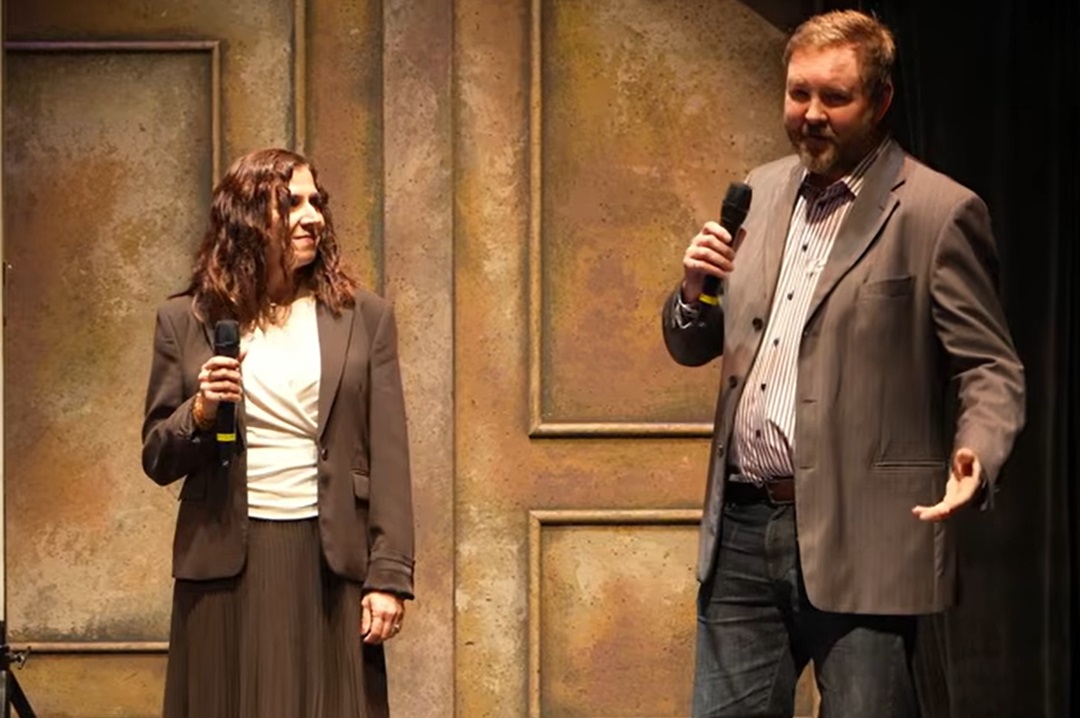
Nasim Morawej and Jonathan Prill of RECON Intelligence won the Startup TNT fall investment summit on Nov. 12 at the Citadel Theatre. (Startup TNT/YouTube)
MagnetaMR has heard plenty of naysayers, suggested founder Aaron Purchase.
"They said it wasn't possible for portable MRI to operate on household power, consuming less power than your microwave; they said it wasn't possible for the masses to have timely access to high-quality medical imaging without breaking the bank," he said in his pitch. "We disagreed, and in fact, we think it's unconscionable that you should have to wait for medical imaging for two months, six months, nine months, or a year."
Rosette Robotics sells a solution to a labour-force shortage that doesn't replace the rare workers needed for seed analysis, co-founder and CEO Curtis Kennedy said.
"Our system is built to be analyst-centered," he said. "We turn a tedious task into a tactical review, so senior seed analysts can process way more samples without experiencing burnout, and junior analysts can start contributing more accurately much sooner. We also give seed companies faster turnaround times."
The field was rounded out by Aqtiva, which increases farmers' yields and reduces fertilizer use; Sentir Technologies, which detects HVAC failures in commercial buildings; and Zylotex, which turns fibres such as hemp into replacements for cotton and synthetics.
Share